







Introduction:The Huacai series of coffees from the Guji-Hambella region of Ethiopia’s Guji zone have been a focal point for specialty coffee enthusiasts ever since the 2017 TOH championship win. With the arrival of the new season, the Huacai 9.0 has officially launched. Compared to its predecessor Huacai 8.0 and the new-season Hambella Huacai, what are the notable flavor transitions? This article provides an in-depth analysis of the differences among the three and offers practical medium-light roast pour over recommendations to help you grasp the essence of this juicy coffee.
As a key origin of global coffee, Ethiopia’s unique native Heirloom variety, due to its adaptability to various microclimates, showcases highly distinctive regional flavor profiles. The Hambella sub-region within the Guji area, with its high altitude and unique microclimate, produces many high-quality coffee beans, among which the Huacai series is one of the representatives.
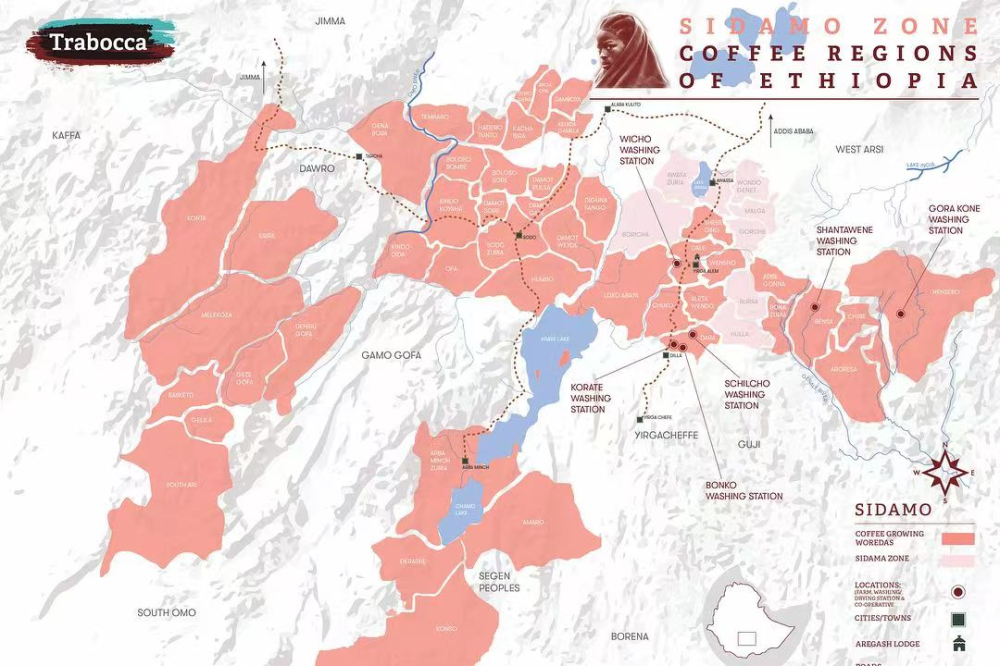
The birthplace of the Huacai coffee—Hambella—is located in the southern part of Guji and is one of the highest-altitude coffee-growing regions in Ethiopia, with an average elevation exceeding 2,000 meters. The region features significant day-night temperature variations, along with fertile black soil and good shading conditions, allowing the coffee cherries to ripen slowly and accumulate richer sugars and flavor compounds. Most farmers in this area practice small-scale, family-based cultivation and often intercrop with bananas, sugarcane, and other crops, creating a diverse ecosystem that helps maintain biodiversity and soil health in the fields.
The origins of the Huacai series can be traced back to the 2017 TOH (Tiny Coffee Competition). That year, a naturally processed Hambella coffee bean submitted by the Buku Abel washing station won the championship with its intense strawberry and creamy notes. This bean later became widely known as “Huacai.” Its name, meaning “the foremost of all flowers,” symbolizes its outstanding performance in the competition and the high expectations it garnered in the market.
In the following years, the Huacai series was released with season numbers—for example, Huacai 3.0 represents the 2019 season, Huacai 4.0 the 2020 season, and so on. However, it’s worth noting that early Huacai referred only to the natural-processed beans produced by the Buku Abel washing station. As DW Company expanded its network of washing stations, including Buku Saysay, Haro Soresa, and Tirtiro Goye, production volume increased, but the flavor profile also diverged from the original Huacai. Therefore, if you’re seeking the most authentic flavor characteristics, the natural beans from Buku Abel remain the most representative.
Returning to the current season, the newly launched Huacai 9.0 has officially hit the market. Compared to the previous Huacai 8.0, the 9.0 continues the rich fruitiness in its dry aroma, including guava, jackfruit, apricot, citrus, and multi-layered floral notes. After hot water is poured in, the sweetness of honey and berries is further released. When sipped, distinct fruit acids from dried mango, jackfruit, orange, and passion fruit are evident, with an overall round and full mouthfeel. As the temperature drops, the sweetness of peach and subtle acidity of berries gradually emerge, while the aftertaste leaves a soft, tea-like sweetness reminiscent of black tea.
The new-season Hambella Huacai also maintains high-altitude cultivation and traditional natural processing. Farmers carefully select only fully red coffee cherries, harvesting them only when the sugar content reaches above 30, then placing them on African raised beds for approximately 18 days of sun-drying. During the processing period, farmers adjust shading according to sunlight intensity and guard against afternoon heat and sudden rainfall to ensure even drying and avoid unwanted fermentation flavors. The final green bean moisture content is stably controlled at around 13%.
Regarding the numbers in the Huacai name, they are actually arranged in chronological order according to the production season. For example, Huacai 9.0 represents the 2024 season version. This naming logic allows consumers to easily identify the bean’s year of production and relative freshness.
To fully showcase the flower and fruit aromas and bright acidity of this coffee, the roaster opted for a medium-light roast level, preserving the bean’s inherent fruity notes while avoiding excessive caramelization to maintain flavor layers and clarity. For pour over enthusiasts, it is recommended to use a Hario V60 filter cone, with a water temperature of 92°C, a medium-fine grind (about 80% passing through a #20 sieve), and a 1:15 coffee-to-water ratio.
In practice, a three-stage pouring method is recommended to enhance extraction complexity. First, perform a bloom with 30 grams of water for about 30 seconds; then slowly pour in water in a circular motion from the center up to 125 grams for the first pour; when the water level is about to drop to the surface of the coffee bed, pour again in a circular motion up to 225 grams. The total extraction time should be controlled to around 2 minutes. This method effectively highlights the multi-layered fruit acids and sweetness of Huacai 9.0, reduces dominance by any single flavor, and results in a more balanced and dynamic overall taste.
In summary, Huacai 9.0, 8.0, and the new-season Hambella Huacai all exhibit intense fruitiness and juice-like characteristics in their flavor profiles, though with slight differences in nuanced layers and acid-sweet balance. Whether you're a beginner or a seasoned coffee enthusiast, mastering the appropriate roast level and brewing parameters will allow you to uncover the unique charm of Ethiopian highland coffee.
The above content is compiled by CoffeeHunters, a coffee news website.


