







Introduction:The first half-year report since TeaBaiDao’s IPO has been released, showing a decline in both revenue and net profit for the first half of 2024, with net profit plummeting nearly 60% year-on-year. The company attributed this to increased support for franchisees and market investment, but concerns have also been raised about its reliance on external suppliers in the supply chain. This article provides an in-depth analysis of its financial data, franchise policy adjustments, and the competitive market environment to help readers understand the real challenges faced by the tea brand and its future direction.
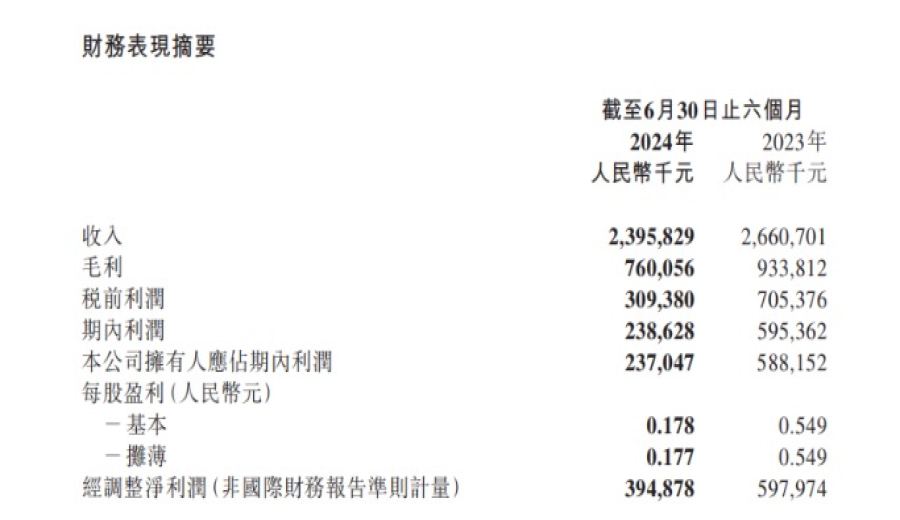
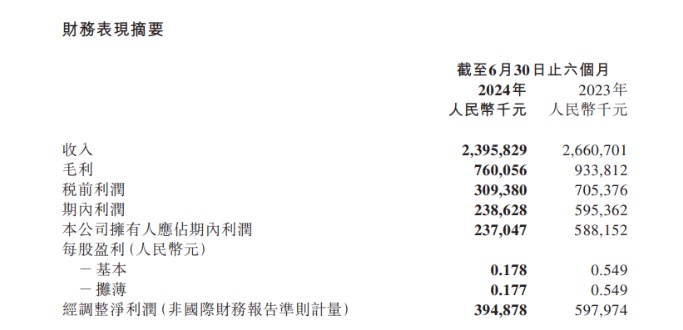
TeaBaiDao’s first semi-annual financial report since listing on the Hong Kong Stock Exchange shows that the company’s overall performance in the first half of 2024 was less than ideal, with clear downward trends in both revenue and net profit. According to official data, the company’s revenue in the first half of the year was RMB 2.396 billion, a decrease of approximately 10% compared to RMB 2.661 billion in the same period of 2023; while net profit saw a significant drop, recording only RMB 237 million, compared to RMB 595 million in the same period last year,a decline of 59.7%, nearly halving.
The financial report further noted that the adjusted net profit was RMB 395 million, which may still seem sizable, but it is lower than the RMB 588 million in the same period of 2023, and the adjusted net profit margin also fell to 16.5%. TeaBaiDao explained that the profit decline was mainly due to increased support for franchisees, including offering more favorable terms for product and equipment sales, as well as increased investment in overall marketing efforts.
In terms of revenue structure, TeaBaiDao’s main earnings still come from selling goods and equipment to franchisees, as well as collecting corresponding franchise royalties and fees, with goods and equipment sales accounting for95%. To alleviate the burden on franchisees, the brand introduced several subsidy measures in its latest franchise policy, including lowering the security deposit threshold and providing material and rent subsidies.
Specifically, in the case of new store signings, each new franchisee can enjoy a fee reduction of RMB 40,000 per store; signing two new stores at once can result in a total reduction of RMB 180,000. As for existing franchisees, each additional store can also receive a discount of RMB 90,000. In addition, regarding marketing activities, TeaBaiDao has also introduced a material sales subsidy mechanism. If a new franchisee signs more than three stores or an existing franchisee adds more than two, they can apply for a rebate of2% to 5%of their annual total material purchase amount. For rent, if the store is located in a first-tier, emerging first-tier, or second-tier city, and the rent reaches RMB 600,000, RMB 420,000, or RMB 300,000 respectively, there is also a chance to receive a 3% material rebate.
These subsidies and support policies have had a significant impact: on one hand, they have driven continuous expansion in the number of stores. As of June 30, 2024, the total number of TeaBaiDao stores reached 8,385, a year-on-year increase of 20.6%; on the other hand, they have also led to continuously rising marketing expenses and directly caused a decline in gross profit and overall profit. Currently, TeaBaiDao stores are distributed with 10.2% in first-tier cities, 26.1% in emerging first-tier cities, 20.4% in second-tier cities, and 43.3% in third-tier and lower-tier cities, indicating that its market layout is still mainly focused on mid-to-low-tier cities. In terms of company-owned stores, the brand maintains only nine outlets.
In terms of the number of franchisees, there were 5,538 at the beginning of 2024, with 667 added within six months, but 508 also terminated their cooperation, bringing the total at the end of the period to 5,697. In addition to financial and franchise policy adjustments, TeaBaiDao also stated that the brand continues to actively expand its brand presence through digital marketing, IP collaborations, cross-industry partnerships, celebrity endorsements, and anniversary celebrations. Marketing methods include operating topics on major social platforms, managing an official self-media matrix, and collaborating with celebrities to boost exposure.
However, despite the steady increase in the number of stores, TeaBaiDao’s overall profitability has taken a sharp downturn, and its market value has also dropped from HK$23 billion at the time of its IPO earlier in the year to currently below HK$10 billion, indicating that market investors hold a cautious or even pessimistic attitude toward its prospects. Analysis points out that in addition to external factors such as intensified competition in the overall tea beverage market and tightened consumer budgets, TeaBaiDao’s insufficient supply chain layout is also a key concern.
According to TeaBaiDao’s prospectus earlier in the year, it currently has 333 main suppliers and 124 alternate suppliers. The brand itself does not have its own production base but instead procures raw materials such as dairy products, tea leaves, and fruits from suppliers and resells them to franchisees to earn intermediary profits. Compared to competitors such as Heytea and Mixue Ice Cream & Tea, which have already invested resources in building their own supply chain systems, TeaBaiDao’s layout in this regard is clearly lagging behind. It not only lacks a “moat” for cost control and quality stability but is also more susceptible to fluctuations in market supply and demand affecting its procurement costs.
Looking back over the past three years, TeaBaiDao’s financial performance showed significant growth, with its net profit climbing from RMB 776 million in 2021 to RMB 1.151 billion in 2023. However, the financial data for the first half of 2024 shows that the brand is at a turning point, facing dual pressures from internal policy adjustments and external market conditions. How to optimize supply chain management and improve profitability will be the key to whether TeaBaiDao can stabilize its market position in the future.
The above content is compiled by CoffeeHunters, a coffee news website.


