







Introduction:Yunnan small-grain coffee, as China’s representative Arabica variety, is known for its small bean size and diverse flavor profiles. This article delves into the climate characteristics and varietal distribution of Yunnan’s four major coffee-growing regions, explores the differences between Catimor and Typica, and details how to achieve optimal extraction to showcase the best flavors—serving as both an introductory and advanced guide to understanding and appreciating Yunnan coffee.
Yunnan small-grain coffee mostly belongs to the Arabica species, named for its relatively small bean size. In contrast, Hainan mainly cultivates the medium-bean Robusta variety, which differs significantly from Yunnan in bean shape, flavor, and usage. The history of Yunnan coffee dates back to 1904, when French missionary Téodore Monod planted the first coffee seedlings in Zhugula Village, Binchuan, marking the beginning of coffee cultivation in this highland region. Today, Baoshan, Pu’er, Dehong, and Lincang form Yunnan’s four main coffee-producing areas, each nurturing distinct-flavored beans based on their unique climate, altitude, and soil conditions.
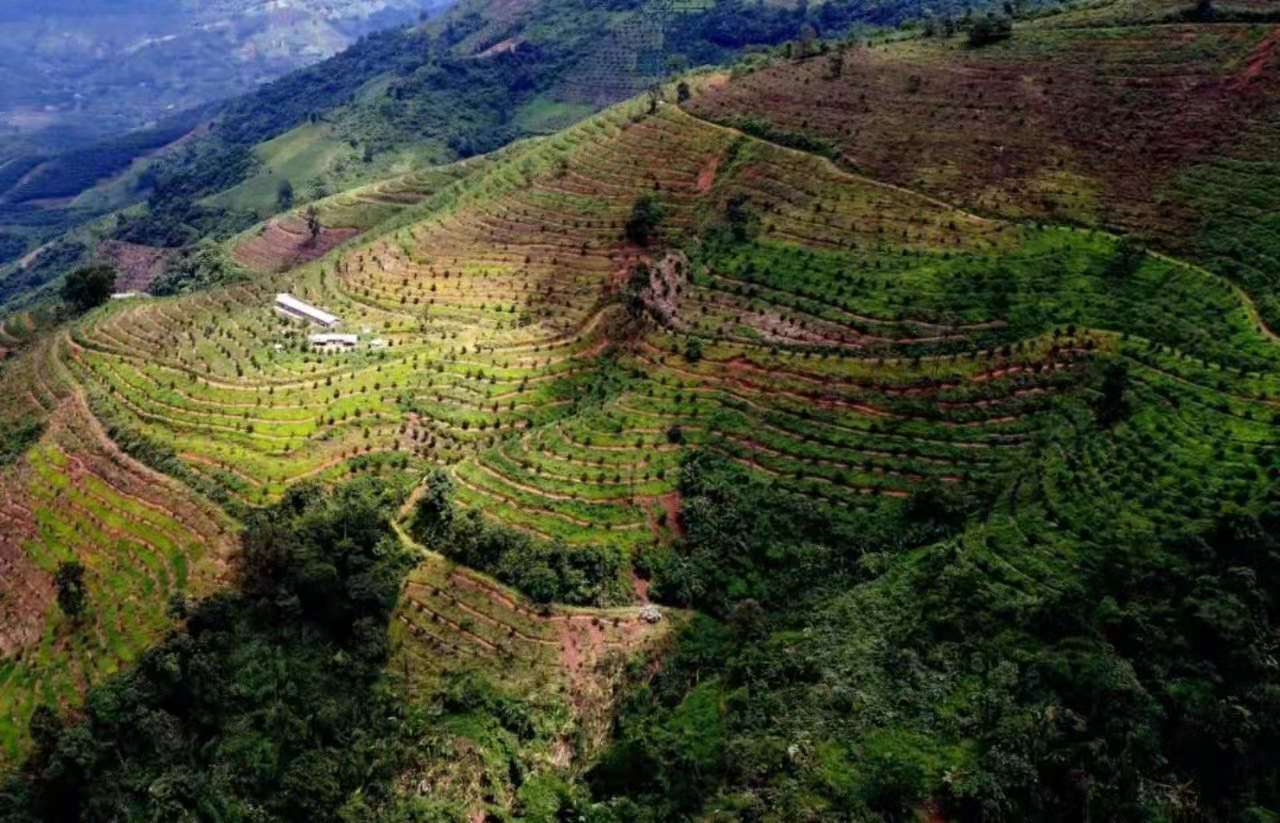
Lincang RegionLocated near the Tropic of Cancer, Lincang boasts a three-dimensional climate with abundant sunshine, plentiful rainfall, and fertile soil—conditions similar to renowned coffee regions like Jamaica and Colombia. Most of its coffee-growing areas exceed 1,300 meters in altitude, making it highly suitable for cultivating high-quality specialty coffee. As a result, it has been certified as both a “China Specialty Coffee Bean Demonstration Zone” and a “China Specialty Coffee Core Production Area.” Lincang coffee often exhibits pronounced acidity and rich, mellow layers, primarily distributed across counties and cities such as Linxiang, Gengma, Cangyuan, Fengqing, Yongde, Yunxian, Zhenkang, and Shuangjiang. In 2015, its planted area reached 36,000 hectares, with plans to expand to 41,700 hectares by 2020.
Dehong RegionKnown as the “Hometown of Chinese Coffee,” Dehong features a South Asian tropical rainforest climate with minimal annual temperature variation and planting altitudes all above 1,000 meters. In 2015, the region’s coffee plantation area was 18,000 hectares, of which 9,300 hectares were already in production, yielding an annual output of 28,000 tons, with an agricultural output value of 616 million yuan and an industrial output value as high as 800 million yuan. Dehong is home to the only national-level agricultural industrialization leading enterprise for coffee in China and has registered the “Dehong Coffee” geographical indication. Plans for 2020 aimed to expand the plantation area to 20,000 hectares, primarily distributed across counties and cities like Ruili, Mangshi, Lianghe, Yingjiang, and Longchuan.
Baoshan RegionThe Longjiang Dam, located at the eastern foot of the Gaoligong Mountains, features a dry-hot valley terrain with a dry, hot climate, intense sunlight, scarce but sufficient heat, and no frost throughout the year—earning it the nickname “natural greenhouse.” In 2010, “Baoshan Small-Grain Coffee” was granted protection under China’s National Geographical Indication Products scheme. In 2015, its planted area was 13,000 hectares, with a 2020 target of 20,000 hectares, primarily distributed across counties and cities like Longyang, Longling, Changning, and Shidian.
Pu’er RegionDubbed the “Coffee Capital of China,” Pu’er’s coffee cultivation history dates back to the late 19th century, with industrialization beginning in 1988. In 2015, its planted area reached a staggering 50,000 hectares, of which 26,800 hectares were in production, yielding 48,900 tons and a total output value of 1.2 billion yuan. Plans for 2020 aimed to expand the area to 54,000 hectares. Pu’er is the largest and highest-yielding coffee-producing region in China, as well as a key trading and distribution hub. Its coffee industry has become a vital pillar of the local highland specialty agriculture and green economy, spanning numerous counties and cities such as Ning’er, Simao, Jiangcheng, Menglian, Lancang, Jinggu, Mojiang, Jingdong, Zhenyuan, and Ximeng.
The term “small-grain coffee” generally refers to Arabica beans with smaller sizes, distinguishing them from medium-bean Robusta and large-bean Liberica. In Yunnan, although Arabica is cultivated, the dominant variety is Catimor, with only a tiny fraction being the traditional Typica. Catimor is a hybrid of Timor and Caturra, while Timor itself is a cross between Robusta and Arabica—thus, Catimor contains about a quarter of Robusta genetics. It offers advantages such as high yield, disease resistance, and no need for shade, but its flavor profile often falls short of traditional varieties.
The early Typica planted in Yunnan was introduced by Father Téodore Monod in 1904 and later promoted in the 1930s by returning overseas Chinese Liang Jinshan, enjoying a peak in cultivation. However, Typica is weak in resistance to leaf rust, has low yields, and was gradually phased out after the market economy transition. By the 1980s and 1990s, Nestlé introduced the Catimor variety to supplement raw material supplies, which later became the mainstay of Yunnan coffee.
Currently, over 90% of Yunnan small-grain coffee on the market is of the Catimor variety. Many consumers, upon tasting Yunnan beans processed with special methods like anaerobic fermentation, are amazed by their tropical fruit flavors. However, such processing methods often mask the beans’ inherent regional characteristics, and varietal limitations remain—still some distance from meeting specialty coffee standards. Professionals recommend prioritizing beans processed with traditional methods like washed or natural (sun-dried) to experience Yunnan coffee’s true flavors.
Take washed Catimor from the Baoshan region as an example: its cupping profile often showcases rich fruity aromas, such as melon and herbal notes, with a smooth mouthfeel. The mid-palate reveals nutty and milk chocolate tones, while the finish highlights the bright acidity of plums, offering distinct and well-balanced layers. Sun-dried Catimor, made from high-altitude fully red cherries, stands out in the Catimor category with even more pronounced sweetness. Meanwhile, Typica grown near the Myanmar border in Lincang, named “2013” and processed with fully red cherry sun-drying, presents cupping notes of apricot, sanhua plum, and caramelized chocolate—rich, unique, and full of character.
For pour-over brewing of Yunnan coffee, it’s recommended to use a Hario V60 filter, with around 15 grams of coffee, water temperature controlled at 90°C, and grind size adjusted to 75% extraction through a 20-mesh sieve. The water-to-coffee ratio should be set at 1:15. For specific brewing steps, a three-stage pouring method is advised: start with 30 ml of water for a 30-second bloom, followed by pouring 100 ml in a circular motion. When the water level drops halfway, add a third pour of 95 ml, totaling 225 ml of water. Once the coffee has fully dripped through, it’s ready to enjoy. These parameters help fully highlight the layered and regional flavor characteristics of Yunnan coffee.
The above content is compiled by CoffeeHunters, a coffee news website.


