







Introduction:Do you know where over 90% of China’s coffee comes from? The answer is Yunnan. This article delves into the main type of Arabica coffee grown in Yunnan, analyzes the characteristics of the dominant variety Catimor, and introduces the historical origins, cultivation regions, and unique flavor profile of Yunnan small-grain coffee. From its early introduction to award-winning performances in international competitions, to its current transformation towards specialty coffee, this piece offers a comprehensive understanding of this “China-flavored” coffee bean.
As the core coffee-producing region in China, Yunnan accounts for over 98% of the country’s total coffee output, making it a veritable coffee powerhouse. Most of the coffee grown here belongs to the Arabica species, commonly referred to as “Yunnan small-grain coffee,” with the Catimor variety being the mainstay. Catimor is a hybrid of Timor and Caturra, known for its strong disease resistance and consistently high yields. Its flavor profile leans neutral, with balanced acidity and bitterness, bright and clear aromas, rich yet not overly intense—making it suitable for the taste preferences of most coffee enthusiasts.
When it comes to coffee, many people first think of South American or African producing regions, often overlooking Yunnan, China—a land brimming with untapped coffee-growing potential. Yunnan is not only a major hub for China’s coffee production but also, thanks to its unique geography and climate, cultivates a distinctive “small-grain coffee” with local character. In recent years, its quality has continued to improve, even earning the reputation of being “China’s most promising specialty coffee.” Whether for everyday drinking or pour over appreciation, Yunnan coffee is well worth exploring.
The so-called “Yunnan small-grain coffee” is actually Arabica coffee, originally from Ethiopia in Africa, and later spread globally via the Arab world. Apart from Yunnan, small amounts are also grown in Fujian, Guangdong, and Hainan in China, but in terms of scale and output, Yunnan accounts for over 99% of the national share. The main variety planted locally is Catimor, which was cultivated through the hybridization of Timor and Caturra, combining both disease resistance and high-yield advantages—perfectly suited to Yunnan’s growing environment. Aside from Catimor, the original homeland of small-grain coffee is believed to be Ethiopia or the Arabian Peninsula, from where it later spread to other continents.
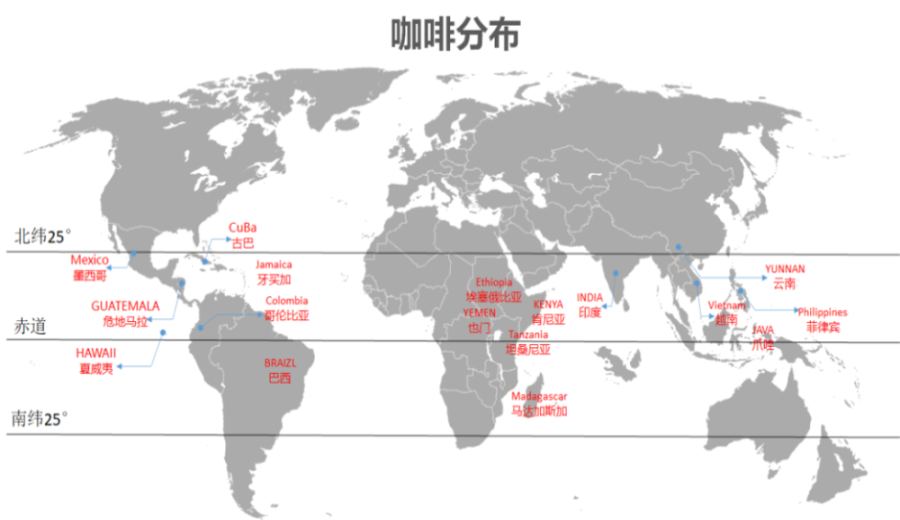
Arabica is the most popular coffee variety worldwide, accounting for approximately 75% to 80% of the market. It is renowned for its rich fruity and floral notes and is commonly found in well-known specialty coffees such as Blue Mountain and Mocha. Apart from most parts of South America (excluding certain regions in Argentina and Brazil), Central America, East Africa (Kenya and Ethiopia), as well as Asia (Yemen, India, and Papua New Guinea), Arabica can be found across these regions.
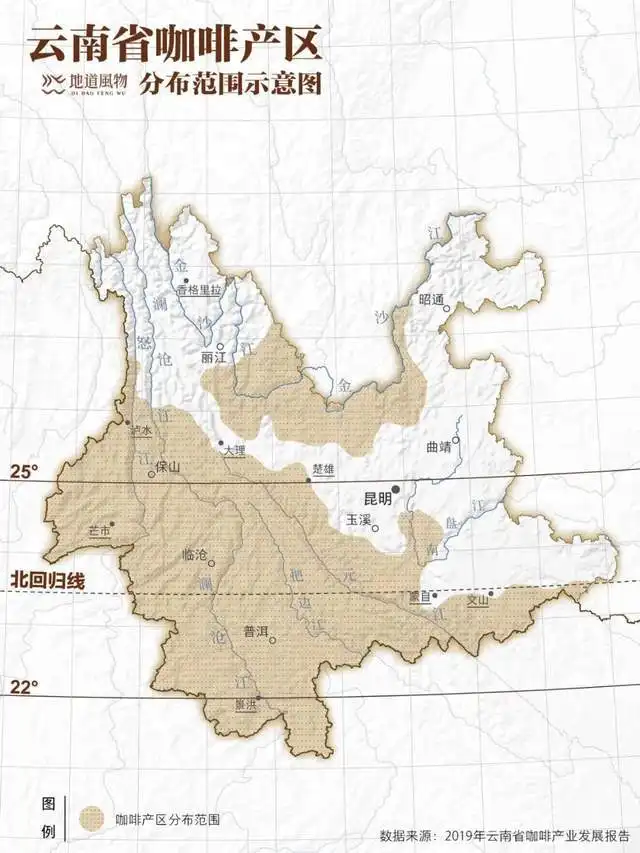
Due to its delicate flavors and aromas, Arabica coffee is especially favored by Chinese consumers who are new to coffee culture. As early as the 19th century, missionaries introduced this variety to China, where it took root in western Yunnan. The region enjoys abundant sunlight and significant diurnal temperature variations. Although rainfall is uneven during the rainy season, artificial irrigation has successfully nurtured “Yunnan small-grain coffee” with its distinctive fragrance.
The planting and processing of Yunnan small-grain coffee emphasizes an “entirely off-the-ground” approach. From harvesting, processing to drying, every step avoids contact with the ground to ensure the purity and consistency of the coffee’s flavor. Moreover, local farmers commonly adopt a “graded picking” method—harvesting coffee cherries in batches based on ripeness, typically selecting only fully red, ripe cherries (whole red cherries), which are then handpicked before undergoing subsequent sun-drying or washed processing. For example, the Yunnan coffee beans roasted by a certain coffee brand use whole red cherries with a sun-dried process, showcasing a clean, bright flavor with notable sweetness.
The history of Yunnan small-grain coffee can actually be divided into two introduction routes: eastern and western. The eastern route began in 1902, when French missionaries introduced coffee in Zhukula Village, Binchuan County, located at around 1400 meters above sea level along the 26th parallel north. Among that batch of planting stock, 69% were Bourbon and 31% were Typica, though subsequent cultivation remained limited. The western route started in 1914, when ethnic Jingpo border residents brought coffee to Longxian Village, Ruili County, initially using it only as an ornamental plant in courtyards. It wasn’t until 1952 that researchers from the Tropical and Subtropical Crops Research Institute of the Yunnan Academy of Agricultural Sciences discovered these coffee trees during a social survey. They brought back 35 kilograms of fresh cherries to Baoshan City’s Ludian Dam for trial planting, laying the foundation for what would become the mainstream cultivation of Yunnan coffee.
Starting in the 1950s, small-grain coffee gradually expanded in cultivation area across Yunnan and developed a unique flavor profile described as “strong but not bitter, fragrant but not overpowering, with a hint of fruitiness,” gradually earning positive market feedback. In 1993, at the World Coffee Quality Competition held in Brussels, Belgium, “Baoshan Small-Grain Coffee” from Baoshan won the “Eureka” Gold Award—an important milestone in Yunnan coffee’s journey to the international stage and also leading to “Baoshan Small-Grain Coffee” becoming a local geographical indication product.
By 1998, the Yunnan Provincial Government officially issued the “Opinions on Accelerating the Development of the Coffee Industry,” outlining clear support policies that drove rapid growth in coffee planting areas. With rising international coffee prices, the planting area of Yunnan small-grain coffee reached 122,000 hectares in 2017, with a total output of 144,000 tons—accounting for 1.5% of global coffee production, ranking 12th in the world and 4th in Asia. To this day, Yunnan is not only China’s largest coffee production base but has also formed a complete industry chain from planting, production to processing. Its products are exported to markets in Europe, America, Japan, Korea, and the Middle East, making it one of the key representatives of Chinese agricultural products in international trade.
Among these, Baoshan City is an important coffee-producing region in Yunnan, endowed with exceptional natural conditions: an average annual temperature of 21.3°C, annual sunshine hours exceeding 2334.5, annual rainfall between 721.51 and 1000 millimeters, accumulated active temperature surpassing 7800°C, and virtually no frost throughout the year. These conditions provide an ideal environment for coffee growth. As early as the late 1950s, Baoshan small-grain coffee received a “first-class” evaluation in the London market and earned the reputation of “Lugjiang No. 1.” In 1980, it was hailed as the “best coffee in China” at a national coffee conference, and by 1987, it even garnered high praise from the technical director of Nestlé in Switzerland. In 2010, “Baoshan Small-Grain Coffee” was officially granted national geographical indication product protection.
Overall, the flavor profile of Yunnan small-grain coffee is predominantly neutral, with mild acidity and bitterness, and pleasant aromas—making it an approachable type for most consumers. If you prefer bright fruity acidity and a light body, you can opt for Yunnan small-grain coffee beans from high-altitude regions with lighter roasting levels. These beans often feature clear acidity, low bitterness, and are better suited for pour over or filtered brewing methods, allowing their subtle regional characteristics to shine through.
The above content is compiled by CoffeeHunters, a coffee news website.


