








Introduction:Yunnan small-grain coffee has become one of China's representatives of specialty coffee since it was first introduced by missionaries over a century ago. This article delves into Yunnan coffee’s flavor potential by exploring its planting history, the characteristics of its four major producing regions, differences between varieties such as Typica and Bourbon, and the impact of washed and natural processing methods. It also provides a pour over recommendation and extraction parameters for a well-known shop’s natural Typica, helping coffee enthusiasts master tasting and brewing essentials.
The history of Yunnan coffee dates back to 1892, when a French missionary named Tévenot accidentally planted coffee in Zhukula Village. He brought coffee seeds from Vietnam and sowed them near the church. These seeds adapted well to the local environment and thrived, marking the beginning of coffee cultivation in Yunnan. Years later, with the rise of the specialty coffee concept, origin and variety gradually became key indicators of quality, and Yunnan coffee has increasingly entered the international market spotlight.

Yunnan’s coffee-growing areas are mainly concentrated in highland regions at elevations between 800 and 1,800 meters, among which the dry-hot river valley areas around 1,100 meters are the most representative. This region features a dry and warm climate with large day-night temperature variations, coupled with abundant sunlight and moderate rainfall, providing ideal growing conditions for coffee. The main coffee-producing regions in Yunnan include Pu’er, Baoshan, Lincang, and Dehong. These areas generally have low latitude, high altitude, and ample rainfall, all of which contribute to the unique regional flavors of the coffee.
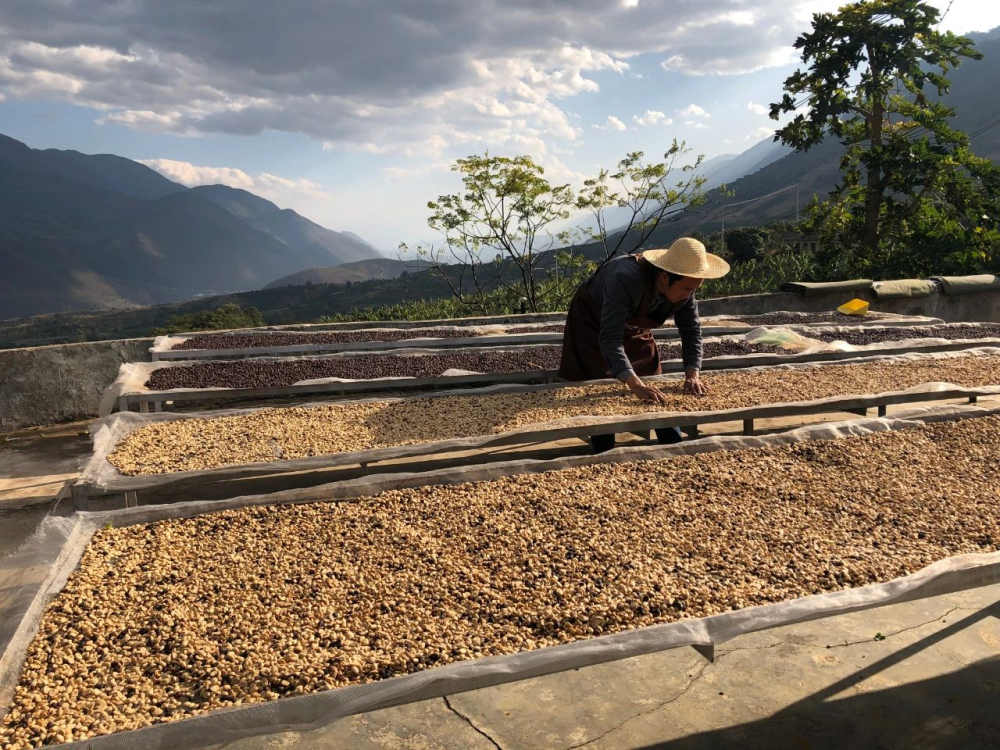
Pu’er is one of the earliest regions in Yunnan to grow coffee, with a planting history of over 100 years and currently the largest production area. Its geography and climate are very suitable for coffee cultivation. Baoshan is known for its high quality, with an average annual temperature of about 21°C. The coffee beans grown there are smaller in size but uniform, with pronounced fruity aromas and a mellow, balanced taste, making it one of the regions with excellent quality performance. Lincang is located in the southwestern part of Yunnan, close to the Tropic of Cancer, with an average annual temperature of about 16°C and abundant sunshine. Its coffee-growing environment is similar to that of Colombia, with most plantations situated above 1,000 meters in elevation. The coffee produced here often exhibits distinct fruit acidity and sweet notes, and a certain brand’s own estate is also located in this region. Dehong has a typical South Asian tropical climate, with coffee plantations also above 1,000 meters, featuring rich characteristics of a tropical rainforest climate.
In terms of varieties, among the Arabica species grown in Yunnan, Typica, Bourbon, and Catimor are the most common. Typica is an ancient Arabica heirloom variety, characterized by its reddish-copper colored leaf tips, which are one of its identifying features. This variety has excellent flavor potential, with prominent sweetness and a smooth mouthfeel, but it is relatively weak in disease resistance and has higher management requirements. Bourbon is a mutation of Typica, originating from the island of Bourbon. It has slightly higher yields than Typica and can display more complex flavor layers at suitable altitudes, with intense aromas and notable fruity notes. However, it also suffers from lower disease resistance and requires a biennial resting period. Catimor is a hybrid of Timor (a Robusta variety) and Caturra. Although it offers higher yields and disease resistance, its non-pure Arabica lineage often results in more ordinary flavor profiles, with muted aromas and a tendency toward noticeable bitterness. It is currently the most widely planted main variety in Yunnan.
In terms of processing methods, Yunnan coffee is primarily washed, though some estates also experiment with honey processing and anaerobic fermentation. The washed process involves selecting ripe coffee cherries, removing the pulp, and then fermenting the seeds to remove the mucilage before drying. This method yields clean, bright acidity and a clear flavor profile. Additionally, a well-known shop’s Yunnan Typica uses the natural processing method, where the coffee fruit is dried naturally under the sun, allowing prolonged contact between the flesh, mucilage, and seeds. This results in fermented aromas and sugar infusion into the beans, leading to richer sweetness and a fuller mouthfeel after roasting. Naturally processed Typica often exhibits a plum-like acidity, the body of black tea, and the lingering sweetness of brown sugar, with a flavor profile that is smoother and more complex compared to the washed version.
If you’d like to try pour over brewing Yunnan natural Typica at home, here are professional-grade reference parameters: Use 15 grams of coffee grounds with a 1:15 coffee-to-water ratio (adjust to 1:16 for a cleaner flavor profile). Choose a V60 filter. Control the water temperature around 88°C to help reduce sharp acidity. The recommended grind size is around 78% through a Chinese standard No. 20 sieve, equivalent to a medium grind. Use a three-stage pouring technique: First, pour 30 grams of water for a 30-second bloom; then pour in a small circular motion until reaching 125 grams for the first pour, and wait until the water level nearly exposes the coffee bed before pouring to 225 grams, then stop and wait for the water level to drop again before removing the filter. The total brew time is approximately 2 minutes and 10 seconds. This brewing method fully highlights the charming combination of plum-like acidity, black-tea-like body, and brown-sugar sweetness.
The above content is compiled by CoffeeHunters, a coffee news website.


