







Introduction:Want to understand where the sweet flavors of Costa Rican honey-processed coffee come from? This article provides an easy-to-understand breakdown of the origins, naming conventions, and color classifications of the honey process, along with brewing tips and practical parameters to help you grasp everything from bean processing to flavor profiles.
Among the many coffee processing methods, natural and honey processes are often favored for their pronounced sweetness. In specialty coffee menus, honey-processed beans are a staple, not only offering intense fruity aromas but also showcasing unique sweet and mellow tones. The honey processing technique, represented by Costa Rica, has a history of evolution and embodies the wisdom of local coffee farmers and their adaptation to the environment. This article will comprehensively dissect this highly acclaimed processing method—from its name origin, development timeline, color classification logic, to actual pour-over parameter settings.

Many coffee enthusiasts have a particular fondness for beans with noticeable sweetness, and honey-processed coffee is one of the representatives. For example, the recently launched Colombian Hope Estate Geisha, processed using the honey method, boasts captivating rose aromas and high sweetness, receiving positive feedback upon its release. But does the “honey” in honey processing actually relate to honey? Why does this method allow coffee to exhibit such distinct sweetness? The answer lies in the evolution of coffee processing techniques in Costa Rica.
The English term for “蜜處理” is Honey Process or Miel Process, where the word “蜜” originates from the Spanish “Miel,” meaning honey. Interestingly, this term was originally a colloquialism used by local Costa Rican farmers to describe the sticky, gel-like layer within the coffee pulp. The precursor to this processing method was actually Brazil’s Pulped Natural (semi-washed/pulp sun-dried), which was first developed to save water. By the time it reached Costa Rica, this technique had evolved and been further promoted. To understand its developmental trajectory, there are several key milestones worth noting.
 In the latter half of the 20th century, washed processing was the mainstream in Costa Rica, and the country was also one of the pioneers of modern washed technology, boasting leading depulping equipment and wet processing mills. However, between 1997 and 2000, global coffee prices were low, prompting many farmers to stop selling all their green beans to large processing plants and instead process and sell them themselves. This allowed them to experiment with different processing methods. The depulped and dried technique emerged in this context, with honey processing being a significant breakthrough.
Honey processing truly gained attention in 2006, when a farmer named Juan Ramón Alvarado won both the championship and runner-up titles at the SCAA-sponsored Costa Rican GOLDEN HARVEST green bean competition with two honey-processed coffees. The following year, honey processing made its debut in the first Costa Rican CoE (Cup of Excellence) event, where three out of the top five entries were honey-processed beans. In 2008, Costa Rica experienced a major earthquake that damaged power and water supply systems in many areas. Under this crisis, local farmers turned to more water-efficient processing methods, leading to the rapid popularization of honey processing. Although some initially worried that drying pulp and mucilage together could lead to uncontrollable fermentation, many farms found through experimentation that not only could stable quality be maintained, but water usage could also be significantly reduced. By adjusting the fermentation level of the mucilage, various honey process types with distinct flavors gradually emerged.
Common honey process classifications include black honey, red honey, yellow honey, and white honey. These names are primarily based on the proportion of mucilage retained during drying and the drying method. Since mucilage is rich in sugars, exposure to air causes it to gradually oxidize, changing the appearance of the coffee beans from yellow-white to golden yellow, and with time and deeper fermentation, possibly to deep red or purplish-black. Generally, black and red honey processes have stronger fermentation characteristics, with flavors closer to natural processing, while yellow and white honey processes are closer to washed processing but still deliver excellent sweetness. It’s worth noting that there is currently no unified standard for these color classifications in the industry, and definitions may vary between different farms or processing mills—so one farm’s “red honey” might be called “yellow honey” by another.
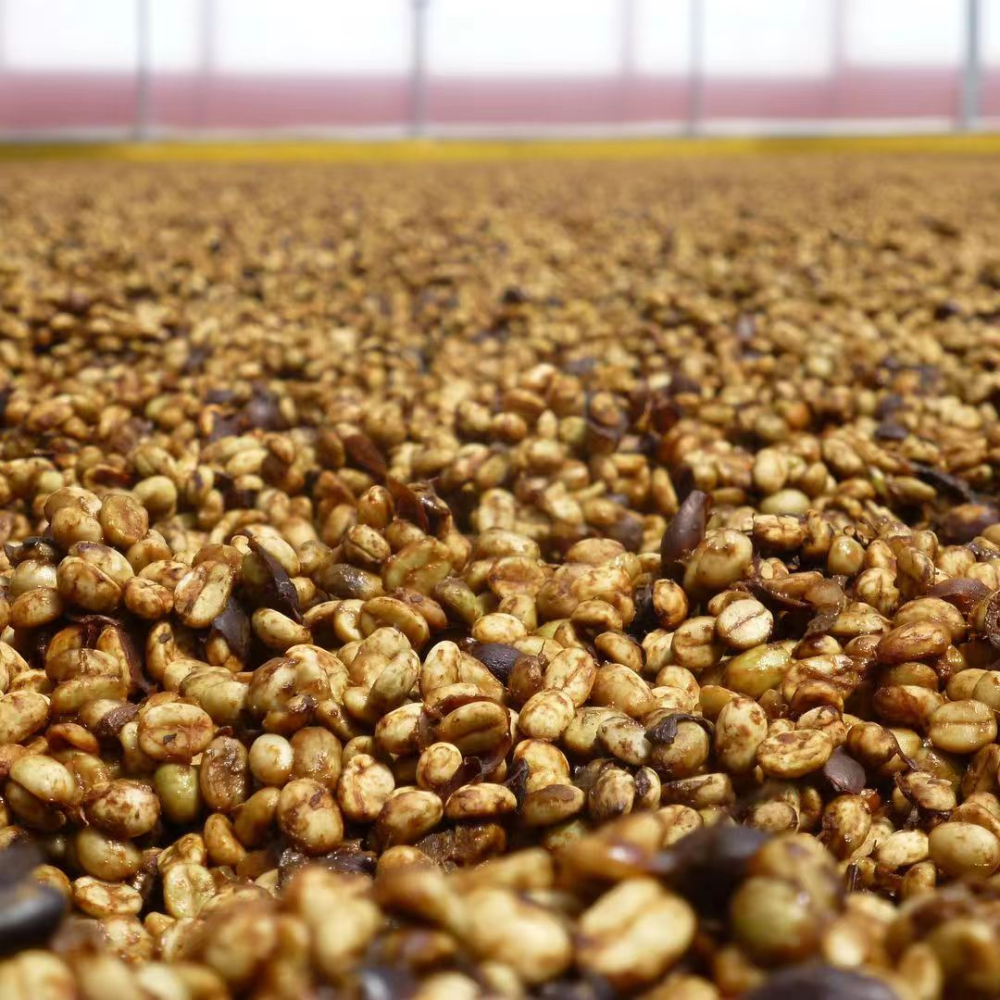 The drying time for honey-processed coffee typically ranges from 2 to 4 weeks, slightly shorter than natural processing but longer than washed. This process results in honey-processed coffee having flavor characteristics that lie between natural and washed methods, but usually leaning more toward the rich profile of natural processing, showcasing sweet flavors reminiscent of preserved fruit and bright, clear acidity. Compared to traditional washed methods, honey processing can save about 40% of freshwater usage and also avoids the defective flavors caused by prolonged intense sunlight. In cupping, honey-processed coffee often presents delicate and full-bodied fruity acidity and refined floral aromas, with a clean and layered mouthfeel overall. Thanks to its combination of environmental benefits and captivating flavors, the honey processing technique has gradually spread across Central and South America and become a highly sought-after element in the specialty coffee market.
If you’d like to brew a honey-processed coffee yourself—such as the Colombian Hope Estate Geisha—here are some useful pour-over reference parameters: A recommended coffee-to-water ratio is 1:15, with a medium-fine grind size, similar to the texture of superfine sugar. Use water heated to 90–92°C, and start with a pre-infusion (bloom) by pouring about twice the coffee dose in water for around 30 seconds. Then proceed with pulsed pouring, keeping the total extraction time between 2 and 2 minutes 30 seconds. Maintain steady water flow and avoid excessive agitation of the coffee bed to fully highlight its fruity-floral aroma and rich sweetness. With this brewing approach, you’ll be able to better experience the layers and charm of honey-processed coffee.
The above content is compiled by CoffeeHunters, a coffee news website.


