







Introduction:Kenyan coffee is renowned for its intense fruit acidity and rich mouthfeel, with the altitude of different growing regions playing a decisive role in flavor. From Thika to Nyeri, we delve into the altitude ranges, varietal characteristics, and grading systems of each region, while also uncovering how the classic K72 washed processing method shapes a clean, bright acidity reminiscent of small tomatoes—making this a practical guide for selecting and brewing Kenyan beans.
Kenyan coffee holds a prominent place in the global specialty coffee market, thanks to its uniquely bright fruit acidity and deep, full-bodied flavor. One of the key factors influencing its flavor profile is the variation in altitude across its growing regions. From Thika to Kirinyaga to Nyeri, these regions not only differ in elevation but also in varietal composition, resulting in a richly layered spectrum of coffee flavors.
Located in East Africa, Kenya is traversed by the equator, with a terrain dominated by plateaus and an average elevation of about 1,500 meters. Its highest peak, Mount Kenya, stands at 5,199 meters, making it the second-highest peak in Africa. The country enjoys a favorable climate and fertile soil, particularly suited for coffee cultivation. Kenyan coffee beans generally exhibit delightful aromatics, balanced acidity, and outstanding fruit notes. Compared to neighboring Ethiopian coffee, Kenyan beans feature more pronounced and robust fruit acidity, making them an ideal choice for coffee lovers who enjoy distinct acidity without excessive delicacy.
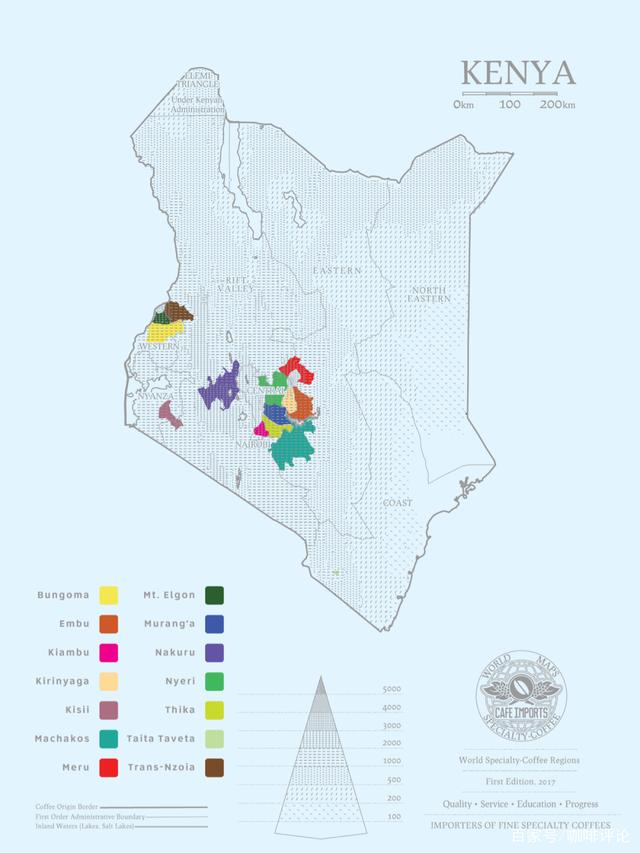
Kenya’s main coffee-growing regions are concentrated in the central and western parts of the country, including Thika, Kirinyaga, the western slopes of Mount Kenya (Mt. Kenya West), Nyeri, Kiambu, and Muranga. The primary harvest season in these regions runs from October to December, with a secondary season from June to August. Among them, Thika and Kirinyaga best showcase the classic flavor characteristics of Kenyan coffee.
Thika is a small town near Kenya’s capital, Nairobi, where industry and agriculture coexist, surrounded by farmland and natural landscapes. Local coffee cultivation dates back to the late 19th century, with the SL28 and SL34 varieties accounting for about 90% of plantings. These two varieties are known for their high acidity, intense fruitiness, and honey-like sweetness. The altitude in Thika ranges from 1,550 to 1,750 meters, making it suitable for growing high-quality Arabica coffee. The beans produced here typically feature bright fruit acidity, a rich berry-like body, and a sweet aftertaste.
The Kirinyaga region is situated at the foot of Mount Kenya, adjacent to Nyeri, and is renowned for producing coffee with strong, well-defined flavors and a solid mouthfeel. This area is mostly home to smallholder coffee farmers who collectively use centralized washed processing facilities through cooperatives to ensure consistent quality. The coffee from Kirinyaga exhibits clear fruit acidity, moderate body, and delicate sweetness, with altitudes ranging between 1,300 and 1,900 meters. The varietals are also dominated by SL28 and SL34, along with disease-resistant varieties such as Ruiru11 and Batian.
Nyeri is located in central Kenya, adjacent to the dormant volcano Mount Kenya. The red soil here is believed to be instrumental in producing some of the finest Kenyan coffee. Agriculture is the main industry, with coffee as the core crop, primarily cultivated by cooperatives of smallholder farmers rather than large estates. Nyeri has two harvests per year, but the main season’s coffee is particularly exceptional in quality. The coffee often features bright berry-like juiciness, citrus notes, and subtle floral aromas, which are key contributors to Kenyan coffee’s international acclaim. The altitude ranges widely from 1,200 to 2,300 meters, and the varietal selection is equally diverse, including SL28, SL34, Ruiru11, and Batian.
When it comes to Kenyan coffee varieties, SL28 and SL34 are the two most important, both being genetic mutants that make up the vast majority of high-quality Kenyan coffee production. These varieties are relatively susceptible to leaf rust but offer exceptional sweetness, complex flavors, and pronounced citrus and dark plum characteristics. SL34 is particularly favored for its copper-colored leaves, broad bean-like appearance, and outstanding balance. In contrast, Ruiru11 is a hybrid variety developed in 1985 to combat a major outbreak of rust disease. While it has higher yields, its flavor profile is not as refined as the SL series, making it less common in the specialty market and more often used in commercial blends to reduce costs.
Kenya’s coffee bean grading system is primarily based on bean size, with eight grades in total. AA is the highest grade, with beans sized 17–18 screens, considered to have the most outstanding flavor profile. AA+ refers to AA-grade beans that perform exceptionally well in cupping. AB-grade beans are 15–16 screens, the most commonly available grade in the market. C-grade beans are smaller, while TT and T are lighter beans sorted by air classification. E is a rare peaberry bean (two beans fused into one), and PB refers to round beans, which are not directly linked to flavor but often attract attention due to their rarity.
The most common processing method for Kenyan coffee is washing, which traditionally involves flotation, pulping, fermentation, washing, drying, hulling, and packaging. Washed processing requires significant water resources and precise machinery, so it is usually carried out by processing facilities with greater capital. Kenya’s unique “double washing” technique was developed to address insufficient drying space: after fermentation, the coffee beans are soaked in clean water again to delay drying and maintain stable quality. This method later became known as the “Kenyan process” or “fully washed.”
Kenya’s most iconic K72 washed process takes the traditional method a step further. This technique divides the fermentation process into three stages, each lasting 24 hours, totaling 72 hours. Through repeated fermentation and washing, it not only ensures stable quality control but also brings out a clear, clean, and bright fruit acidity, with flavor layers resembling small tomatoes and dark plums. This has become a classic flavor profile cherished by many specialty coffee enthusiasts. Though time-consuming and labor-intensive, this process fully showcases the unique charm of Kenyan coffee and is a signature method of renowned processing facilities like the Asali Honey Processing Plant.
The above content is compiled by CoffeeHunters, a coffee news website.


