







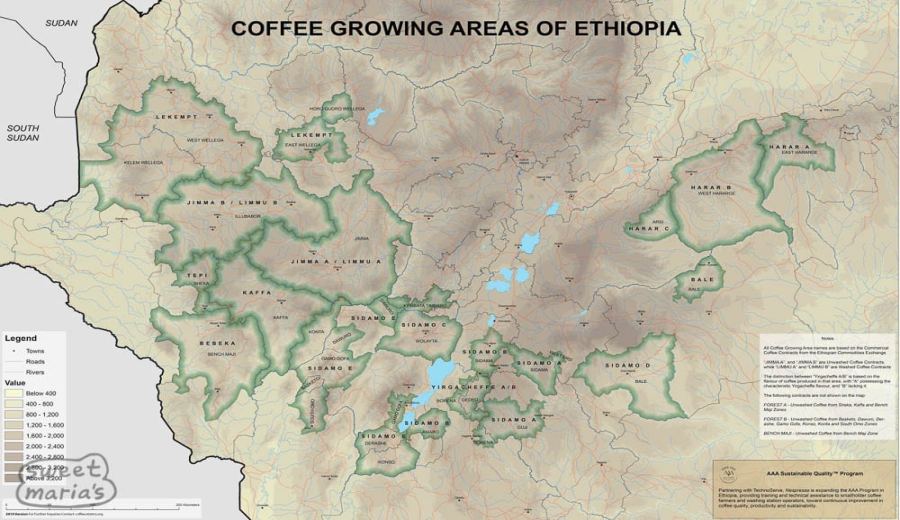
Introduction:As the birthplace of coffee, Ethiopia is home to over five thousand native coffee varieties, with each of its nine major growing regions offering distinct characteristics. This article delves into the altitude, farming methods, and flavor profiles of key regions such as Yirgacheffe, compares the evolution and differences between washed and natural processing methods, and provides practical brewing parameters and techniques to help you better appreciate the unique charm of these specialty coffees.
Ethiopia is hailed as the cradle of coffee. The pristine forests of the Kaffa region alone in the south harbor more than five thousand native coffee varieties. Following the 1995 administrative reorganization, Yirgacheffe—which was formerly part of the Sidamo Province—was incorporated into the Gedeo Zone, leading to the common mixing of old and new regional names in the market. Based on the latest administrative divisions, this article systematically introduces Ethiopia’s nine major coffee regions, covering aspects from altitude and cultivation practices to flavor characteristics. It also focuses on the evolution of washed and natural processing in Yirgacheffe, while offering expert cupping insights and practical brewing guides.
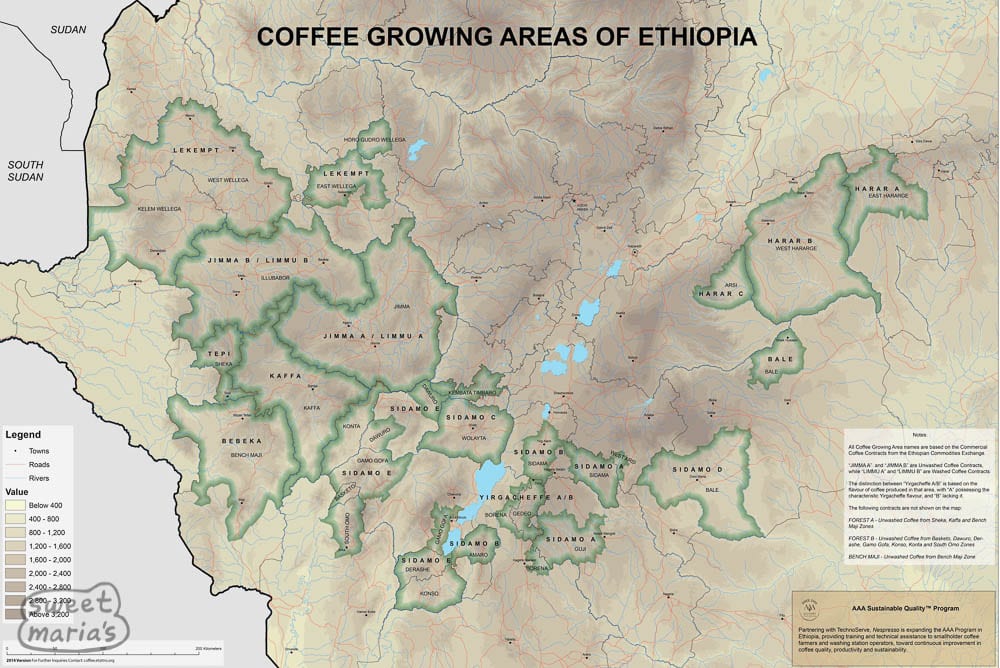
Coffee cultivation in Ethiopia is concentrated in the western and southern parts, with about 90% managed by smallholder farming families. Each household typically farms no more than four hectares, at altitudes ranging from 1,000 to 2,300 meters. Farming models can be divided into four main types: forest coffee (8–10%), semi-forest coffee (30–35%), garden coffee (50–55%), and plantation coffee (5–6%). Among these, garden coffee is mostly grown around homesteads by farmers themselves and serves as an important source of specialty coffee.
Originally part of the Sidamo Province, Yirgacheffe was designated as an independent region due to its distinctive flavors, encompassing sub-regions such as Wenago and Kochere. Under the new grading system, areas labeled Grade A (e.g., Yirgacheffe A) generally command higher prices than those with the same name but a Grade B designation. This region sits at an altitude of approximately 1,800–2,000 meters and is dominated by the garden coffee system. Its flavors are renowned for jasmine floral notes, lemon, peach, and almond-like sweetness, often described as "a burst of blooming flowers." Traditionally processed via natural methods, the introduction of washed processing in 1972 resulted in clearer jasmine and citrus aromas, establishing it as a flagship specialty coffee. In the 21st century, innovations in natural processing have led to improved methods, yielding celebrated beans such as Idido Mist Valley, Biloya, and Aricha, which feature more pronounced sweetness and fermentation characteristics.
Beyond washed and natural processes, Yirgacheffe has also experimented with special processing methods like red honey and anaerobic fermentation. Red honey versions retain the foundational flavors while adding layers of complexity, with a mouthfeel that lies between natural and washed. The Sidama region, at an altitude of 1,400–2,200 meters, produces refined washed or natural beans often with notable sweetness and strawberry-like berry tones, rivaling those of Yirgacheffe. The local Huaca series gained recognition after emerging in the 2017 TOH competition and has since evolved to version 8.0. With medium-light roasting, it showcases complex fruit aromas like guava, jackfruit, and apricot. During sipping, dried mango and passion fruit offer bright acidity and sweetness, with a tea-like aftertaste reminiscent of black tea.
The Limu region, at an altitude of 1,200–2,000 meters, primarily exports to Europe and the Americas. Its coffee features lower body, with prominent grassy and black sugar aromas and bright acidity, though it is less commonly found in the market. The Harar region, situated at 1,500–2,400 meters, exclusively employs natural processing. With annual rainfall as low as 1,000 mm, its flavors carry unique "fermented" notes, regarded as representative of ancient early-era profiles. Alongside Yirgacheffe, it is considered one of the “dual stars” of Ethiopian coffee. However, quality has been inconsistent in recent years, so cupping is recommended before purchasing.
Jimma is Ethiopia’s largest coffee-growing region, accounting for one-third of its exports, mainly consisting of commercial-grade beans. Varietals sourced from the Kaffa forests are often sold as blends, which can mask individual flavor profiles. However, washed specialty-grade beans from this area still exhibit clean and transparent flavor profiles, similar to those of Central American specialty coffees. Regions such as Illubabor, Gimbi, and Teppi Bebeka mostly produce bulk commercial beans with more balanced flavors, suitable for blending purposes. The Lake Tana area produces extremely limited quantities—no more than 10 tons per year—and is managed by communities around monasteries. These beans possess a unique “divine” character, resembling a rare gem from a secluded paradise.
Ethiopian processing methods have evolved from traditional natural drying to modern washed techniques. After the introduction of Central and South American washed processing methods in 1972, the jasmine and citrus notes in Yirgacheffe became notably clearer, establishing it as a flagship specialty coffee. In the 21st century, advancements in natural processing—such as Baghish’s improved method—have reduced defects and enhanced sweetness. Washed processing directly reflects regional flavor profiles, while natural processing adds layers of fermentation and sweetness. The natural process includes steps like fruit selection, long-term drying (27–30 days until moisture content reaches 11%), pulping and hulling, and secondary sorting. Washed processing, on the other hand, starts with floatation to remove defective beans, followed by removal of mucilage and pulp, multiple washes, and drying—a method that consumes more water.
When brewing Ethiopian coffee, it is recommended to use high water temperature (90–91°C) and a finer grind size (e.g., BG#6M, with 80% passing through a Chinese No. 20 sieve), paired with a fast-flowing V60 filter. The V60’s 60-degree cone shape and clockwise spiral ridges promote smooth water flow, with its large holes accelerating filtration. Practical parameters include a coffee-to-water ratio of 1:15, using 15 grams of coffee grounds. Begin with a 30-second bloom by pouring 30 grams of water (twice the coffee weight), then pour in stages up to 125 grams as the water level drops, continuing until reaching 225 grams. Total extraction time is around two minutes, fully highlighting fruity acidity and layered flavors.
The above content is compiled by CoffeeHunters, a coffee news website.


