







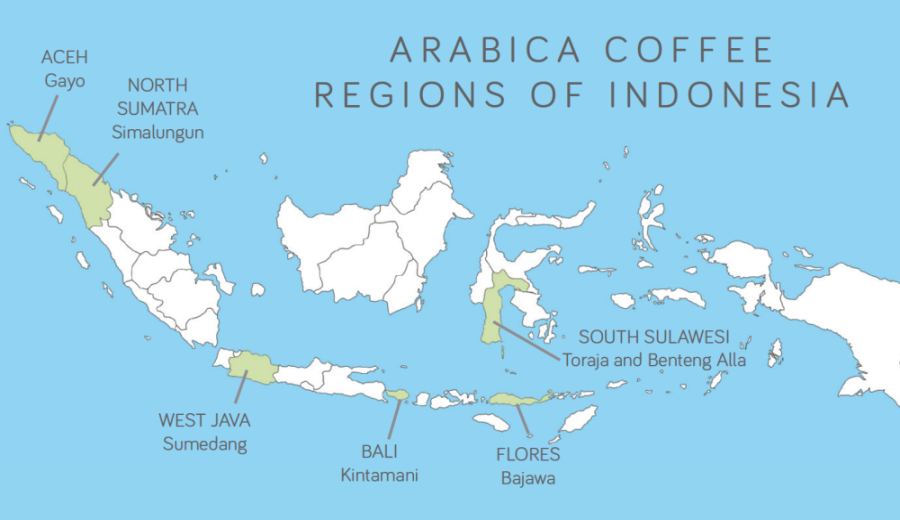
Introduction:As a globally renowned coffee origin, Indonesia is famed for its low-acid, richly flavored coffees with notes of caramel and chocolate. From Sumatra’s Mandheling, the mysterious Kopi Luwak, to Java’s refined fruity beans, each variety has its own unique character. This article delves into the geographic features, main varieties, and special processing methods of Indonesia’s three major coffee regions, along with detailed flavor profiles and practical pour over parameters to help you find the Indonesian coffee that best suits your taste.
Indonesian coffee holds an irreplaceable position in the global market. Its rich, full-bodied flavor, low acidity, and caramel and dark chocolate finish captivate many coffee enthusiasts. From the introduction of Arabica varieties by the Dutch in the 17th century, to the later shift to disease-resistant Robusta due to leaf rust, and now to the distinctive characteristics of the three major regions—Sumatra, Java, and Sulawesi—Indonesia’s coffee evolution is full of stories.
Indonesia is renowned for its wet hulling process. This unique technique involves removing the parchment layer from the coffee beans before they are fully dried, allowing the green beans to be more directly exposed to air, accelerating the subsequent drying process and shaping its low acidity, high body, and distinctive “earthy and spicy” profile. This process has a profound impact on the final flavor and is also a key factor that distinctly sets Indonesian coffee apart from other regions.
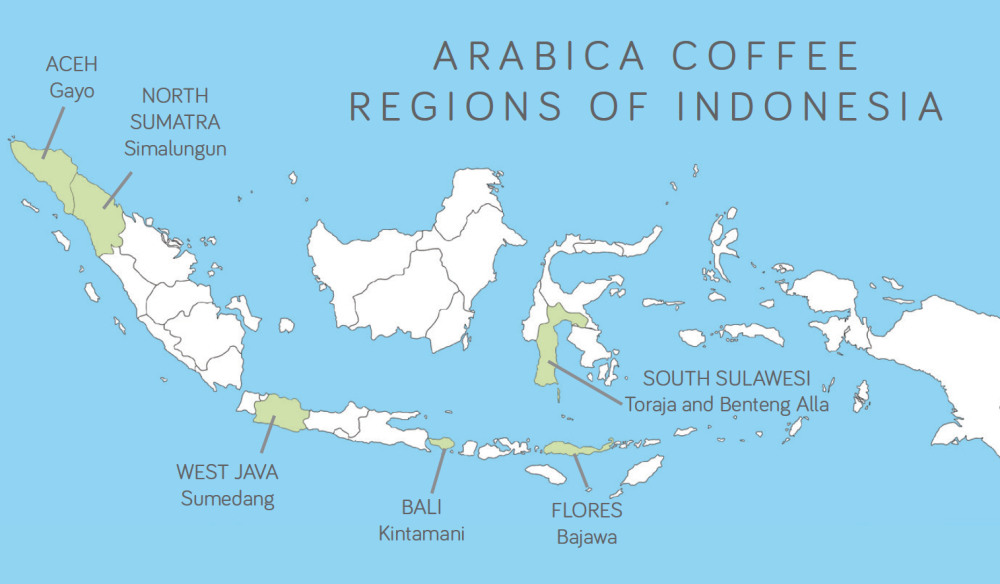
Indonesia’s coffee-growing environment is exceptionally favorable, characterized by a tropical rainforest climate with year-round high temperatures and humidity, annual rainfall of about 1600 to 2200 millimeters, and many areas located in volcanic zones with mineral-rich soil. Coffee is mainly grown at altitudes between 900 and 2100 meters, with the 1200-meter range being most suitable for Arabica. The country has two main harvest seasons each year: the primary season from September to October and the secondary season from May to June. In recent years, export volumes have also fluctuated noticeably due to climate and market factors.
Indonesian coffee can be divided into three main categories by variety: Arabica, Robusta, and Liberica, including over 20 sub-varieties such as Catimor, Timor, Typica, and Heirloom. Currently, the country’s total coffee plantation area exceeds one million hectares, with over 95% produced by smallholder farmers, primarily located in East Java and Central Java. Many farms have obtained organic certification, reflecting a trend toward sustainable cultivation.
When it comes to Indonesia’s most representative processing method, none surpasses “wet hulling” (Giling Basah). In this technique, after removing the outer skin of the coffee cherry, the beans are hulled at around 30% moisture content, exposing the green beans to air before undergoing a second drying phase. This significantly reduces acidity while enhancing body and complex earthy, spicy, and smoky notes, making it the driving force behind classic profiles like Sumatra Mandheling.
Sumatra Mandheling is one of Indonesia’s flagship coffees, produced around Lake Toba, with Aceh Province’s Gayo region being particularly renowned. Common types include Lintong Mandheling, Golden Mandheling, and Aged Mandheling. Lintong Mandheling exhibits typical herbal and earthy tones; Golden Mandheling is rigorously sorted for uniform bean size, offering a clean, full-bodied taste with pronounced sweetness; Aged Mandheling, through a special maturation process, develops a deeper, more intense flavor profile, suiting those who prefer bold tastes.
Taking Golden Mandheling as an example, its flavor profile often includes nuts, chocolate, spices, caramel, and herbs, with low but bright acidity and a long, sugar-free dark chocolate-like aftertaste. For pour over, it is recommended to use a Kono filter, with water temperature around 86°C, a 1:15 coffee-to-water ratio, and a grind size of about 11 on the EK43s grinder (medium-coarse). Begin with a 30-second bloom using 30 grams of water, then proceed with step brewing up to 225 grams, keeping the total extraction time around 2 minutes to fully highlight its body and sweetness.
Another notable item is “Kopi Luwak,” which is actually coffee beans excreted by civets after fermenting in their digestive tracts. During this process, special digestive enzymes break down proteins into short-chain peptides and amino acids, giving the coffee unique herbal, nutty, and fermented aromas with very high body. It should be noted that since most civets inhabit mid-to-low altitudes, Kopi Luwak is mostly Robusta, and there are also animal welfare controversies in the market.
The flavor description of Kopi Luwak commonly includes herbal, nutty, dark chocolate, and fermented layers. It is recommended to use a Kono filter, with water at 86°C, a 1:15 coffee-to-water ratio, and a medium grind (EK43s 11), using the same 30-second bloom with 30 grams of water, then brewing up to 225 grams, with a total time of about 2 minutes to balance its intensity and detail.
Java coffee showcases a distinctly different style, produced on Indonesia’s second-largest island, which has a hot, humid climate with fertile, volcanic-rich soil. Compared to Sumatra, Java coffee has slightly higher acidity, more pronounced fruitiness, and a delicate, balanced taste. The main producing areas are concentrated above 1400 meters in West Java, with both state-owned and private estates in production, some even exported to European and American markets.
Taking West Java coffee as an example, its flavor profile often carries fruity notes such as mango, red wine, and peach juice, blended with unique characteristics of plum and jackfruit, and a clean, sweet finish. It is recommended to use a V60 filter, with water temperature at 90°C, a 1:15 coffee-to-water ratio, and a medium-fine grind (EK43s 10). After a 30-second bloom with 30 grams of water, proceed with step brewing up to 225 grams, with a total extraction time of 2 minutes, helping to accentuate its fruitiness and layered complexity.
The above content is compiled by CoffeeHunters, a coffee news website.


