







Introduction:Delve into the unique charm of Kenya AA-grade coffee—from its geographical environment, varietal characteristics, to the K72 washed processing method—and explore this specialty coffee bean renowned for its bright acidity and rich fruitiness. This article breaks down the grading standards, regional differences, and actual flavor profiles in detail, providing tasting and purchasing references for pour over enthusiasts and coffee professionals alike.
As the most representative specialty coffee-producing country in East Africa, Kenya boasts unparalleled geographical conditions—situated on the equator with high-altitude volcanic soils—that nurture coffee beans with distinct fruity acidity and complex aromas. Kenyan coffee not only enjoys international acclaim but also stands as a flavor benchmark for many coffee lovers, thanks to its rigorous grading system and unique K72 washed processing method.
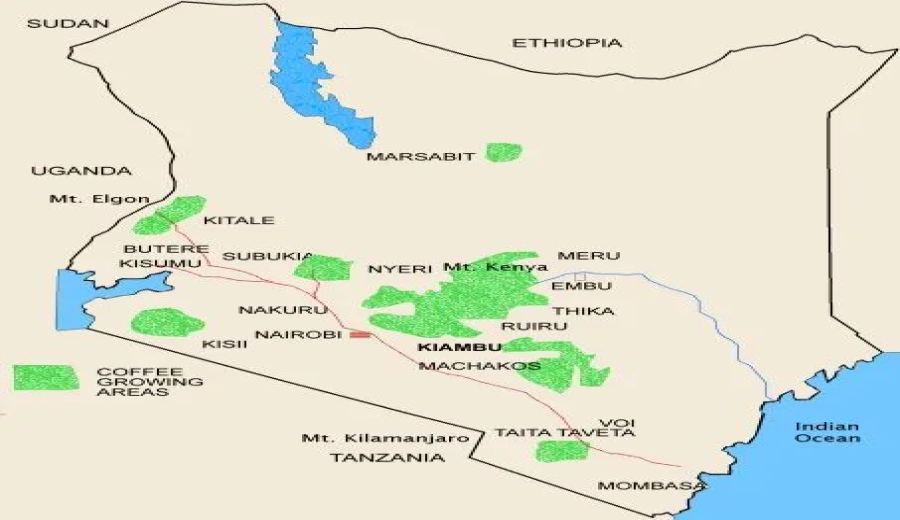
Located in East Africa, Kenya is traversed by the equator in its central region, with a terrain dominated by plateaus and an average elevation of about 1,500 meters. It is home to Mount Kenya, the second-highest peak in Africa at 5,199 meters above sea level. This high-altitude environment slows the growth of coffee cherries, aiding the accumulation of aromatic compounds and creating the bright acidity and full-bodied taste characteristic of Kenyan coffee. Approximately 80% of the country’s coffee is grown in volcanic regions at elevations of 1,600 to 2,100 meters, particularly concentrated around Nairobi and the areas near Mount Kenya.
The structure of Kenya’s coffee industry is primarily cooperative-based, with about 75% of the coffee coming from 270 cooperative organizations composed of over 700,000 smallholder farmers. These cooperatives ensure stable quality through collective processing and sales. The remaining 25% comes from around 3,300 private farms, covering a total area of about 40,000 hectares. Coffee is Kenya’s second-largest export agricultural product after tea, and its auction system is one of the few globally that balances quality and farmer income transparently.
Kenya’s coffee auction system began in 1934 and is managed uniformly by the Kenya Coffee Board for grading and sales. Traditionally, 85% of the coffee is traded through public auctions at the Nairobi Coffee Exchange via an agent bidding system; since 2006, an additional 32 independent marketing agents have been allowed to directly engage with international buyers, forming a dual-track trading system. In addition, about 15% of the coffee is traded through the so-called “second window” direct trade model, where producers negotiate prices directly with roasters or importers. This approach is common in cases where specific flavors are sought or long-term partnerships are established.
In terms of varieties, Kenyan coffee mainly consists of SL28, SL34, French Mission Bourbon, and Ruiru 11. Among these, SL28 and SL34 were cultivated by Scott Labs under the commission of the Kenyan government in the 1930s. The former features bright citrus notes and black plum aromas, with copper-colored oval-shaped beans; the latter has a richer, heavier flavor, more layered acidity, and strong adaptability. French Mission Bourbon retains the elegant traits of the original Bourbon variety, while Ruiru 11, though a high-yield hybrid variety, is generally not categorized as specialty coffee.
Kenya’s coffee grading system is rigorous, primarily based on bean size, density, and defect rate. The top-tier AA grade (17–18 mesh) and AA+ grade represent the largest and highest-quality beans, while AB grade (15–16 mesh) is the mainstream in the market. Special grades such as PB (peaberry), due to their higher density, often exhibit intense flavors, whereas E grade (elephant ear beans) and T grade, due to smaller size or weight, are typically not considered specialty grade. Flavor ratings are divided into TOP, PLUS, and FAQ, with FAQ allowing minor defects without compromising overall quality.
Processing is key to the flavor of Kenyan coffee. Its iconic K72 washed processing method involves three 24-hour fermentation cycles (totaling 72 hours), along with multiple rinses with clean water, thoroughly removing the mucilage while enhancing the balance of sweetness and acidity. The specific process includes: water-density sorting → pulping and 24-hour fermentation → first rinse → second fermentation (24–48 hours) → final rinse and drying on raised beds (approximately 5–10 days). This intricate process imparts bright lemon acidity, a wine-like body, and deep layers of fruity aroma.
Kenya’s seven major producing regions each have distinct characteristics, with Nyeri and Kirinyaga regarded as the core areas for specialty coffee. Nyeri, located at the foot of Mount Kenya, produces coffee with vibrant acidity and berry and citrus notes, thanks to its red soil. Kirinyaga is known for its solid body and rich layers, often featuring honey, caramel, and tropical fruit flavors. Other regions, such as Muranga and Embu, also showcase unique aromatic profiles due to microclimatic variations, ranging from green apple and grapefruit to chocolate and nutty notes.
In actual tasting cases, for example, the AA-grade coffee from the Karogoto Factory in the Nyeri region exhibits a refreshing cherry tomato acidity and berry tones, with a caramel and tea-like aftertaste; the Haria Estate French Mission Bourbon natural beans from Thika showcase intense dried fruit aromas and honey sweetness. As for the TOP AA-grade coffee from the Asali Honey Factory, processed through a 72-hour washed method, it presents a rare combination of black plum, strawberry, and green tea flavors, with a medium body but outstanding sweetness—a refined representation of classic Kenyan flavor.
The above content is compiled by CoffeeHunters, a coffee news website.


