







Introduction:The flavor expression of pour over coffee largely depends on whether the extraction is properly executed. Under-extraction or over-extraction can both cause the coffee to lose its intended balance. This article delves into the flavor differences between these two types of extraction imbalance, helps you master the Golden Cup extraction standard, and provides specific, actionable adjustment suggestions for common issues such as pouring technique, grind size, and filter choice—assisting you in consistently brewing richly layered, high-quality coffee.
In the world of pour over coffee, extraction is not only the technical core but also the key factor that determines the success or failure of a cup. However, many coffee enthusiasts often struggle with under-extraction or over-extraction, leading to imbalanced flavors and making it difficult to showcase the complex layers inherent in the coffee. To resolve these issues, one must first understand the essence of extraction and how to adjust parameters to achieve the ideal balance in every cup.
Extraction, simply put, is the process of using hot water to penetrate the coffee grounds and extract the water-soluble flavor compounds within. During this process, variables such as water temperature, grind size, pouring method, and time all influence the final outcome. Generally, we can categorize extraction results into three types: under-extraction, Golden Cup extraction, and over-extraction. Among these, Golden Cup extraction is considered the ideal range, with a concentration between 1.2–1.4 TDS and an extraction yield between 18%–22%. Results below this range are classified as under-extracted, while those above are considered over-extracted.

Under-extraction typically means that the water flow fails to fully carry out the soluble substances from the coffee grounds, leaving a large amount of undissolved components in the grounds. Such coffee often tastes sharp and acidic, lacks sweetness, and may even carry a slight salty note. The overall body (mouthfeel thickness) is thin, and the aftertaste is short-lived and dissipates quickly. The reason lies in the fact that during extraction, small molecules like acids and salts are released first, followed by sweet compounds, and finally bitter substances. If the overall extraction volume is insufficient, the acidic components are not balanced by sweetness and bitterness, resulting in a prominent and unharmonious taste.
Conversely, over-extraction involves extracting too many soluble substances from the coffee grounds, especially those large-molecule bitter and astringent compounds. Although around 30% of the substances in coffee beans are soluble, only about 20% are ideally suitable for extraction. Once this proportion is exceeded, the coffee is prone to tasting burnt, bitter, off-flavored, and astringent, disrupting the harmony of the overall flavor.It’s especially important to note that the darker the roast of the coffee beans, the more caramelization reaction products are present, making it easier to extract bitterness during brewing. Therefore, those who prefer a cleaner taste may want to prioritize medium to light roast bean varieties.
So, how should one adjust when facing these extraction issues? Below, we’ll go through several common variables and explain feasible optimization strategies one by one.
First is brewing time that is too long. Different substances in coffee are released at varying speeds under the effect of water temperature, with large-molecule bitter and astringent substances usually being released gradually in the later stages. Therefore, if the brewing time exceeds a reasonable range, it can easily lead to intensified bitterness and astringency. Generally, it is recommended that the total brewing time for a single serving using 15–16 grams of coffee grounds be kept within 2 minutes and 30 seconds. If the actual brewing time exceeds this and you taste noticeable bitterness or astringency, it’s necessary to review and adjust the relevant parameters.
For example, if after brewing there is a large amount of wet, sticky, muddy fine grounds remaining on the surface of the coffee bed, this usually indicates that there are too many fine particles causing water retention, which in turn prolongs the extraction time. In this case, it’s advisable to adjust the grind size to a coarser setting to reduce the proportion of fine particles.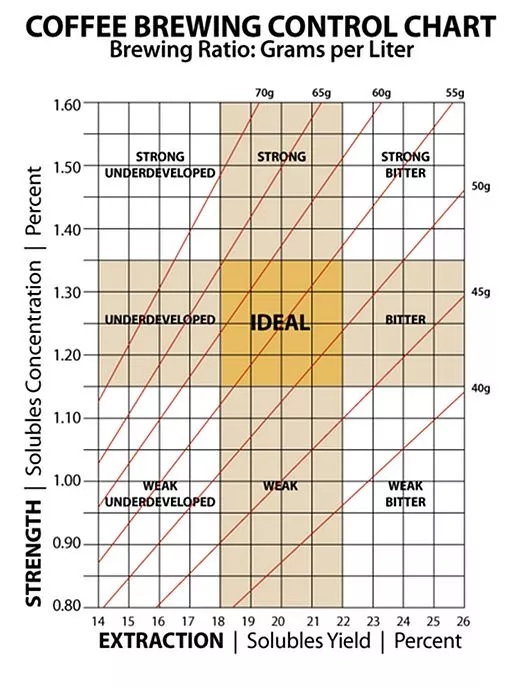
Next is the pouring method and water stream control. An unstable water flow can easily lead to uneven extraction, where some areas may be over-extracted while others are under-extracted, resulting in coffee that tastes either sour and astringent or offensively murky. Additionally, brewers who habitually use a strong water flow to aggressively agitate the coffee bed may also release excessive impurities and bitter substances in the later stages. To avoid this, it’s recommended to usea vertical water stream, maintaining a distance of about 3–4 centimeters from the coffee bed, and pour in a steady circular motion to ensure each stream of water uniformly penetrates the coffee grounds.
Lastly, the material of the filter cup is also an important factor affecting extraction efficiency, though it is often overlooked by beginners. For instance, ceramic filter cups have a higher specific heat capacity. While preheating them sufficiently can help maintain stable water temperature, it may also unknowingly increase extraction efficiency—especially in the later stages, where it can easily extract more astringent substances. If you’re using a ceramic filter cup and, after ruling out other variables, still find the coffee tasting overly astringent, try lowering the brewing water temperature by 2–3°C. This can help reduce the risk of over-extraction and result in a cleaner, more balanced flavor.
In summary, whether it’s under-extraction or over-extraction, there is a logical framework behind each that can be analyzed and adjusted. By mastering the standard range of Golden Cup extraction, observing flavor performance, and gradually fine-tuning parameters such as grind size, pouring method, water temperature, and filter choice, you will be able to confidently handle various variables during the pour over process and consistently produce a cup of coffee with distinct layers and balanced mouthfeel.

The above content is compiled by CoffeeHunters, a coffee news website.


