







Introduction:Why are Arabica coffee beans so expensive? This article delves into their botanical background, variety characteristics, and cultivation challenges, while also detailing the planting varieties, processing methods, and grading standards of major producing regions such as Brazil, Colombia, and Panama. Through real-world regional examples and flavor profiles, it helps readers grasp the key points for selecting specialty Arabica beans and understand their value logic.
From a botanical classification perspective, coffee belongs to the Rubiaceae family, genus Coffea, with approximately eighty confirmed species. Among them, the main cultivated species used for drinking are Arabica, Robusta, and Liberica. Arabica is often used for single-origin or specialty coffee due to its elegant flavor and suitability for high-altitude environments, whereas Robusta is more commonly used for instant coffee. However, this classification is not absolute, and consumers can choose based on personal taste preferences.
Arabica originated in Ethiopia and is now widely cultivated in South Africa, Africa, and Asia, accounting for about 70% to 75% of global coffee production. This variety has relatively weak resistance to pests and diseases, so it thrives best at high altitudes (typically above 1500 meters), which helps produce high-quality beans with rich flavor complexity. Its green beans have a dark, narrow, and elongated appearance, and are known for their sweetness, acidity, and aroma. Examples include Hawaiian Kona, Jamaican Blue Mountain, and Yemen Mocha, all of which belong to the Arabica variety.
Within Arabica, the Typica variety boasts excellent acidity and high cupping scores, while the Geisha variety is widely praised for its fresh floral notes and pleasant acidity. However, Arabica also has its drawbacks. In addition to its weaker disease resistance, there are many mutant or hybrid sub-varieties, such as Bourbon and Geisha, which are quite common in well-known coffee shops and offer over 50 different regional options to meet diverse flavor needs.
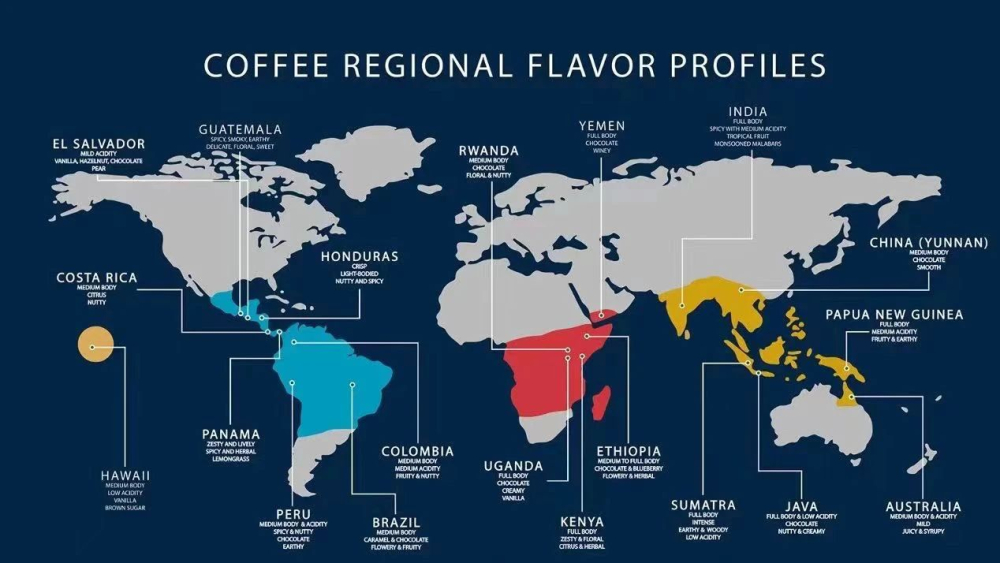
With the rise of specialty coffee, consumers are paying more attention to the cultivation and processing methods of the origin. Below is an introduction to the current status of several well-known producing regions:
As the world’s largest coffee producer, Brazil’s main producing regions are concentrated in Minas Gerais, São Paulo, and Paraná. In recent years, frost damage in the south has led to a gradual northward shift of plantations. Large estates have introduced irrigation and mechanization, and are planting disease-resistant varieties such as Catuaí. Brazilian coffee typically has low acidity, with grassy notes and a mild bitterness, and a smooth mouthfeel. The Queen’s Estate Bourbon beans, recommended by some, feature flavors dominated by nuts and chocolate, paired with medium caramel sweetness, offering overall balance.
Planted varieties include Bourbon, Mundo Novo, Catuaí, and Catuaí; processing is mainly sun-dried, with some honey processing; grading is based on bean size and defect count, with the highest grade being 'No.2', requiring fewer than 11 defective beans in a 300-gram sample, with bean size S17 (6.75mm) to S18 (7mm).
Colombia is the world’s third-largest coffee producer, with producing regions located in small farms at altitudes of 1000 to 2000 meters in the Andes foothills. The country has two harvest seasons per year, and coffee is primarily processed using the washed method, with flavors featuring citrus notes, nuts, and dark cocoa, and refined acidity. It is a specialty coffee-producing country with distinct American characteristics.
Mainly planted with Caturra, Castilla, and Colombian Typica; processing is primarily washed, with harvests occurring from October to January and April to June; grading is based on bean size, with S17 and above classified as 'Supremo', and S14 to S16 as 'Excelso'.
Panama is famous for its Geisha variety, with the Gesha variety from Hacienda Esmeralda being the most representative. Most producing regions consist of small farms, cultivating Caturra, Catuaí, and a small amount of unimproved Typica. The harvest season runs from September to March, with processing mainly washed, supplemented by sun-drying or machine drying. Grading is based on altitude, categorized as 'Strictly Hard Bean' (SHB) and 'Hard Bean' (HB).
Guatemala is known for its volcanic soil, with the Antigua producing region surrounded by three volcanoes and nutrient-rich soil. The recommended Fuego coffee beans, processed by a local washed mill commissioned by La Minita, feature floral and tea-like flavors, with bright citrus acidity and berry notes on the palate, and a honey-like finish. The coffee is outstanding in cleanliness and layering.
Planted varieties include Bourbon, Caturra, and Catuaí; processing is mainly washed, with a harvest season from September to April; grading is based on altitude, with over 1300 meters classified as 'Strictly Hard Bean' (SHB), 1200 to 1300 meters as 'Hard Bean' (HB), and 900 to 1050 meters as 'Extra Prime Washed' (EPW).
Costa Rica is one of the few countries in the world that prohibits the cultivation of Robusta, placing great emphasis on coffee quality and being renowned for its honey processing method. It combines the cleanliness of washed processing with the sweetness of sun-drying, with a flavor profile based on nuts, accompanied by refreshing acidity and sugary sweetness.
Mainly planted with Caturra and Catuaí; processing is primarily honey-processed, with a harvest season from November to March; grading is based on altitude, categorized as 'Strictly Hard Bean' (SHB), 'Good Hard Bean' (GHB), and 'Hard Bean' (HB).
Jamaican Blue Mountain coffee is known for its balanced flavor, produced in the Blue Mountains, with the main harvest in October, primarily using washed Typica. Its flavor features citrus acidity, with a middle note of nuts and dark cocoa, and a long-lasting, rich aftertaste. Although sun-dried and Geisha varieties are also available now, washed Typica remains the representative.
Primarily planted with Typica; processing is mainly washed; grading is based on bean size and defect count, divided into 'No.1', 'No.2', 'No.3', or based on altitude and bean size.
Ethiopia is the birthplace of coffee, with a wide variety of species, mostly referred to as 'heirloom'. The washed coffee beans from Yirgacheffe are the most representative, featuring citrus and lemon acidity, along with gentle floral notes and a tea-like aftertaste. In the past, sun-dried processing often had defect flavors, but the quality improved significantly after washed processing gained popularity.
Mainly planted with Typica and various heirloom varieties; processing is mainly washed, with some still using sun-dried methods; grading is based on defect count, divided into Grade 1 to Grade 8, with only Grade 1 to Grade 5 eligible for export.
Kenya is known for its berry tones and high acidity, with the main varieties being SL28 and SL34, cultivated by the Nairobi Coffee Research Institute. The washed processing technique is mature, and the flavors are suitable for making iced coffee. Grading is based on bean size, with S18 and above classified as 'AA', S15 to S17 as 'AB', and peaberries as 'PB'.
Indonesia, composed of numerous islands, has Sumatra as its main producing region. The Arabica variety is famous for Mandheling, processed using the Sumatra semi-washed method, with flavors featuring herbal and spicy notes. Golden Mandheling, selected multiple times by hand, has few defects and a smooth, clean taste. Planted varieties include Catimor, Typica, and Robusta; processing is mainly sun-dried, with some washed; grading is based on bean size and defect count, divided into 'Large' and 'Small', and further categorized into Grade 1 to Grade 5 based on defect count.
The above content is compiled by CoffeeHunters, a coffee news website.


