







Introduction:Want to dive deeper into the charm of Kenyan coffee? This article focuses on the Thika region, taking you from geographical conditions, regional distribution, historical background, to washed processing techniques and the official grading system, to explain in simple terms the source of the refined flavors of this major East African coffee-producing country. Additionally, it compiles practical brewing parameters and flavor profiles so that whether you’re a beginner or a seasoned enthusiast, you can gain useful insights.
Kenyan coffee is renowned for its bright acidity, full body, and clean finish, making it a classic among global specialty coffee lovers. Especially in the Kiambu region, home to Thika, the coffee stands out with its pronounced fruity notes and excellent body, attracting the favor of many coffee enthusiasts. This article will detail Kenya’s coffee growing conditions, major regions, historical development, grading system, and key technologies of the washed process, giving you a comprehensive understanding of this promising origin.
Located in East Africa, Kenya is bisected by the equator and traversed north to south by the East African Rift Valley. The terrain is predominantly highland, with an average elevation of about 1,500 meters. Its highest peak, Mount Kenya (formerly known as Mount Kirinyaga), reaches 5,199 meters above sea level and is covered with snow year-round. This high-altitude environment is key to producing high-quality coffee: the slow ripening of coffee cherries helps accumulate flavor compounds, and the large diurnal temperature variation results in hard beans with bright acidity, often featuring fruity and floral notes.
Although Kenya’s coffee-growing history is not as long as that of neighboring Ethiopia, its development has been rapid and systematic. In 1893, missionaries introduced Bourbon variety coffee beans from Brazil, marking the beginning of Kenyan coffee cultivation. Starting in 1895, British colonial rule classified the region as part of the “East Africa Protectorate” and gradually took control of coffee production and trade. Between 1900 and 1933, the Coffee Board was established to regulate the industry, and the first coffee auction in 1935 laid the foundation for the market trading model still used in Kenya today. The Coffee Marketing Board (CMB), founded in 1946, further improved the production and sales system until its dissolution in 1971.
Kenya currently has ten major coffee-growing regions: Nyeri, Murang’a, Kirinyaga, Embu, Meru, Kiambu, Machakos, Nakuru, Kisii, and Thika. Each region has its unique geography and microclimates, which influence the final flavor profile of the coffee.
Take Nyeri as an example. Located in central Kenya and adjacent to Mount Kenya, Africa’s second-highest peak, the region boasts fertile volcanic soil and an elevation ranging between 1,200 and 2,300 meters, making it an important producer of specialty coffee. Production is mainly managed by smallholder cooperatives, with meticulous farming practices ensuring stable coffee quality. Murang’a was one of the earliest areas where missionaries settled, with a large population and over 100,000 smallholders farming at elevations of 1,350 to 1,940 meters. The soil is also fertile, yielding coffee with clear flavor profiles. Regions such as Kirinyaga, Embu, and Meru are also dominated by smallholders, each situated in the highlands at elevations between 1,300 and 1,950 meters, all with good flavor potential.
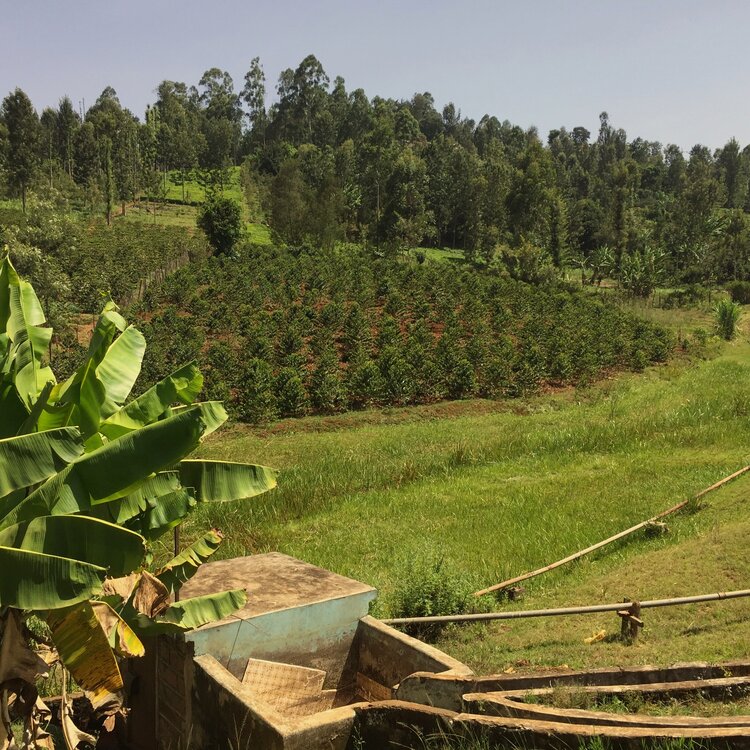
The Kiambu region, where Thika is located, is slightly different. It was once known for its large estates, but with urban development, the number of estates has gradually decreased. Currently, most coffee comes from smallholders and sub-regions such as Thika, Ruiru, and Limuru, at elevations ranging from 1,500 to 2,200 meters, forming an important coffee belt in the suburbs of the city.
Other regions such as Machakos, Nakuru, and Kisii also have their own characteristics. Machakos ranges from 1,400 to 1,850 meters in elevation, with both estate and smallholder production; Nakuru has relatively high-altitude growing conditions in the central region, though some areas are affected by coffee berry disease impacting plant growth; Kisii is near Lake Victoria, at elevations of 1,450 to 1,800 meters, mostly produced by small cooperatives with stable quality but limited output.
Kenya’s coffee grading system is renowned for its rigor and scientific approach. An comprehensive grading standard was established during the colonial period and remains a benchmark in the industry. Grading is mainly based on bean size, shape, and density, with common grades including:
Grade E(Elephant beans, over 18/64 inch, including peaberries, rare)
Grade AA(17–18/64 inch, usually the top grade, large and uniform beans)
Grade AB(15–16/64 inch, a mix of Grade A and B beans, with Grade A being over 17/64 inch and Grade B over 16/64 inch)
Grade TT(Light beans resulting from air classification of Grade AA and AB)
Grade PB(Peaberry, over 15/64 inch, about 10% of total production, with intense flavors)
Grade Cand Grade T(Smaller beans or those with more defects)
Grade HE(Beans that do not meet the above grades)
Those that do not meet the standards are classified as UG (Ungraded), where UG1 includes Grades E, AA, AB, and PB; UG2 includes Grades C, TT, T, and HE. Additionally, natural (sun-dried) beans are graded as MBUNI, further divided into MH (Heavy Mbuni, no obvious defects) and ML (Light Mbuni, with slight defects).
In addition to the official grading, some exporters further classify Grade AA and AB beans into categories such as TOP, PLUS (+), and FAQ, offering consumers more selection criteria.
The unique flavors of Kenyan coffee are inseparable from its special washed processing method. Compared to other origins that typically ferment for no more than 36 hours, Kenya employs a fermentation process lasting up to 72 hours. After fermenting for 30 to 48 hours, the parchment beans are first removed and most of the mucilage is washed off, followed by 24 hours of soaking in clean water. This extra step more thoroughly removes residual impurities and also plays a key role in flavor clarity and bright acidity, making it a crucial factor in shaping Kenya coffee’s “clean and bright” style.
If you want to experience the classic washed flavors of the Thika region, try K72 washed beans made from the SL28 and SL34 varieties. These coffees often feature layered flavors of black plum, cherry tomato, Asian pear, brown sugar, and plum, with vibrant acidity and a sweet yet full-bodied finish.
Recommended brewing parameters are as follows: use a Hario V60 filter, 15 grams of coffee, a 1:15 coffee-to-water ratio, water temperature controlled at 90°C, and grind size approximately EK43s#10 (80% through a 20-mesh sieve). First, pour 30 grams of water for a 30-second bloom; second, pour up to 125 grams for the first pour; when the water level drops just about to expose the coffee bed, proceed with the third pour up to 225 grams, then wait for the dripping to finish. The total extraction time is around 2 minutes, which fully showcases the delicate and layered characteristics of Kenyan coffee.
The above content is compiled by CoffeeHunters, a coffee news website.


