







Introduction:The Hua Kui series of coffee beans has sparked a wave in the global specialty coffee market with its intense fruity aroma and unique processing method. What’s the story behind the name "Hua Kui"? How have the bean appearance and flavor evolved in version 6.0? This article delves into the origin of Hua Kui, the meticulous natural processing technique at Buku Abel washing station, and analyzes the cupping characteristics and brewing recommendations of the latest harvest to give you a comprehensive understanding of this highly acclaimed specialty coffee bean.
The Hua Kui series launched by Luckin Coffee quickly became a bestseller upon its release, often selling out within a single day—testament to its popularity. This Ethiopian specialty coffee, with its unique berry profile and rich body, has become a top choice for many coffee enthusiasts eager to explore new flavors. But do you know the origin of the Hua Kui name? And why is the price of the smaller-sized Hua Kui always so high? This article will uncover the mysteries of Hua Kui coffee beans, from the origin of the growing region and processing techniques to the actual performance of the latest 6.0 version.
Initially popularized by Luckin Coffee, Hua Kui was in such high demand at launch that it even sparked discussions about raw material monopolies in the market. In fact, although the total import volume of Hua Kui to China in 2021 was only about 30 to 40 tons, Luckin announced in 2022 that it would directly source over 80 tons from the origin—highlighting its commitment to this coffee variety. However, the overall annual production of Hua Kui coffee actually exceeds 1,000 tons, with only about 8% entering the Chinese market. Luckin chose to present this bean with a dark roast, which stabilized its flavor but also reduced its originally rich berry acidity and juicy character, drawing some regret from industry insiders. Nevertheless, there’s no denying that Luckin’s promotion strategy has indeed introduced more consumers to the charm of single-origin coffee.
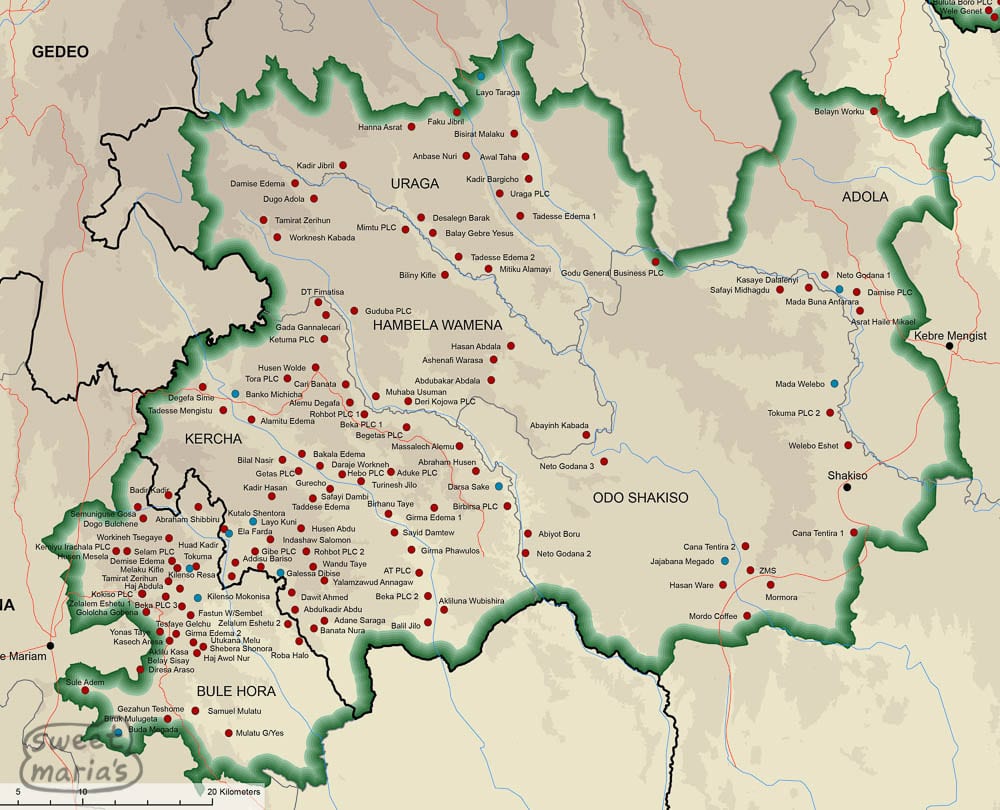
The homeland of Hua Kui coffee beans is the Hambella region in Ethiopia, part of the larger Guji zone in the Oromia state. This area is not only one of the highest-altitude coffee sub-regions in Ethiopia but is also just separated from other well-known regions like Yirgacheffe by a highland plateau at an altitude of 3,200 meters. Hambella features rugged terrain, surrounded by mountains, and enjoys unique climatic conditions that provide an ideal environment for coffee trees. There are currently over twenty coffee washing stations in the region, among which DW Company owns four, including Buku Abel, with an annual production of over 1,000 tons. It’s worth noting that only the natural-processed beans produced by Buku Abel washing station qualify to be called "Hua Kui coffee beans."
Buku Abel is a small village nestled among mountains, where the surrounding hills are home to many naturally selected heirloom coffee trees. Though these trees vary in appearance, they are vigorous and produce coffee cherries with intense flavors. The washing station’s coffee farms sit at altitudes between 2,250 and 2,350 meters, covering a total area of about 80 hectares—all owned by DW Company’s high-altitude farms. During each harvest season, farmers carefully select ripe red cherries with a sugar content of 30 or higher and employ a rigorous natural processing method.
During processing, the first two days require maintaining appropriate humidity in the red cherries to promote fermentation, while the large diurnal temperature variation in the high-altitude area—with nighttime lows dropping to as low as 12°C—helps control the fermentation process and avoid off-flavors. During the day, excessive sun exposure is avoided, with workers providing shade when necessary, and plastic sheeting is used immediately if rain occurs at night to protect the cherries. The entire natural drying process lasts up to 18 days, gradually reducing the moisture content of the green beans to 13%. They are then rested in an environment with temperatures controlled between 12–22°C and humidity maintained at 45–55% for 50 days until the moisture stabilizes at around 11%, after which hulling and screening take place. Such a meticulous process forms the exceptional quality foundation of Hua Kui coffee beans.
To trace the origin of the name "Hua Kui," we must go back to 2017. That year, DW Company sent the natural-processed beans from Buku Abel washing station to Ethiopia’s TOH (Taste of Harvest) competition, where they won the local natural category championship and the African regional runner-up thanks to their intense strawberry cream flavor. These beans were later introduced to China, where Hongshun Green Coffee, a Beijing-based green bean importer, was deeply impressed by their flavor potential and bestowed upon them the name "Hua Kui"—meaning the “foremost flower”—kicking off their legendary journey on the international specialty coffee stage. Notably, in the same year, during the China leg of the World Brewers Cup, contestant Li Jianfei, who used the same batch of Hua Kui beans, took second place, further solidifying its market presence.
In the following years, the Hua Kui series was released annually in the format of "Hua Kui X.0", such as Hua Kui 2.0 in 2018, Hua Kui 5.0 in 2021, and Hua Kui 6.0 was expected in 2022. However, the Hua Kui 6.0 that arrived in China between June and July 2022 showed noticeable changes in bean appearance. According to Hongshun, the lower rainfall during the rainy season in that harvest year led to insufficient moisture in the coffee cherries, resulting in smaller beans and a high flat bean ratio. After roasting, many beans exhibited cracking and breakage, with a relatively high defect rate—even after manual sorting, a significant proportion of defective beans remained.
Cupping tests on this batch of Hua Kui 6.0 revealed aromas of berries, honey, and passion fruit, with decent sweetness, but due to the 30% defect rate, the supplier ultimately decided not to officially release it. Subsequently, they sourced another batch of 2022 Hua Kui beans from the same Hambella region but produced by Buku Abel washing station. This new batch featured plump, uniformly sized beans and displayed bright citrusy cupping notes—such as orange blossom, citrus, honey, and grapefruit—along with pronounced juiciness and a rich layering of flavors.
Given that this batch of Hua Kui coffee beans emphasizes floral and fruity sweetness characteristics, it is recommended to use a light roast and pair it with a V60 filter to enhance its flavor profile. Specific brewing parameters are suggested as follows: use water at 91°C, 15 grams of coffee, a 1:15 coffee-to-water ratio, and a grind size passing 80% through a Chinese standard No. 20 sieve. For brewing, a three-stage pouring method is advised—start with a small circular “の”-shaped pour of 30 grams of water for a 30-second bloom, then slowly circle from the center to reach 125 grams for the first pour, and finally pour up to 225 grams just before the coffee bed is exposed. Total brew time should be controlled around 2 minutes to achieve optimal flavor complexity and balance.
The above content is compiled by CoffeeHunters, a coffee news website.


