







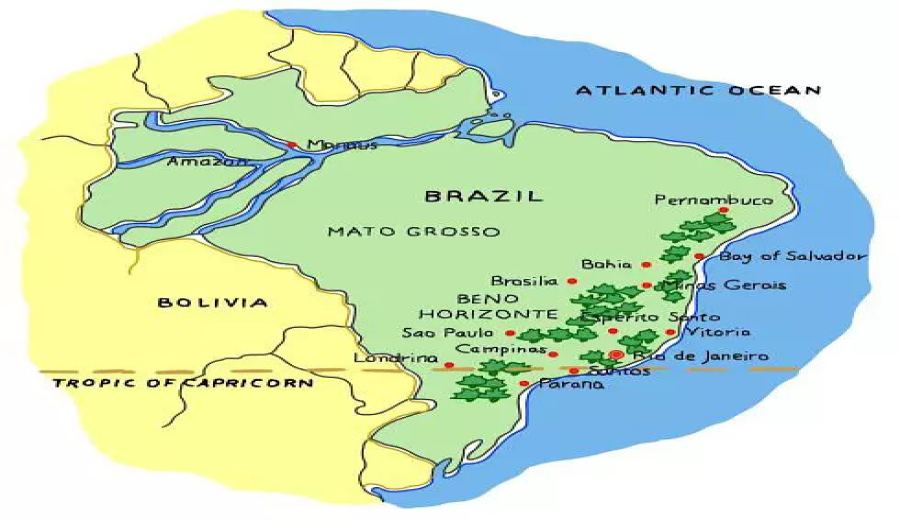
Introduction:Brazil is not only the world’s largest coffee-producing country but also the birthplace of the uniquely flavored Yellow Bourbon variety. This article delves into the historical roots, climate challenges, and varietal characteristics of Brazilian coffee, with a focused analysis on the aroma layers and sweetness profile of the Queen Estate Natural Yellow Bourbon. It also provides professional roasting curves and pour-over parameters to help you grasp the balanced charm of this classic bean.
As a country accounting for over one-third of global coffee production, Brazil has long been misunderstood as a supplier of only commercial-grade beans. In fact, this land also nurtures a Yellow Bourbon variant that can rival specialty-grade quality.Its nutty-chocolatey tonesandbright sweetnesshave become hallmark flavor profiles of Brazilian coffee.
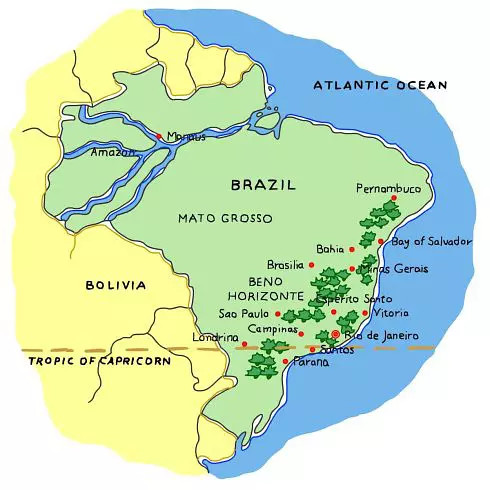
The origins of Brazilian coffee are steeped in a dramatic tale. In the 17th century, disputes among European colonizers over the division of Guyana led an officer stationed in Brazil to gain access to coffee seeds—strictly prohibited from being exported—by ingratiating himself with the governor’s wife. These seeds ultimately rewrote Brazil’s agricultural history.
In recent years, the COVID-19 pandemic has significantly impacted Brazil’s coffee industry. Due to the labor-intensive nature of the harvest season and the historically labor-dependent characteristics stemming from the legacy of slavery, the outbreak initially raised concerns about delayed harvests. Notably, under the threat of climate warming, research has confirmed that planting areas covered with50% shade treescan maintain75% of production capacity, making it a key strategy to mitigate rising temperatures.
Yellow Bourbon, a rare mutation of the Bourbon variety, retains its yellow fruit color even when ripe. Compared to the more common Red Bourbon, this variety performs exceptionally well at high altitudes: when processed via natural drying, it exhibitscitrusy aromatic notes,gentle acidity,and a rich profile ofhazelnut/tropical fruit layers,with a sweetness structure that clearly surpasses that of typical commercial varieties.The overall flavor profile of Brazilian coffee is shaped by altitude and microclimate constraints, resulting in a distinctive
low-acidity and roundedcharacter. Although some coffee drinkers perceive its acidity as mild, it is precisely thissolid nutty baseanddark chocolate finishthat form the highly recognizable balanced profile of Brazilian beans.Take the Queen Estate Natural Yellow Bourbon, for example—it is grown at
1400–1950 meters above sea levelin the Mogiana region, where the washed processing method enhances the natural sugar conversion of the fruit. This bean is best brewed using aKONO filter, with a recommended water temperature of, a87℃1:15 coffee-to-water ratio,and medium-coarse grind (70% extraction through a #20 mesh sieve).For professional roasting, a medium heat level is advised: when using the Yangjia 800N machine, set the bean inlet temperature to
, and once the first crack begins at200℃9 minutes 14 seconds / 188.9°C,continue development for1 minute 48 secondsuntilthe roast is complete. These parameters effectively highlight the bean’s197.5℃caramelization reactionwithout excessive carbonization.For pour-over brewing, adopt a pulsed extraction method: start with
30 grams of blooming waterand let it rest for 30 seconds, then pour in small circles to reach125 gramsfor the first pour. When the water level is about to expose the coffee bed, continue pouring to225 gramsto finish. Keep the total extraction time within2 minutes. This approach balances sweetness and body while avoiding over-extraction bitterness.The final flavor profile of this Yellow Bourbon includes:
a pronounced honey-like sweetness,a delicate lemon aroma,a rich nutty core,and a dark chocolate aftertaste.It showcases the classic traits of Brazilian beans while adding a unique tropical fruit vibrancy through natural processing—making it an ideal entry point for exploring South American specialty coffee.Rich nutty bodyanddark chocolate aftertaste,which not only showcases the classic characteristics of Brazilian beans but also adds a unique tropical fruit vibrancy through the natural processing method, making it an ideal entry point for exploring premium South American coffees.
The above content is compiled by CoffeeHunters, a coffee news website.


