







Introduction:As a hidden micro-region of Yirgacheffe, Misty Valley nurtures bright, fruit-forward specialty coffees through its high-altitude environment and traditional natural processing methods. This article takes you deep into the background of its cooperative, the evolution of its unique processing techniques, and explores the flavor differences between washed and natural profiles, while also offering practical pour over parameters to help you uncover the layered charm of this coffee.
When it comes to Yirgacheffe in Ethiopia, many people immediately think of its refreshing floral aromas and citrus acidity. This distinctive flavor profile led the region to break away from Sidamo in 1995 and become a holy grail for specialty coffee enthusiasts worldwide. Among its many micro-regions, Misty Valley (Misty Valley), with its elevation exceeding 2,000 meters, years of inherited natural processing traditions, and the artisan philosophy of the Aricha processing site, has created a recognizable fruity character. A certain well-known coffee merchant’s imported batch from Misty Valley is a classic representation of the area’s potential.
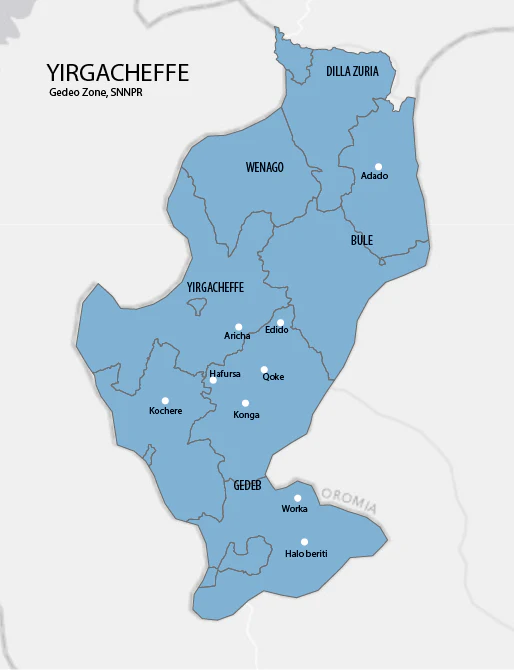
The official definition of Yirgacheffe encompasses administrative regions such as Wankanu, Yirgacheffe, Kochere, and Gedeb, and coffee beans produced within these areas can all be categorized under this name. As a high-quality micro-region adjacent to the town of Yirgacheffe, Misty Valley’s geographical location and microclimate provide ideal growing conditions for coffee trees.
Since the introduction of washed processing techniques in the late twentieth century, the defect rate of Yirgacheffe coffee has significantly decreased, boosting its international reputation. However, local coffee merchant Abdullash Bagersh has always been committed to the potential of traditional natural processing. Through systematic improvements to fermentation processes and drying management, he has successfully reduced defect rates while enhancing the balance between fruitiness and sweetness. His three natural lots—Idido Misty Valley, Beloya, and Aricha—have now become industry benchmarks.
The Misty Valley Coffee Cooperative holds both Fair Trade and Organic certifications, with planting elevations reaching up to 2,300 meters, approaching the physiological limits of the Arabica species. During the harvest season from October to January each year, 1,683 member farmers participate, approximately 8% of whom are women. On average, each farmer manages 1.25 hectares of terraced coffee farms, which are mostly scattered around their homes. These farms previously supplied mainly local markets, but have only recently entered the international market through the cooperative system.
The coffee-growing culture here is distinctly different from that of commercialized farms—many farmers treat coffee trees as garden crops, coexisting with vegetables and fruits in their living spaces. While this environment makes it difficult to collect beans on a large scale, it also fosters more natural ecological interactions. Traditionally, locals prefer the natural processing method, believing that the fermentation process bestowed by sunlight brings out deeper flavor layers, such as complex notes of blueberry, honey, and wine.
Misty Valley features distinct microclimatic characteristics, with relatively low average annual temperatures and significant day-night temperature variations, which help the coffee cherries ripen slowly and accumulate more sugars. The processing site Aricha (formerly Idido), operated by renowned exporter Abdullah Bagersh, often features “Bagersh” markings on its sacks, a symbol of quality. This processing site collaborates with premium brands such as Ninety Plus from the United States to release extremely limited production batches, while also maintaining stable washed and natural product lines—the former showcases lemon acidity and jasmine floral notes, while the latter excels with tropical fruit flavors and caramel finishes.
For pour over enthusiasts, it is recommended to use medium-light roasted Misty Valley natural beans, ground to a fineness similar to fine sugar (70–75% passing through a Chinese No. 20 sieve), with water temperature controlled at 90–92°C. During the brew, start by pouring 30% of the total water volume for a 30-second bloom, followed by spiral pouring to reach 225 milliliters (for 15 grams of coffee), with a total brew time of 2 minutes 10 seconds to 2 minutes 30 seconds. These parameters help highlight bright lemon acidity and red berry fruit notes, while avoiding over-extraction that could lead to harsh astringency.
Whether you’re a coffee explorer seeking unique terroir flavors or an amateur collector looking to expand your regional knowledge, the story and craftsmanship of Misty Valley are worth savoring in depth. From the ecological conditions of its high-altitude farms to the evolutionary journey of its natural processing methods, this micro-region continues to write a diverse chapter in Ethiopian coffee.
The above content is compiled by CoffeeHunters, a coffee news website.


