







Introduction:Brazil is the world’s largest coffee producer, renowned for its coffee’s rich body, low acidity, and mild flavor—making it especially suitable for beginners and those who prefer bold, full-bodied brews. This article delves into Brazil’s six major coffee-growing regions, including Bahia, Espírito Santo, Minas Gerais, São Paulo, Paraná, and Rondônia. We explore each region’s altitude, climate, farming practices, and typical flavor profiles, along with recommended processing methods and roast suggestions to help you find your ideal Brazilian coffee.
Brazil isn’t just the top coffee-producing country—it’s also the gateway for many coffee enthusiasts entering the world of specialty coffee. Compared to the bright acidity often found in high-altitude African or Central American coffees, Brazilian beans typically exhibit lower acidity and a rounder, more balanced mouthfeel. They often feature flavors such as nuts, chocolate, and caramel, making them ideal for those who enjoy bold flavors or are new to specialty coffee.
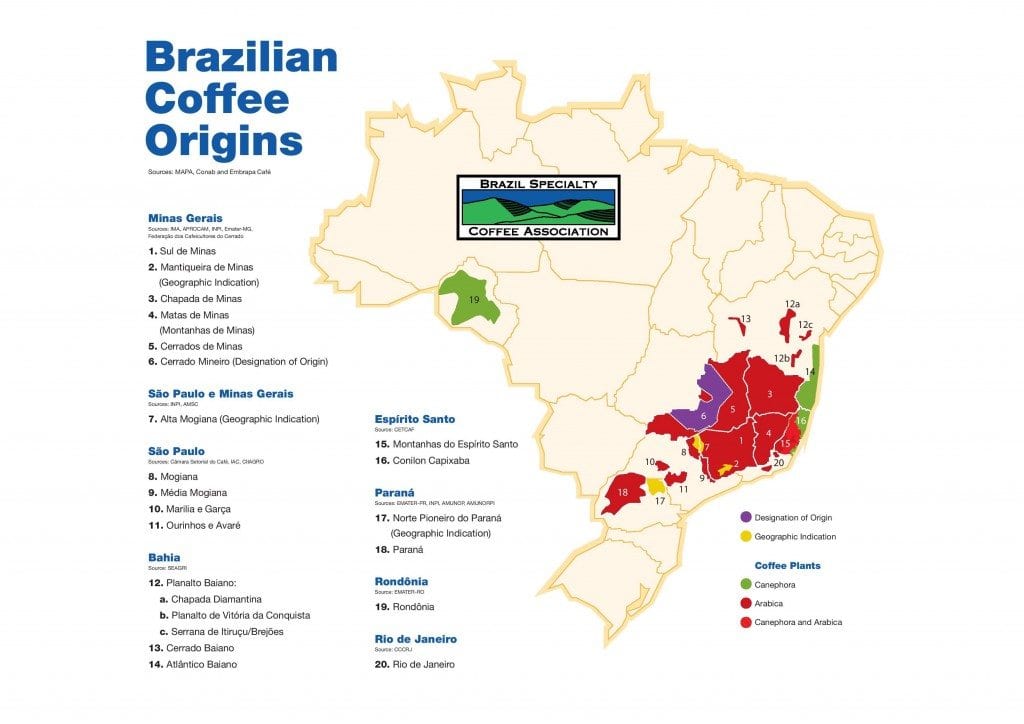
Coffee cultivation in Brazil is primarily concentrated in six major regions: Bahia, Espírito Santo, Minas Gerais, São Paulo, Paraná, and Rondônia. Each region, shaped by its unique geography, altitude, microclimate, and farming methods, produces coffees with distinct personalities. Among these, the Cerrado region in Minas Gerais is hailed as a benchmark for Brazilian specialty coffee, earning widespread acclaim for its consistent quality and outstanding flavor.
[Bahia]
Located in northeastern Brazil, Bahia began developing its coffee industry relatively late—in the 1970s—but has since become a model for technified farming. Approximately 75% of its coffee is Arabica, with two main sub-regions: Chapada Diamantina and Oeste Baiano (Western Bahia). These areas rely heavily on mechanized cultivation, significantly boosting production efficiency. Notably, in the 2009 Brazil Cup of Excellence (COE) competition, five of the top ten coffees came from Bahia, showcasing its exceptional potential.
[Espírito Santo]
As Brazil’s second-largest coffee-producing state, Espírito Santo is also the country’s primary source of Robusta beans, with its capital, Vitória, serving as a major export port. In addition to large-scale commercial Robusta production, the region features two distinctive sub-regions: Montanhas do Espírito Santo and Conilon Capixaba. The former lies in a highland area between 700 and 1,300 meters above sea level, with a pleasant climate well-suited for cultivating varieties like Mundo Novo and Catuaí, offering potential for high-quality specialty coffee. The latter mainly consists of small-scale Robusta farms at lower elevations.
[Minas Gerais]
Minas Gerais is Brazil’s largest coffee-producing state, accounting for over 55% of the nation’s total output and serving as an important source of specialty coffee. It can be further divided into four key sub-regions:
• Cerrado: Brazil’s first coffee region to receive origin certification, covering 55 municipalities at altitudes between 800 and 1,300 meters. The region is dominated by medium to large farms that commonly use irrigation systems. Cerrado coffees are frequently found in classic blend recipes, known for their stable profiles and layered complexity.
• Sul de Minas (South Minas): With an average elevation of around 950 meters and mild temperatures of about 22°C, this region is composed of numerous small and medium-sized farms, most spanning 10 to 100 hectares.
• Matas de Minas (Minas Plateau): Coffee cultivation here began in the late 1970s. The terrain is flat, favoring mechanized operations, though yields are relatively limited.
• Mata Atlântica de Minas (Atlantic Forest Minas): Characterized by diverse terrain and warm, humid climates, over 80% of farms here are under 20 hectares. Coffee contributes significantly to local agricultural income, and the share of specialty beans has been gradually increasing in recent years.
[São Paulo]
São Paulo is one of Brazil’s oldest coffee-producing regions, home to the Port of Santos—an important hub for coffee exports. The Mogiana sub-region, with altitudes of 900 to 1,200 meters and an average temperature of around 20°C, produces well-balanced Arabica coffees with pronounced sweetness, making them especially appealing to those who enjoy a full-bodied cup.
[Paraná]
Paraná was once a traditional coffee-producing state in Brazil, but after severe frosts in the 1970s drastically reduced coffee acreage, it is no longer a major player. The region’s generally low altitudes and cooler climate are not conducive to high-quality Arabica, shifting its focus away from specialty production.
[Rondônia]
This region mainly produces Robusta varieties, set in a tropical climate with low altitudes and high temperatures. As a result, its coffee is typically destined for instant or commercial use, lacking the refined flavor nuances characteristic of Arabica.
Among Brazil’s many producing regions, Cerrado in Minas Gerais stands out for its consistent and high-quality output. One common processing method here is pulped natural—a hybrid of washed and natural processes where the coffee cherry’s skin and pulp are removed but some mucilage is retained during drying. The natural sugars in the mucilage seep into the bean, enhancing sweetness and body while preserving the smooth characteristics typical of Brazilian coffee.
Take, for example, Red Bourbon grown in the Cerrado region. When processed using the pulped natural method, it often displays prominent notes of peanut, nuttiness, and chocolate, with a caramel-like sweet finish. The cup is silky and refined. For optimal results when brewing pour over, we recommend using water at around 88°C, paired with a medium-coarse grind and a slower-flow filter (such as a KONO filter) to fully highlight its rich body and sweet flavor layers.
The above content is compiled by CoffeeHunters, a coffee news website.


