








Introduction:The Yirgacheffe Gori Gesha Natural from Ethiopia’s Gesha Village, with its distinctive floral and fruity aromas and bright, clean acidity, has become a sought-after choice in the specialty coffee scene. This article delves into its regional background, processing methods, quality control standards, as well as detailed green bean characteristics, roasting recommendations, and optimal brewing techniques to help you fully appreciate the charm of this top-tier coffee bean from origin to cup.
Gesha Village, one of the most talked-about brands in the specialty coffee market in recent years, originates from the Bench-Maji region of Ethiopia. Its Gori Gesha Natural, an heirloom variety, has long been a dream bean for many coffee enthusiasts. This coffee not only boasts intense tropical fruit and floral aromas but also features a rich sweetness and layered fermentation profile thanks to its unique natural processing method, making it highly favored in global auctions and by consumers alike.
This article will take you through the origin of the region, variety selection, processing workflow, green bean characteristics, roasting advice, and down to the most practical pour over and siphon brewing parameters—helping you fully understand this premium natural bean from the birthplace of Gesha, and master how to brew it at home to bring out its most captivating flavors.
Regional Background: From Documentary to the Hometown of Gesha
The establishment of Gesha Village stems from the accidental discovery made by a couple of documentary filmmakers. In 2007, documentary director Adam Overton and his photographer wife Rachel Samuel were shooting a coffee-themed documentary for the Ethiopian government when they visited the Bench-Maji region in the southwest and entered the renowned Gera Coffee Forest. This journey not only changed their lives but also laid the foundation for what would later become Gesha Village.
In 2009, through the introduction of coffee expert Willem Boot, they resolved to delve deeper into finding the origin of the Gesha variety. Finally, in 2011, they arrived at the Bench-Maji region on the border between Ethiopia and South Sudan, at an altitude of 1,900–2,100 meters, and discovered wild coffee trees in a pristine forest known locally as Gori Gesha, which bears a striking resemblance to the Gesha variety found in Panama. This forest is believed to be the true origin of the Gesha variety.
They collected seeds from the native Gesha trees, screened and nurseried them, and officially established the Gesha Village Coffee Estate in 2011. The estate is located about 12 miles from the Gori Gesha forest, covering a total area of 475 hectares, and gradually expanded to a cultivation scale of 320 hectares.
Variety & Quality Control: Carefully Selected Native Gesha Variety
To recreate the most authentic Gesha flavor, Gesha Village sourced seeds from the Gori Gesha forest, about 20 kilometers from the estate, and sent them to professional institutions for genetic testing to confirm that they are the original source of the Panamanian Gesha variety. Then, through observation of plant morphology, bean appearance, and cupping results, they ultimately selected the variety closest to the commercially available Gesha for cultivation.
Due to the large scale of the estate, to manage it effectively, Gesha Village divided the planting areas into 8 major blocks, each further subdivided and numbered to ensure that the flavor characteristics of different micro-regions can be clearly tracked. Batch codes such as Lot104 serve as important references for quality control and traceability.
Natural Processing Method: Exquisite Craftsmanship to Preserve Full Flavor
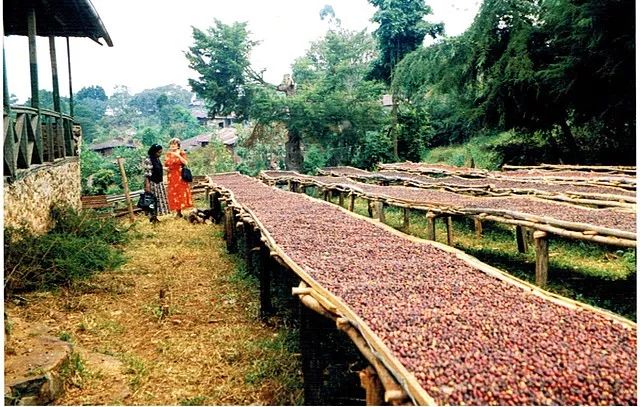
The natural processing at Gesha Village emphasizes extreme precision. With the help of local farmers, they trained a team of professional harvesters and processors. During harvesting, only perfectly ripe coffee cherries are selected, with all fallen or defective beans removed. Throughout the drying process, the beans are repeatedly turned and sorted to remove insect-damaged and underripe beans, and initially dried in the shade to prevent the bean husks from becoming too brittle due to intense sunlight.
The design of the drying beds has also been optimized to ensure ventilation and even sun exposure, allowing the coffee to steadily develop aroma and sweetness during the drying process.
Green Bean Characteristics: A Mild, Yellowish-Green Appearance
Compared to the common bluish-green hue of Panamanian washed Gesha, the natural Gesha green beans from Gesha Village exhibit a gentle jade-like color with a yellowish tint, featuring a fine sheen. They emit an aroma of fresh grass, peach, berries, and even a faint milky sweetness reminiscent of oolong tea, showcasing a rich and unique aromatic profile.
Roasting Recommendation: Light Roast to Highlight Floral and Fruity Notes
Due to the smaller bean size and higher density of natural Gesha, it is important to control heat during roasting. It is recommended to use a relatively low charge temperature (around 200°C) and slowly dehydrate in the first stage to avoid over-exploding. Maintain gentle heating in the mid-to-late stages to sustain the Maillard reaction, and drop the beans about 1 minute and 20 seconds after first crack, with the temperature controlled around 193°C, to preserve the maximum floral and fruity aromas and delicate acidity.
A light roast can best showcase the unique aromatic profile of Gesha, while a darker roast may easily mask its subtle fruit acids and floral notes.
Brewing Parameters: Best Practices for Pour Over and Siphon
To fully experience the layered profile of the Gori Gesha Natural, it is recommended to use a V60 filter cone with a 3.5 grind size (similar to Japanese Fuji R440), a water temperature of 91–92°C, and a brew ratio of approximately 1:15. Begin with a 30-second bloom using 35 grams of water, then pour in stages up to 100 milliliters before pausing, and finally slowly pour up to 225 milliliters to effectively enhance sweetness and aroma.
If using a siphon pot, it can also highlight the combination of richness and aroma; the AeroPress and French press are suitable for those who prefer a stronger body, with adjustments to grind size and water temperature recommended to suit individual taste.
This Gori Gesha Natural from Gesha Village, with its intense floral and fruity aromas, bright acidity, and full sweetness, is worth trying whether you’re a coffee novice or a seasoned enthusiast. By mastering the right processing and brewing knowledge, you too can recreate that exceptional flavor from the depths of the Ethiopian forests at home.
The above content is compiled by CoffeeHunters, a coffee news website.


