







Introduction:Want to understand Starbucks' internal promotion paths and actual salary levels? This article takes an in-depth look at the complete job hierarchy from entry-level baristas to regional managers, covering key positions such as trainers, shift supervisors, and store managers, and analyzes operational details like IPLH staffing metrics and ordering formulas. It also shares real compensation experiences from current and former employees, helping you fully grasp Starbucks' operational system and career development possibilities.
Are Starbucks salaries truly competitive? How long does it take to climb from entry-level to management? This article will detail Starbucks' complete job structure and actual operational model—from store operating hours and job responsibilities at each level, to the promotion routes of baristas, trainers, shift supervisors, store managers, and even regional managers—explaining everything. Not only does it include internal operational details such as IPLH efficiency metrics and ordering calculation formulas, but it also compiles real salary situations shared by multiple current and former partners, giving you a clearer understanding of career development within Starbucks.
First, Starbucks generally operates on an eight-hour workday, with actual on-site time around nine hours, including meals and breaks. Shifts are mainly early, mid, and late, with a rotating rest schedule that allows for two days off per week. While actual operations may vary slightly by location, the overall structure remains consistent. In particular, the closing shift involves key tasks such as organizing the pastry display (Pastry), cleaning the espresso machine and grinder (Bar), and cleaning the back-of-house (Bellow and Slide Lobby)—an important part of any shift.
In terms of job hierarchy, Starbucks offers a clear development path. Typically, one starts as a barista (Barista), and high performers can be promoted to a Star Barista Trainer (Barista Trainer, abbreviated as BT), responsible for training new baristas. Although this doesn’t involve a pay raise, it’s considered an important transitional step toward promotion. The next step is promotion to shift supervisor (Shift Supervisor, SS), where one must have the ability to manage store cash and operations. This role is usually part of the core management team of 3 to 5 people at each store.
Above that are assistant store manager (Assistant Store Manager, ASM) and store manager (Store Manager, SM). The store manager is the final decision-maker for a single store, responsible for scheduling, operations, sales data, and personnel management, with relatively full authority. The regional manager (District Manager, DM) oversees the overall operations and personnel of 10 to 15 stores, serving as a higher-level management role, with decisions directly impacting store performance and performance bonus distribution.
Notably, starting from ASM, a partner’s performance bonus is tied to store sales performance, whereas positions below ASM do not have this direct linkage. Promotion reviews are generally decided by the regional manager or higher-level operation manager (Operation Manager, OM), especially the process of being promoted from shift supervisor to assistant store manager, which requires passing multiple assessments and interviews.
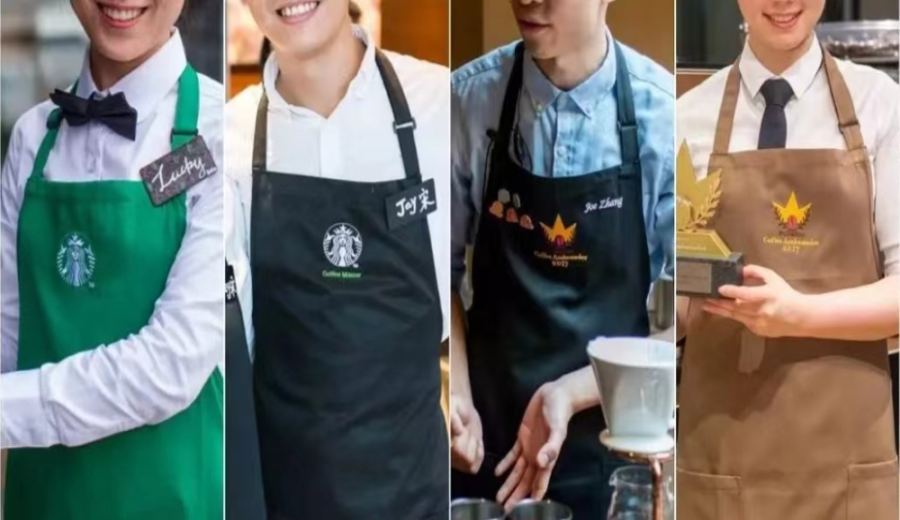
In terms of professional certification, Starbucks has a Coffee Master (CM) program, typically participated in by promising partners from entry-level to regional levels. To become a Coffee Master, one must pass written and practical exams, including coffee tasting, latte art skills, flavor description, and action plan presentations. Upon passing, one earns the right to wear the symbolic black apron. Although the black apron itself does not directly lead to a salary increase, it symbolizes a commitment to and recognition of coffee expertise. The District Coffee Master (DCM) is responsible for cultivating local Coffee Masters and leading coffee-related educational activities. Additionally, the biennial Coffee Ambassador (CA) competition is a higher-level honor challenge, with winners earning the title of "Coffee Ambassador" for two years—an internally highly regarded technical certification.
Daily store operations can be divided into four main roles: the bar (beverage preparation and customer service), the register (order processing and sales recommendations), lobby cleaning (maintaining cleanliness), and the IC (In Charge), a role taken by shift supervisors and above. Starbucks evaluates staffing efficiency through the precise IPLH metric (i.e., the number of beverages and product transactions completed per employee per hour), with general store targets ranging from 10 to 12, and high-traffic stores potentially exceeding 20—directly influencing staffing numbers and operational costs.
Administratively, shift supervisors and above are involved in ordering and staff training. Ordering requires calculating safety stock levels and ordering cycles based on system data, using the common formula: “Order quantity = Safety stock – Current inventory,” where safety stock is closely related to beginning and ending inventory, ordering cycle, and safety factor (usually 1.15). Training responsibilities cover onboarding new staff and updating promotional information, which are essential for ensuring service quality and smooth store operations.
Regarding salaries, according to multiple current and former employees, Starbucks part-time hourly wages generally range between 11 and 19 yuan, while full-time employees with at least one year of tenure earn about 4,000 yuan after tax, with annual bonuses and double pay bringing the annual salary to over 60,000 yuan. However, promotion speed varies by individual—many need more than five years of experience to have a chance at becoming a store manager. Although the management trainee program offers a path to reserve store manager roles, achieving this within two years is still rare. While Starbucks is relatively standardized in benefits and management systems, compared to other industries, its salary growth and career advancement pace still require careful consideration.
The above content is compiled by CoffeeHunters, a coffee news website.


