







Introduction:Green Mountain Coffee and Jamaican Blue Mountain Coffee are often mistakenly thought to be related, but in reality, they differ vastly in terms of brand, origin, market positioning, and quality standards. This article delves into the fundamental differences between the two, explaining how Green Mountain established itself as a U.S. coffee brand, while Blue Mountain represents a world-class coffee-growing region with its grading system and proper purchasing methods. It also includes professional roasting and pour over parameters to help you truly appreciate the flavor profile of Blue Mountain.
Many people, upon first hearing “Green Mountain Coffee,” mistakenly assume it is related to the renowned “Jamaican Blue Mountain Coffee,” or even suspect that Green Mountain is just an imitation brand. In truth, aside from their somewhat similar names, Green Mountain Coffee and Jamaican Blue Mountain Coffee share almost no connection in terms of brand background, origin, or product form.
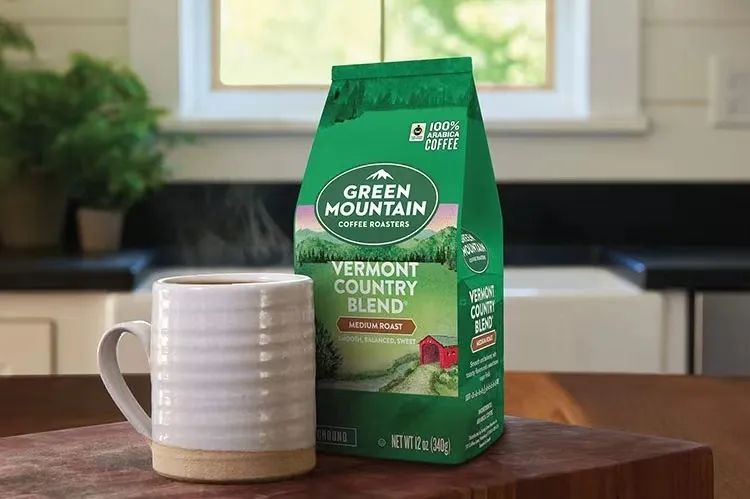
Green Mountain Coffee Roasters is a well-known American coffee company founded in 1981, headquartered in Vermont. It gained global fame for its Keurig single-serve coffee machines and K-Cup pod system. The company was acquired by a German consortium in 2015 for $13.9 billion and boasts a massive user base of over 16 million coffee machines. Its primary profits come from K-Cup consumables rather than the coffee beans themselves. The K-Cup is a patented design that preserves coffee freshness and aroma, is easy to use, and represents a classic “plug-and-play” coffee solution.
In contrast, Jamaican Blue Mountain Coffee is a premium Arabica Typica variety grown in the Blue Mountains of Jamaica, renowned for its unique origin, limited production, and balanced, refined flavor. Blue Mountain Coffee is not a brand but a high-end coffee bean that undergoes strict grading and quality control, certified and regulated by the Jamaica Coffee Industry Board.
The Blue Mountains are located in eastern Jamaica and boast exceptionally favorable geographic conditions for cultivating high-altitude specialty coffee. According to official definitions, only Typica variety coffee grown at elevations between 910 and 1700 meters within four specific regions—St. Andrew, St. Mary, St. Thomas, and Portland—can be called “Jamaican Blue Mountain Coffee.” The total area of these regions is only about 6,000 hectares, making production very limited. Coffee grown between 460 and 910 meters is classified as “Jamaican High Mountain Coffee,” and anything below 460 meters is labeled “Jamaican Prime Coffee.” The quality and price among these three categories vary significantly.
Jamaican Blue Mountain Coffee is further subdivided into the following five grades based on screen size and defect rate:
1. Blue Mountain No.1: The highest grade, using S-17/18 screens, with large and uniform bean size and a defect rate below 2%.
2. Blue Mountain No.2: Slightly smaller than No.1, using S-16/17 screens, also with a defect rate below 2%.
3. Blue Mountain No.3: Even smaller in size, using S-15/16 screens, with defect rates controlled within 2%.
4. Blue Mountain Peaberry (P.B): A naturally occurring round mutation of the coffee bean, accounting for over 96% of this grade, also with a defect rate below 2%. This grade is often considered to have a more concentrated flavor and is sometimes rated even higher than No.1.
5. Blue Mountain Triage: A blend of beans from the above grades that do not meet the higher standards, with a defect rate below 4%, representing a lower-tier mixed grade.
Common misconceptions about purchasing Blue Mountain Coffee include beliefs such as “all Blue Mountain Coffee is bought by the Japanese” or “you can’t buy the real thing in China.” In fact, since 2011, China has officially imported Blue Mountain green beans. The Hangzhou Coffee and Western Food Industry Association even signed a cooperation intention, with the first batch of Blue Mountain green beans arriving at Ningbo Port in May 2011. Today, there are officially imported Blue Mountain Coffees available on the market—they are not out of reach.
When exported, Blue Mountain Coffee is packaged in wooden barrels, mainly in two sizes: 70-kilogram large barrels and 15-kilogram small barrels. Legitimate imported products usually come with certification from the producing farms, such as Clifton Mount Estate, one of the few well-known farms in the Blue Mountain region certified by the Rainforest Alliance. When purchasing, it’s advisable to check whether the product is in original barrel packaging and whether it comes with relevant certification documents to ensure authenticity.
In terms of processing methods, Blue Mountain Coffee mostly uses the washed process, which helps preserve the clean flavor characteristics of the beans and minimizes impurity interference. Due to Jamaica’s isolated island environment and the pure gene pool of the Typica variety, Blue Mountain Coffee boasts a uniquely delicate, sweet-and-acid balanced taste.
For those brewing Blue Mountain No.1 via pour over, it is recommended to use a medium-dark roast to bring out its rich yet balanced sweet-and-acid profile. The suggested roasting reference data is as follows: using 500 grams of green beans, a Yangjia 600N semi-direct-fire roaster, with an initial drum temperature of 165°C, starting firepower at 130 and damper at 3, then gradually adjusting the firepower and damper. After the first crack begins, continue for about 3 minutes, and drop the beans at 198.5°C to enhance flavor complexity and body.
Practical pour over recommendations are as follows: use 15 grams of Blue Mountain No.1 coffee beans, with a brew ratio of 1:15, water temperature around 87°C, and grind size at 75% passing through a Chinese standard 20-mesh sieve (approximately medium-fine grind). It is recommended to use a KONO filter. Start with a 30 ml bloom for 30 seconds, then pour in a small circular motion up to 125 ml before stopping. Once the liquid level drops, continue pouring up to 225 ml. Total brew time is about 2 minutes, which fully highlights the delicate and balanced flavor of Blue Mountain Coffee.
The above content is compiled by CoffeeHunters, a coffee news website.


