







Introduction:Yirgacheffe is one of Ethiopia’s most iconic coffee-growing regions, renowned for its distinctive floral and fruity aromas as well as its bright acidity. This article delves into the region’s geography, historical background, primary processing methods, and most representative flavor characteristics. It also explores how different processing methods can highlight its diverse flavor profiles, while providing practical pour over brewing references to help you gain a more comprehensive understanding of this star bean in the specialty coffee world.
In the specialty coffee scene, Ethiopia’s Yirgacheffe region has long been a highly representative presence. Compared to the pricey Panamanian Geisha, Yirgacheffe wins the hearts of coffee enthusiasts worldwide with its delicate acidity, abundant floral and fruity notes, and refreshing, bright flavor profile. This article will comprehensively analyze the unique charm of Yirgacheffe—from its growing environment and historical evolution, to common processing techniques and actual flavor expressions—and introduce several classic coffee varieties from the region. Whether you’re just getting started or already have some experience, you’ll find useful insights here.
Although Panamanian Geisha is famed for its high price and complex layers, Ethiopian-grown coffees also exhibit rich floral and fruity profiles. It’s worth noting that although Africa accounts for only about 12% of global coffee production—far less than Latin America—as the birthplace of coffee, its genetic diversity and unique balance of sweetness and acidity give the region’s beans an irreplaceable position in the global market. Among them, Yirgacheffe is the dream origin for many coffee aficionados.
The division of coffee-growing regions within Ethiopia is not static. With ongoing research and the influence of competitions, emerging regions such as Guji and Bale have gained increasing attention in recent years. This reflects the continuous exploration and refined classification of terroir potential by both authorities and the industry. Yirgacheffe has also gradually established its status as an independent producing region within this context.
Yirgacheffe’s coffee is cultivated at altitudes of nearly 2,000 meters, making it one of the highest-altitude coffee-growing regions in the world. In the past, it was part of the Sidamo region, but today it is located within the Gedeo Zone of the Southern Nations, Nationalities, and Peoples' Region, as well as the West Guji Zone of the Oromia Region. Due to its proximity to lakes, the area enjoys humid air and frequent fog—especially in the Misty Valley—where the climate remains cool and stable throughout the year. These conditions provide an ideal growing environment for coffee trees and contribute to the region’s unique aroma and flavor.
As early as the 1970s, advanced washed processing techniques from Central and South America were introduced locally, significantly improving coffee quality and providing more stable income for coffee farmers. The washed method involves removing the pulp and mucilage, leaving only the parchment-covered beans to dry. This effectively reduces interference from extraneous impurities and off-flavors, allowing the intrinsic terroir characteristics of the coffee to be presented more clearly. Yirgacheffe’s distinctive fresh floral notes and refined acidity are precisely the result of this processing method.
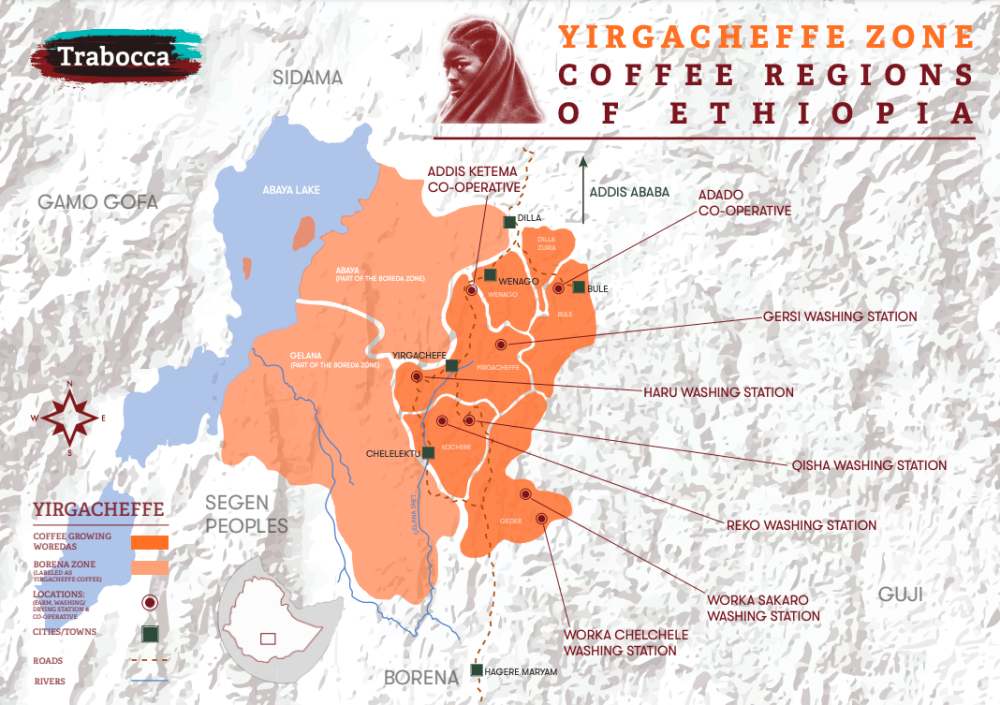
Coffee beans from Yirgacheffe often exude a soft white jasmine floral aroma, with a bright and layered mouthfeel—qualities that set them apart from other coffees in the wider Sidamo region. In fact, many producers in Sidamo take pride in being able to produce coffee that meets Yirgacheffe’s standards. Prior to the 1995 administrative restructuring, Yirgacheffe coffee was often sold under the name of Sidamo. It wasn’t until 2010, following multiple classification adjustments by the ECX (Ethiopian Commodity Exchange), that Yirgacheffe officially became an independent producing region, currently encompassing the Gedeo Zone and parts of the West Guji Zone.
Within the Gedeo Zone, there are five main coffee woredas (districts): Yirgacheffe, Dilla Zuria, Wenago, Kochere, and Gelana Abaya. Additionally, Gedeb, located in the southernmost part of the zone, is not included in the ECX’s official classification but is widely regarded within the industry as part of Yirgacheffe’s terroir. The coffee produced here also boasts exceptional quality and recognizability.
The flavor profile of Yirgacheffe is extremely rich and difficult to encapsulate in a single description. Common tasting notes include lemon, blueberry, jasmine, honey, and tea—all of which often blend seamlessly within a single cup, creating a unique sensory experience. For those new to specialty coffee, the various washed processing everyday-drinker beans offered are an excellent entry point to understanding Yirgacheffe’s flavors. Among these, varieties with citrus-dominant profiles are especially effective in showcasing the bright characteristics typical of African beans.
Beyond the standard everyday-drinker series, the market also offers a variety of premium beans from Yirgacheffe and surrounding regions, whose flavors vary significantly depending on processing methods and micro-regions. For instance, Gedi Tingding and Kaffa Forest are typically washed-processed—the former presents a refreshing combination of citrus, apricot, and green tea, while the latter features a mellow profile of citrus, honey, and black tea. Konga Red Cherry, on the other hand, is a classic naturally processed Yirgacheffe, characterized primarily by berry, strawberry, and fermented wine-like notes, complemented by pronounced citrus acidity and a rich honey sweetness, with a long-lasting and layered aftertaste.
The above content is compiled by CoffeeHunters, a coffee news website.


