








Introduction:Delve into the unique charm of Kenyan coffee, from the terroir conditions of its seven core growing regions to the genetic background of classic varieties such as SL28 and SL34, and the key processing techniques of the K72 washed method. This article systematically breaks down every factor that influences the flavor profile of Kenyan coffee. It also includes practical brewing parameters and cupping flavor references to help coffee enthusiasts fully grasp the essence of Kenyan coffee from origin to cup.
As one of Africa’s most representative specialty coffee-producing countries, Kenya is globally renowned for its coffee’s bright berry acidity and richly layered flavors. Moreover, differences in altitude, microclimate, and processing methods across various regions have resulted in distinctive flavor profiles. This article will take you on an in-depth exploration of Kenya’s seven core growing areas, focusing on the terroir characteristics and cupping performances of three well-known regions—Thika, Nyeri, and Kirinyaga—while also discussing the origins and physical traits of the main varieties SL28 and SL34. It further details the iconic K72 washed processing procedure in Kenya and concludes with practical brewing recommendations and flavor insights to help you fully understand the flavor logic of Kenyan coffee from origin to cup.
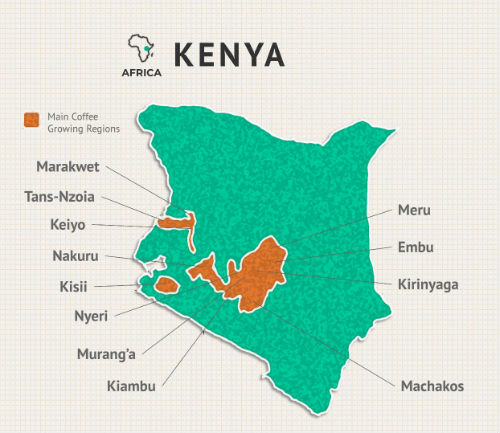
Kenya’s coffee-growing regions can be categorized into seven major zones: Thika, Kirinyaga, Mt. Kenya West, Nyeri, Kiambu, Ruiru, and Muranga. Among them, Thika, Kirinyaga, and Nyeri stand out in the market due to their consistently high-quality coffee and outstanding flavor profiles.
Thika is located near Kenya’s capital, Nairobi. Although it is primarily an industrial town, it is surrounded by farmland and waterfalls, with approximately two thousand coffee growers. The local coffee cultivation history dates back to the late 19th century, with seeds originally introduced from neighboring Ethiopia and later improved locally. The main varieties grown today include Bourbon, SL34, SL28, Typica, and Ruiru 11, with SL34 and SL28 accounting for about 90%. The region sits at an altitude of around 1550–1750 meters, and cupping often reveals bright fruit acidity, rich berry juice flavors, and honey-like sweetness.
Nyeri is situated in the highland area of Mount Kenya and is a significant producer of specialty coffee, with an average altitude exceeding 1500 meters. Located east of the Aberdare Mountains and on the spur extending from Mount Kenya, its high altitude and fertile soil make it a central hub for coffee production, supported by a mature industry infrastructure. Nyeri has two harvest seasons per year: the main season runs from October to December, and the secondary season from June to August, with the main season generally producing higher quality. When cupping coffees from this region, one often experiences deep berries, bright sweet-tart notes reminiscent of black plums, and a delicate, lingering finish.
The Kirinyaga region neighbors Nyeri and lies on the slopes of Mount Kenya. It is known for its intense, layered flavors and full-bodied mouthfeel, ranking alongside Nyeri as one of Kenya’s top two coffee-producing regions. Most producers here are smallholder farmers who manage washing stations collectively through cooperatives, where coffee cherries are processed centrally. The altitude ranges approximately from 1300 to 1900 meters, with main harvests occurring from October to December and secondary harvests from June to August. Cupping results show that Kirinyaga coffees are dominated by berry flavors, balanced sweetness, and soft notes of honey and cream.
When discussing Kenyan coffee, one cannot overlook its flagship varieties SL28 and SL34. SL28 was selected in 1935 from drought-resistant strains in Tanganyika and thrives at medium to high altitudes. Though drought-tolerant, it is susceptible to diseases. Its bean shape resembles Bourbon—round and full—and genetic testing confirms it belongs to the Bourbon genetic group. SL34 originated in the late 1930s at the Scott Agricultural Laboratories in Kenya from a tree known as “French Mission” at the Kabete Loresho Estate. Its beans are slightly oval and flatter on the sides, resembling Typica, and genetic tests indicate a relationship with the Typica genome.
Kenya’s iconic K72 washed processing method is the core technique behind its unique flavor profile. The process involves washing ripe coffee cherries and removing the skin, followed by 24 hours of dry fermentation. After washing, the steps are repeated three times, totaling 72 hours of fermentation—hence the name. Once fermentation is complete, the beans are soaked in clean water overnight and then moved to drying beds the next day. This extended fermentation imparts pronounced acidity and complex aromatic layers to the coffee.
For brewing recommendations, using a V60 filter cone as an example, you can employ a water temperature of 90°C, a coffee-to-water ratio of 1:16, and a medium-fine grind size (sieve the coffee through a #20 sieve to achieve 77% extraction). The specific method involves wetting the filter paper and preheating the equipment, blooming with 30 grams of water for 30 seconds, then pouring in a small circular motion until reaching 130 grams for the first pour. When the water level drops and is about to expose the coffee bed, continue pouring to 240 grams. The total extraction time is around 2 minutes. These parameters fully highlight the bright berry acidity, juicy mouthfeel, and sweet lingering finish typical of Kenyan coffee.
The above content is compiled by CoffeeHunters, a coffee news website.


