








Introduction:Want to understand why Geisha coffee from Panama’s Boquete region can repeatedly fetch sky-high prices at international auctions? This article will take you through the country’s coffee cultivation history, and explore in depth the unique geography and climate conditions of the three major regions—Boquete, Volcán, and Renacimiento—to analyze how the Panama Specialty Coffee Association has propelled the global popularity of Geisha through the Best of Panama (BOP) competition. With a washed Boquete Geisha as an example, we also provide practical V60 pour over parameters and a three-stage pouring technique so that you, too, can brew a specialty coffee with bright citrus notes and rich floral and fruity aromas.
Though a small Central American country, Panama holds an unshakable position in the global specialty coffee market. Many coffee enthusiasts often wonder about the wide price range when tasting or purchasing Panamanian beans, which span from affordable everyday-grade to auction-grade beans priced at several thousand yuan. Behind this lies the country’s unique regional conditions, meticulous cultivation management, and the international market’s high regard for exceptional Geisha. This article will comprehensively explore the charm of Boquete Geisha from historical background, geographic environment, regional characteristics, competition mechanisms, to hands-on brewing techniques.
The history of coffee in Panama dates back to 1742. According to records, the first batch of coffee beans arrived in Portobelo via Cartagena on a ship departing from French Martinique. However, it wasn’t until the 1780s that settler Pedro Antonio de Ayarza first attempted to cultivate coffee locally, though his efforts were unsuccessful due to climatic and geographic factors. It was not until the 1820s that coffee gradually took root in other parts of Panama, even briefly replacing chocolate as one of the main beverages and rivaling Europe’s popular tea culture.
Panama is located in the narrow strip of Central America, bordered by the Caribbean Sea to the east and the Pacific Ocean to the west. Its climate is influenced by the interaction of these two major ocean currents, and the country is home to the towering Barú Volcano, creating diverse microclimates and fertile volcanic soils. Particularly in the Boquete Valley at elevations above 6,500 feet, where the diurnal temperature variation is significant and humidity is moderate, this environment is highly conducive to the slow ripening of coffee cherries and the accumulation of aroma, giving rise to coffee beans with rich layers and delicate flavors.
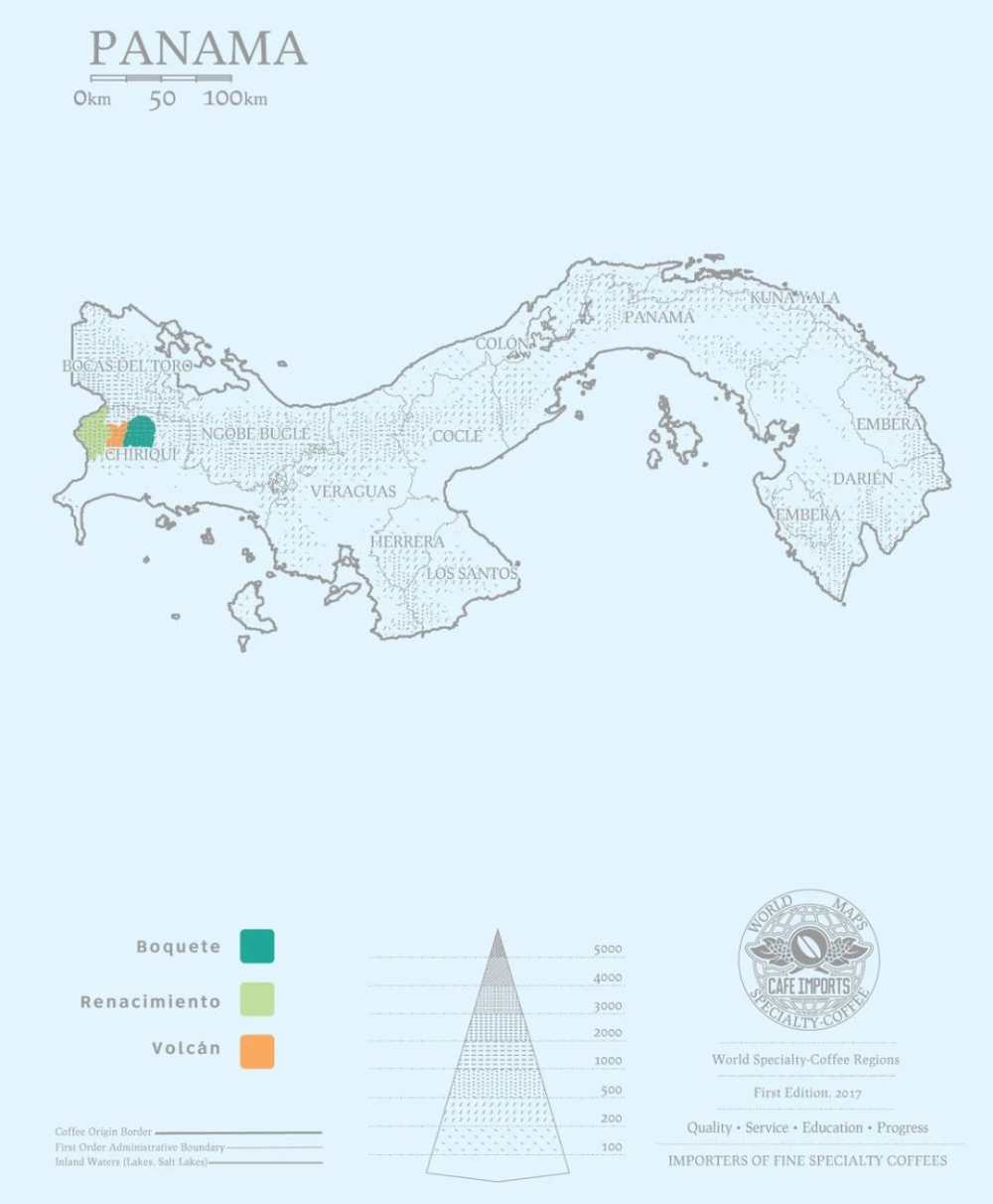
Panama’s coffee-growing area covers more than 20,000 hectares, over 70% of which are Arabica varieties, primarily distributed in Chiriquí Province near the border with Costa Rica. This region includes the three renowned coffee-growing areas: Boquete, Volcán, and Renacimiento. These areas are not only close to the Barú Volcano and situated at moderate altitudes, but also benefit from fertile soils and cool climates, making them ideal locations for cultivating premium coffee. Among them, Boquete is the most famous—not only the birthplace of Panama’s coffee industry but also the home of many top-tier Geisha coffees.
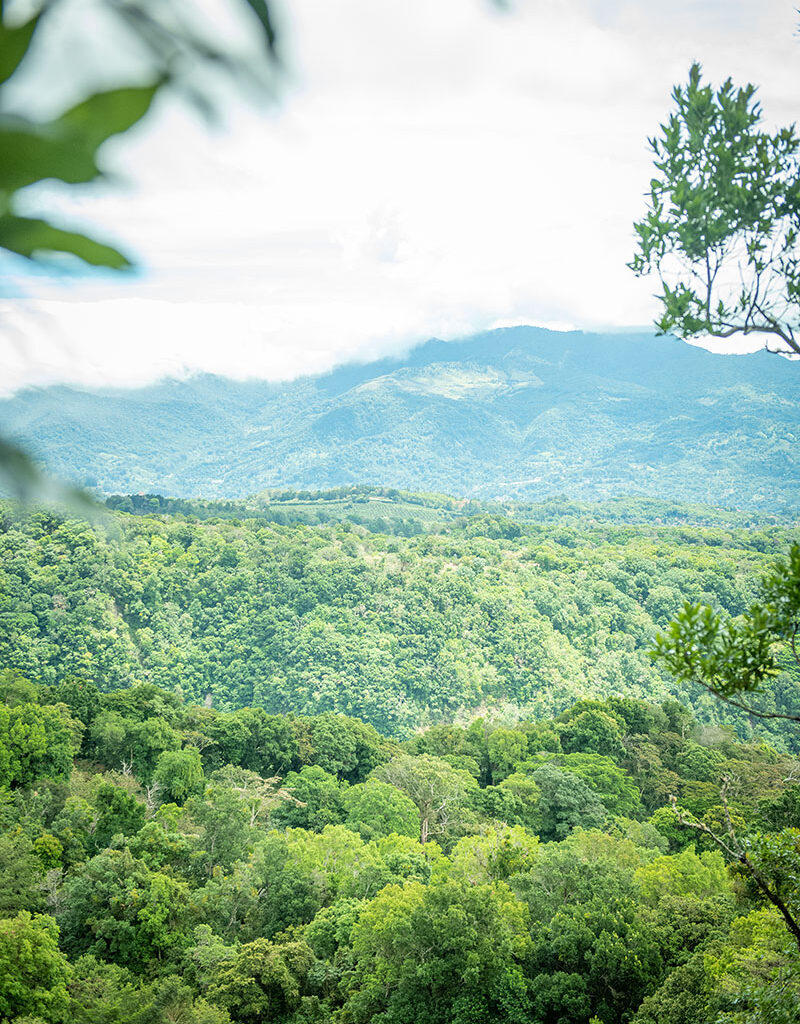
The Boquete Valley spans approximately 514 square kilometers, with a population of around 15,000. The terrain is mountainous, and the climate is cool and dry, especially in summer when a barely visible layer of mist often lingers, helping to slow the ripening process of coffee cherries and allowing more flavor compounds to accumulate. Most coffee here is grown at altitudes of around 1,600 meters, and the soil is rich in volcanic nutrients, resulting in coffee with medium to high acidity and bright aromas. The main harvest season is from September to December, and the indigenous Gnobe Bugle people, known for their skilled harvesting techniques, are often invited to help pick the beans, forming an important part of Boquete’s coffee culture.
The year 1996 marked a turning point for Panama’s coffee industry. When the International Coffee Agreement collapsed, leading to a sharp drop in coffee bean prices, many small farms faced existential crises. To break through, seven coffee estate owners joined forces to establish the Panama Specialty Coffee Association and held the first coffee green bean competition and online auction, dedicated to promoting high-quality specialty coffee. This initiative not only united local farmers but also began to draw international market attention to Panamanian coffee.
One of the most representative events is the Best of Panama (BOP) green bean competition. This competition serves not only as an indicator of coffee quality but also as a stage for the world’s top green bean buyers to compete. The contest divides entries into Geisha and non-Geisha categories, and further subdivides them according to different processing methods such as natural and washed. Ultimately, an international panel of judges scores the beans blindly, and the highest-scoring entries are auctioned. In recent years, BOP champion beans have repeatedly fetched auction prices exceeding one thousand US dollars per pound, making it an annual highlight in the specialty coffee world.
The Geisha variety originated in Ethiopia but found the pinnacle of its flavor expression in Boquete, Panama. Compared to regular coffee, Geisha boasts exceptionally high acidity brightness and complex aromatic layers, with common flavor notes including white floral, lemon, bergamot, honey, and green tea tones. Its taste is refreshing with a long-lasting aftertaste. To fully showcase these characteristics, this coffee shop often uses medium-light roasting and employs the washed processing method to preserve its original cleanliness and vibrant fruit acidity.
The washed processing method involves removing the skin and pulp of harvested coffee cherries, fermenting them with the mucilage for about 24 hours, then washing away the residues with clean water, and finally drying the parchment-covered green beans to a moisture content of about 12%. This method effectively enhances the clarity and consistency of the coffee, reduces off-flavors, and makes the delicate flavors of Geisha more prominent. Roasted Boquete washed Geisha often exhibits a bright acidity of citrus and lemon, with floral and fruity aromas in the mid-palate, and a sweet aftertaste reminiscent of green tea and honey.
If you want to brew a high-quality Boquete washed Geisha at home, it is recommended to use a V60 filter, with a grind size similar to fine sugar (about 80% passing through a #20 sieve), a powder-to-water ratio of 1:15, and a water temperature of around 91–92°C. Here is a reference process for a three-stage pour over: First, pour 30 grams of hot water for a 30-second bloom; then pour 120 grams of water with a slightly stronger flow, reaching a total of 150 grams, taking about 55 seconds; finally, pour 90 grams of water in small circles, reaching a total extraction of about 240 grams, with the entire process taking about 2 minutes and 10 seconds. This parameter setup helps balance the acidity and sweetness levels while avoiding over-extraction or flatness.
The brewed Boquete washed Geisha delivers an immediate hit of distinct citrus and lemon acidity, followed by delicate floral and fruity notes in the mid-palate, a creamy-smooth mouthfeel, and a sweet, mellow aftertaste of green tea and honey. As long as you master the altitude, processing method, roast level, and brewing parameters, you too can enjoy the top-tier coffee flavor that repeatedly commands high prices in international competitions—all from the comfort of your home.
The above content is compiled by CoffeeHunters, a coffee news website.


