








Introduction:Yirgacheffe G1 washed coffee beans are world-renowned for their distinctive citrus notes, tea-like finish, and elegant floral aromas, making them a top choice for both coffee beginners and connoisseurs. This article delves into its growing environment, how altitude and climate influence its flavors, details the evolution of washed processing techniques, analyzes the unique performance of high-altitude native varieties from the Kochere area, and provides practical pour over parameters to help readers fully grasp the charm and brewing secrets of this classic bean.
Yirgacheffe is a renowned high-altitude coffee region in southern Ethiopia, famous for producing washed beans with bright citrus acidity, delicate floral notes, and a tea-like finish. It is one of the most representative regions in the global specialty coffee market. The G1 grade washed beans produced here are considered the “flavor bible” by many coffee enthusiasts. With their intricate aroma reminiscent of a blooming garden, silky-smooth mouthfeel, and lingering hints of citrus and stone fruit sweetness, they offer an unforgettable tasting experience.
Originally part of the town of Yirgacheffe within the larger Sidamo region, it was later designated as a standalone coffee-producing area due to its uniquely identifiable and highly distinctive flavor profile. The exceptional qualities of Yirgacheffe coffee are inseparable from its geographical location, climatic conditions, and refined post-harvest processing techniques.
When discussing the classic flavors of Yirgacheffe, many first think of refreshing jasmine, lemon, or lime acidity, along with sweet notes of stone fruits such as peaches and apricots. Some batches even present a gentle black tea-like finish. This distinctive experience, often referred to as the “Yirgacheffe taste,” awakens both the nose and palate, as if one were wandering through a spring garden. Moreover, the coffee generally has a light yet not heavy body, offering a silky-smooth mouthfeel that delivers exceptional drinking pleasure.
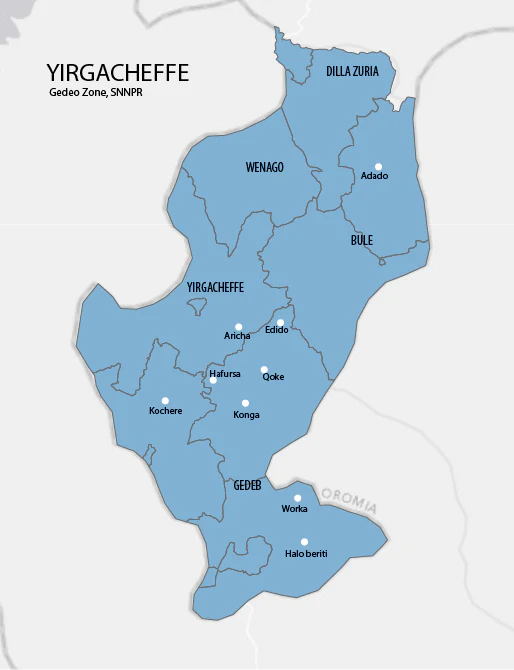
In fact, “Yirgacheffe” was originally just a small town and surrounding villages under the jurisdiction of Sidamo. However, due to its exceptionally outstanding coffee flavors, it eventually stood out and became its own independent producing region. Most of the coffee cultivation here is concentrated in villages around the Misty Valley, such as Idido, Harfusa, Hama, and Biloya. These areas generally sit at altitudes of 1,700 to 2,000 meters or higher, featuring large day-night temperature variations, year-round cloud cover, and evenly distributed rainfall—all of which provide an ideal growing environment for coffee trees.
The Turning Point in Washed Processing Techniques
In the early days, Ethiopia primarily used the natural (sun-dried) method for processing coffee. However, due to limitations in technology and management, this often led to over-fermentation and high defect rates, negatively affecting the final flavor. It wasn’t until 1972, when the Ethiopian government introduced modern washed processing techniques and established the first washed processing plant in the town of Yirgacheffe, that the overall quality of the coffee was significantly improved. The washed method not only effectively reduced defect rates but also better preserved the inherent clarity of the coffee's flavor characteristics. This gave rise to Yirgacheffe’s signature bright citrus acidity, delicate floral notes, and clean green tea-like finish—now widely recognized as the classic “Yirgacheffe flavor.”
Coffee cultivation in the Yirgacheffe region is mostly managed by local smallholder farmers or cooperatives. Many of the coffee trees were originally introduced and planted by European missionaries in earlier years and have since been maintained by local communities. These trees are often scattered around villages, coexisting with other crops, forming a unique mixed-cultivation ecosystem. Notably, some premium batches are processed using the natural method to enhance fruity aromas and rich mouthfeel, but the mainstream approach remains washed processing to showcase the region’s most classic and balanced citrus and tea-like flavor profile.
In terms of altitude, most coffee in the Yirgacheffe area is grown between 1,700 and 2,200 meters above sea level, with the Kochere sub-region being the most celebrated. Located at the southern edge of Yirgacheffe, Kochere boasts some of the highest altitudes in all of Ethiopia. Coupled with iron-rich soil and the genetic diversity of native coffee varieties, it produces exceptional coffee with vibrant acidity, rich floral aromas, silky texture, and a finish that carries hints of spice and complex fruit flavors.
After harvesting, the coffee in the Kochere region is typically hand-sorted by local farmers within the community to ensure only the ripest cherries are selected. Most of these coffee trees are old vines that retain the most original Ethiopian genetic traits, enabling them to express a layered and complex flavor profile. For coffee enthusiasts who pursue detail and regional character, Kochere can be considered a hidden gem within Yirgacheffe.
Practical Pour Over Recommendations and Extraction Parameters
If you’d like to brew Yirgacheffe G1 washed beans from Kochere at home, you can refer to the following practical parameters: Use a Baratza Encore grinder and set the grind size to level 18 (close to medium-fine). The recommended powder-to-water ratio is 1:15, with water temperature controlled at around 86°C. Pour steadily using a gooseneck kettle, aiming for a total extraction time of approximately 1 minute and 40 seconds. Use about 15 grams of coffee grounds to produce around 225 grams of brewed coffee. These parameters effectively highlight the bean’s citrus acidity, tea-like layers, and soft sweet finish, making it ideal for those who enjoy bright acidity and delicate flavors.
The above content is compiled by CoffeeHunters, a coffee news website.


