








Introduction:Kenya AA coffee beans, with their bright acidity and rich body, have become the top choice for coffee lovers who enjoy acidity but want to avoid the lighter style of Ethiopian beans. This article delves into the main growing regions of Kenyan coffee, bean variety characteristics, the rigorous grading system, and highlights the most representative K72 washed processing method, while also providing practical roasting and pour over parameter recommendations to help you better understand the charm of this classic African bean.
Kenyan coffee holds a unique place in the global specialty coffee market with its distinctive fruity acidity and full-bodied flavor. Especially for those who prefer acidity but are not accustomed to the bright and light style of Ethiopian coffee, Kenyan beans are often an excellent transitional choice. And when it comes to Kenyan coffee, one cannot overlook its star product — Kenya AA coffee beans. So, what exactly does AA represent? What kind of grading and processing logic lies behind it? This article will take you through a comprehensive exploration of the mysteries of Kenya AA coffee beans, from region, variety, grading to processing method.

Kenya is located in East Africa, with the equator running right through the center of the country and the East African Rift Valley stretching from north to south. Geographically, it borders Somalia to the east, Tanzania to the south, Uganda to the west, and Ethiopia and Sudan to the north, with the Indian Ocean to the southeast. The country is mostly highland terrain, with an average elevation of about 1,500 meters, and its highest peak is Mount Kenya (formerly known as Mount Kilimanjaro), which stands at 5,199 meters, making it the second highest peak in Africa. Thanks to the high altitude and significant day-night temperature variation, Kenyan coffee typically exhibits pronounced fruit acidity, a rich body, and abundant fruity notes. Compared to neighboring Ethiopia, although both regions feature fruit acidity as their main characteristic, Kenyan acidity is more intense and robust, whereas Ethiopian acidity tends to be lighter and brighter. If you are new to African beans, it is recommended to start with Ethiopian beans before gradually trying Kenyan coffee to appreciate the differences and layers.
Kenyan coffee cultivation is mainly concentrated in the central and western highlands, including six major regions: Thika, Kirinyaga, Mt. Kenya West, Nyeri, Kiambu, and Muranga. These areas have two main harvest seasons each year: the main season from October to December, and the secondary season from June to August. Among them, Thika and Kirinyaga are the two core regions that best showcase the characteristics of Kenyan coffee.
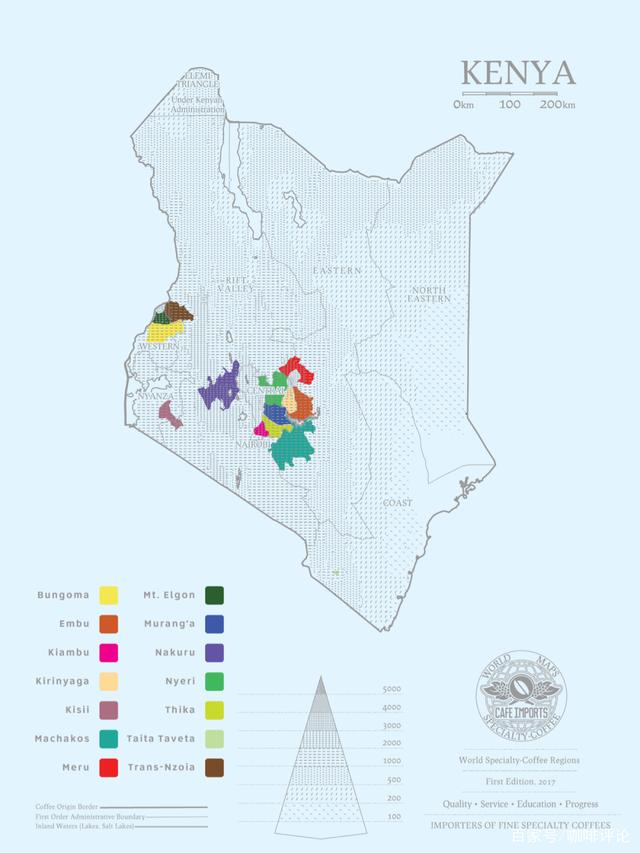
Thika is located in the suburbs of Nairobi, the capital of Kenya. Though it is an industrial town, it is surrounded by farmland and natural landscapes. The area has approximately 2,000 coffee farmers, and its coffee-growing history dates back to the late 19th century when coffee trees were initially introduced from nearby Ethiopia. After years of local improvement, the main varieties currently planted include Bourbon, Kents, SL34, SL28, Typica, and Ruiru 11. However, about 90% of the cultivated area is now SL34 and SL28. Although the new variety Batian was introduced in 2007, it has not yet been widely planted. The flavor profile of Thika coffee is characterized by bright acidity, rich berry juice notes, and honey-like sweetness. The planting elevation ranges between 1,550–1,750 meters, with the main varieties being SL-28 and SL-34.
Kirinyaga is located at the foot of Mount Kenya, adjacent to the Nyeri region, and is known for its intense, layered, and full-bodied coffee, considered one of Kenya’s top-tier coffee regions. This area is mostly made up of smallholder coffee farmers who produce collectively through cooperatives, which provide washed processing facilities where farmers deliver their harvested coffee cherries for centralized processing. The coffee from this region typically showcases bright acidity, medium body, and delicate sweetness, with elevations ranging from about 1,300–1,900 meters. The planted varieties include SL-28, SL-34, Ruiru11, and Batian.
Nyeri is one of the representative coffee-producing regions in Kenya, situated at the foot of Mount Kenya, featuring fertile red soil and a high-altitude environment ideal for coffee growth. The region is primarily composed of cooperatives formed by smallholder farmers rather than large estates. The region has two harvests per year, but the main season coffee generally boasts superior quality. Nyeri coffee is known for its bright berry juice notes, citrus tones, and subtle floral aromas, qualities that make Kenyan coffee stand out in the global market. Elevations range approximately from 1,200–2,300 meters, and the main planted varieties are also SL-28, SL-34, Ruiru11, and Batian.
When it comes to Kenyan coffee varieties, the most commonly planted are SL28, SL34, and Ruiru11. Among these, SL28 and SL34 are genetic variants and the primary sources of Kenya’s high-quality coffee, although these varieties are more susceptible to leaf rust. SL34 has a mixed lineage of French Mission, Bourbon, and Typica, and its copper-colored leaves and pea-shaped beans deliver outstanding sweetness, balance, and complex, varied flavors, with memorable citrus and dark plum notes. In contrast, Ruiru11 is a variety developed in 1985 against the backdrop of a global leaf rust epidemic. Although it has higher yields, its flavor profile is not as prominent as the SL series and is less favored in the specialty coffee market, occasionally used in blends to reduce costs.
The so-called “AA” is actually the grading standard for Kenyan coffee beans, primarily based on bean size. Kenyan coffee is generally divided into eight grades, with AA being one of the highest, representing a bean size of 17–18 mesh, typically offering the most outstanding flavor performance. In addition, there is AA Plus (AA+), referring to beans within the AA grade that perform exceptionally well in cupping; the AB grade has a bean size of 15–16 mesh and is the most widely circulated grade in the market; the C grade has smaller beans, while TT and T are lighter beans sorted by air; E refers to the rare elephant bean (a giant bean formed by two beans fused together), and PB refers to peaberry beans, which usually have no direct relation to flavor but are often favored in the market.
The processing method for Kenyan coffee is predominantly washed, and the most representative is the K72 washed process. Traditional washed processing steps include flotation, pulping, fermentation, washing, drying, hulling, and packaging, requiring stable water sources and equipment support. In Kenya, to address the issue of insufficient drying space, the so-called “double washing” or “fully washed” method was developed, where fermented coffee beans are washed again, sometimes even soaked multiple times before drying. Later, this practice evolved into the more systematic K72 washed process.
The key to the K72 washed process lies in the precise control of fermentation time: the coffee beans first undergo 24 hours of fermentation, are then cleaned after mucilage removal, followed by a second 24-hour fermentation and cleaning, and finally a third 24-hour fermentation, totaling 72 hours. This long and multi-stage fermentation process gives Kenyan coffee an exceptionally clean, bright, and layered fruity acidity, while maintaining extremely high purity. Many renowned processing mills, such as Asali Honey Processing Factory, use this technique to process their top-grade AA beans.
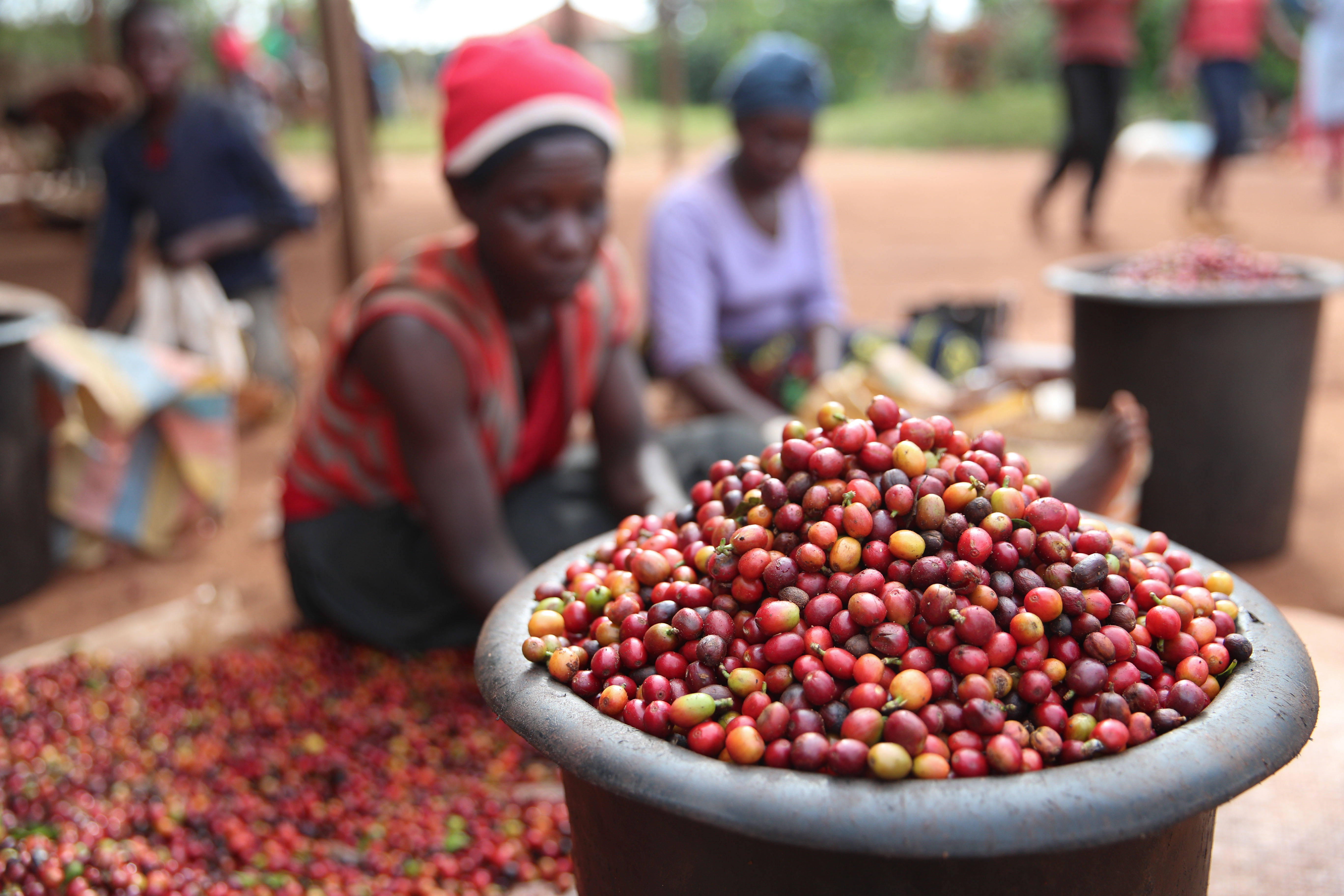
Take the Asali processing factory in the Thika region as an example. Its Kenya AA TOP grade coffee beans, produced using the SL28 and SL34 varieties and processed with the K72 washed method, exhibit bright acidity reminiscent of cherry tomatoes and dark plums, paired with honey-like sweetness and rich berry juice notes — a classic favorite among many pour over enthusiasts.
In terms of roasting recommendations, to fully highlight the fruity acidity and berry characteristics of Kenya AA coffee beans, a medium-light roast is generally used. Taking the Yangjia 800N roaster as an example, the charge temperature is about 200°C, the air damper is set to 3, and the heat is at 160. After the return to temperature at 1’34”, the heat and air damper are adjusted step by step to enter the dehydration and Maillard reaction stages, and the beans are dropped at 191.6°C, 2’10” after first crack, to preserve the maximum flavor details.
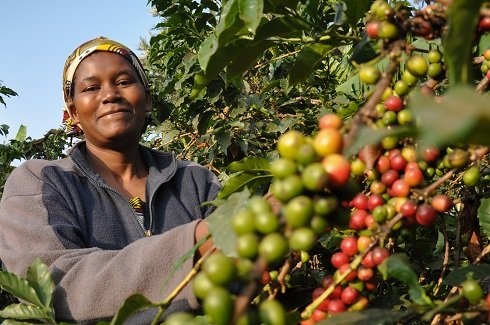
For brewing, since this bean is medium-light roasted, it is recommended to use a V60 filter cone with a high water temperature of 90–91°C to fully extract the bright acidity and juicy notes. The suggested powder-to-water ratio is 1:15, with 15g of coffee, ground to about 80% through a #20 sieve, or roughly the size of fine sugar. First, pour 30g of water for a 30-second bloom, then add 105g of water. When the water level drops to two-thirds of the coffee bed, add another 120g, for a total extraction time of about 2’10”, balancing acidity, sweetness, and body. The resulting coffee typically features flavors of dark plum and cherry tomato, with a noticeable sweetness in the mid-palate and an aftertaste of berry notes and green tea-like freshness. The acidity is solid yet not overly sharp, making it a classic option enjoyable for both beginners and advanced enthusiasts.
The above content is compiled by CoffeeHunters, a coffee news website.


