







Introduction:Delving into the century-long development of Yunnan small-grain coffee, the distinctive characteristics of its core growing regions, and the performance of classic varieties—with a special focus on the pour-over brewing method for sun-dried Typica from a particular Lincang estate. From historical origins to roasting applications, this guide provides a comprehensive analysis of the unique charm of this homegrown Chinese specialty coffee, along with professional-level bean selection and brewing references.
The story of Yunnan coffee began in 1892, when French missionary Térence Tien Dekeng planted the first batch of coffee seeds from Vietnam in Zhukula Village, inadvertently marking the start of domestic coffee cultivation in China. After over a century of development, this land has emerged as an important global specialty coffee-producing region. Its unique highland terrain and climatic conditions have nurtured a "small-grain coffee" system with distinct regional flavors.
Yunnan's coffee-growing zones are concentrated in dry-hot river valley areas at elevations of 800 to 1,800 meters, among whichthe area around 1,100 metersbenefits most from significant day-night temperature variations and abundant sunlight, making it ideal for the accumulation of flavor compounds in coffee beans. Major producing regions are distributed across Pu'er, Baoshan, Lincang, and Dehong: Pu'er, with its century-long planting history, boasts the largest contiguous coffee plantations in Yunnan; Baoshan is renowned for its 21°C annual average temperature and uniformly sized Typica beans, achieving an excellent balance of fruity aroma and body; Lincang, adjacent to the Tropic of Cancer,Annual average temperature of 21℃Renowned for its uniformly sized Typica beans with an outstanding balance of fruity aroma and rich body; Lincang lies adjacent to the Tropic of Cancer,with temperatures of 16°C and elevations exceeding 1,000 meters, produces a bright acidity reminiscent of Colombian coffee; Dehong features a typical South Asian tropical climate, suitable for cultivation at medium to high altitudes.
In terms of varieties, the traditional mainstay Typica is an ancient Arabica heirloom variety. Itsreddish-copper young leavesare a clear identifying feature. Though less resistant to disease, it delivers a smooth cup with prominent sweetness. Bourbon, a mutation of Typica, can exhibit more abundant fruitiness and sugar levels at high altitudes but is prone to biennial bearing. Widely cultivated Catimor, a hybrid of Timor (a Robusta lineage) and Caturra, boasts strong disease resistance and high yields but often struggles to reach specialty-grade status due to its monotonous flavor and pronounced bitterness.
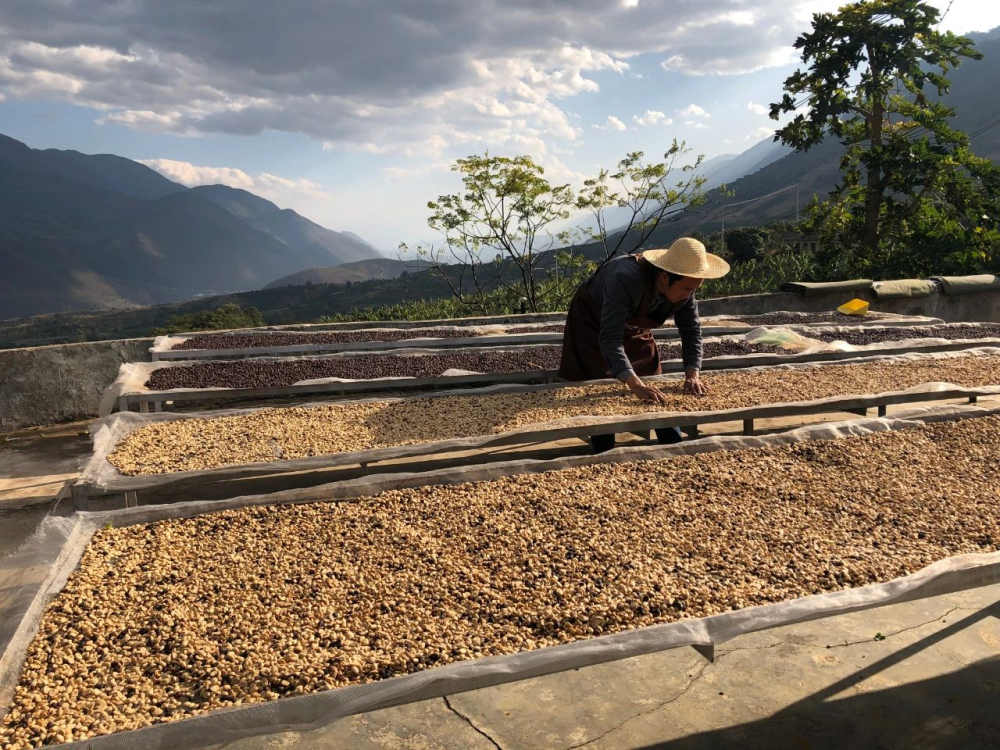
In processing methods, Yunnan producers predominantly use washed processing to ensure cleanliness, though innovative techniques like honey processing and anaerobic fermentation have been gradually adopted in recent years. Notably, one Lincang estate insists on traditional sun-drying for Typica: carefully selected ripe coffee cherries are thoroughly sun-dried, allowing the penetration of pulp sugars and microbial fermentation to impart a distinctly sweet and mellow profile. Coffees produced by this method often showcase lively plum-like acidity, velvety black-tea-like textures, and a long-lasting caramel sweetness in the aftertaste.
For home brewing of this sun-dried Typica, the recommended setup is a V60 filter cone with15 grams of coffee grounds and 225 milliliters of total water (a 1:15 brew ratio). For a clearer flavor layering, adjust to a 1:16 ratio. Grind size should be medium (approximately 78% passing through a #20 sieve), with water temperature controlled at88℃to soften the acidity. The brewing process consists of three stages: the first stage involves pouring 30 grams of hot water for a 30-second bloom to initiate enzyme release; then, a slow circular pour is used to reach 125 grams for the first drawdown, followed by a continuation to 225 grams as the liquid level nears the bed surface (total brew time approximately2 minutes and 10 seconds). This parameter combination effectively highlights the tripartite flavor structure of plum acidity, black-tea texture, and caramel aftertaste.
The above content is compiled by CoffeeHunters, a coffee news website.


