







Introduction:The sun-dried Huakui coffee from Ethiopia's Sidamo region is renowned for its pronounced floral aroma and ripe fruit character. It offers a sweet entry with a long-lasting aftertaste, and its honey-like sweetness is particularly unforgettable. This Heirloom varietal coffee, grown at high altitudes, not only boasts the prestigious G1 grade but also showcases the unique charm of Ethiopian coffee. This article delves into the terroir of the Sidamo region, the origins of the Heirloom variety, the G1 grading system, and provides practical V60 pour-over parameters to help you master the brewing techniques for this popular coffee bean.
The sun-dried Huakui coffee produced in Ethiopia's Sidamo region is beloved by coffee enthusiasts for its distinctive floral notes and rich fruit character. This coffee is not only sweet on the palate but also leaves a honey-like aftertaste that lingers delightfully. What’s more, it offers great value for money, with a half-pound pack typically priced around 65 yuan, making it an excellent choice for high-quality specialty coffee.
As the birthplace of Arabica coffee, Ethiopia is home to many renowned coffee regions, among which Yirgacheffe and Sidamo are particularly representative of specialty coffee. Yirgacheffe is known for its washed processing method, which highlights bright and clear jasmine-like floral notes, while Sidamo excels in sun-dried processing, imparting richer aromas and sweetness. Huakui coffee is one of the classic representatives of the Sidamo sun-dried processing method.
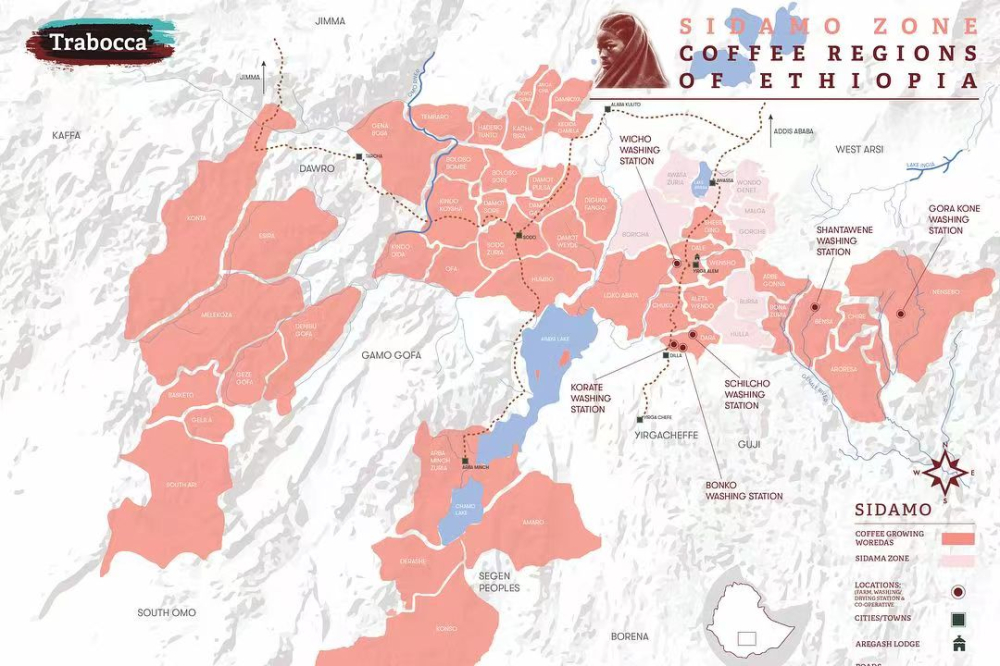
Located in southern Ethiopia and adjacent to Yirgacheffe, Sidamo is another region with a reputation for producing specialty coffee. Interestingly, in 2006, Starbucks attempted to trademark the name "Sidamo," sparking strong opposition from local producers. Two years later, Starbucks withdrew its application and shifted to a cooperative purchasing model. The altitude in Sidamo ranges from 1,400 to 2,000 meters, and the region’s diverse terrain and climate contribute to the wide variation in its coffee flavors.
The unique flavor profile of coffee from this region is closely tied to its soil composition, microclimates, and numerous Heirloom varieties. To allow consumers to experience the distinct characteristics of different Ethiopian coffee regions, a variety of single-origin beans—including both sun-dried and washed options—have been introduced to cater to diverse taste preferences.
Regarding the Heirloom variety used in Huakui coffee, it is actually a general term for Ethiopia’s unique "native varieties." Since most coffee farmers in the region practice small-scale garden cultivation, the varieties they grow often lack formal names. These may be inherited from previous generations, exchanged among neighbors, or even seeds introduced from other areas. As such, Heirloom is not a single variety but rather a blend of many unclassified ones, which also explains why each batch of beans may vary slightly in size and shape.
Ethiopia’s coffee grading system is also worth exploring. Before the establishment of the ECX (Ethiopian Commodity Exchange), coffee grades were primarily determined by the number of defective beans in a 300-gram sample of green beans. Huakui belongs to the G1 grade, the highest level of specialty coffee, indicating that its green beans have undergone rigorous screening—not only with a low defect rate but also with meticulous attention to detail during processing. This coffee is grown at elevations between 2,200 and 2,500 meters, and its flavor profile often features rose-like floral notes and peach-like aromas, with an aftertaste as smooth as black tea.
The sun-dried processing method in the Sidamo region is highly refined. Only fully ripe coffee cherries are selected during harvest to ensure uniform size and ripeness. Before processing, the cherries undergo strict hand-sorting to remove defective beans. The red coffee cherries are then evenly spread on elevated wooden racks or platforms to dry naturally under the sun. During this process, they are frequently turned to prevent mold or the absorption of off-flavors. Typically, every three to five days, farmers reinspect and remove subpar beans until the skins become completely hard and dry. Finally, a hulling machine removes the hardened outer skin, followed by a final screening to ensure the quality of the green beans.
In comparison, while washed processing yields a cleaner taste, sun-dried processing better accentuates the coffee’s aroma and sweetness, giving Sidamo Huakui its unique fruity notes and rich aftertaste. It is believed that this method preserves more of the coffee’s inherent terroir characteristics, which is one of the reasons this coffee is so well-loved.
To fully appreciate the layered flavors of Huakui coffee, it is recommended to use a V60 dripper for pour-over brewing. The V60’s 60-degree conical design helps concentrate the coffee grounds, allowing the water flow to naturally converge toward the center during pouring, extending the contact time between water and coffee grounds and improving extraction efficiency. Additionally, its internal clockwise spiral ribs increase the gap between the filter paper and the dripper, ensuring smooth water flow. Combined with the large bottom hole, this design results in a faster overall extraction rate, helping to highlight Huakui’s bright acidity and fruity notes.
The recommended pour-over parameters are as follows: Use a V60 dripper, set the water temperature to 90°C, maintain a coffee-to-water ratio of 1:15, use 15 grams of coffee grounds, and grind to a medium-fine consistency (approximately 80% extraction through a Chinese No. 20 standard sieve). This setup balances the extraction rate, avoiding over- or under-extraction, and fully showcases Huakui’s rich flavor profile.
During actual brewing, freshly harvested Huakui coffee often exudes a strong aroma of ripe fruits. Upon tasting, you’ll notice pronounced fermentation notes and the fresh flavor of green grapes. As the temperature cools, lemon-like acidity and a creamy mouthfeel gradually emerge, with the finish reminiscent of the juice of ripe grapes. The overall flavor profile is well-layered, with a long-lasting aftertaste.
The above content is compiled by CoffeeHunters, a coffee news website.


