







Introduction:Jamaican Blue Mountain coffee is renowned for its delicate and balanced flavor profile and has long been regarded as a flagship specialty coffee. This article delves into the unique terroir characteristics of Jamaican Blue Mountain, the official CIB grading standards, with a special focus on the stringent requirements of the top-grade NO.1. It also details how the washed processing method influences flavor, and provides expert brewing recommendations—including coffee-to-water ratio, water temperature, grind size, and a three-stage pouring technique—to help readers understand how to brew a cup of Blue Mountain coffee that boasts the combined aromas of dark chocolate, nuts, and caramel.
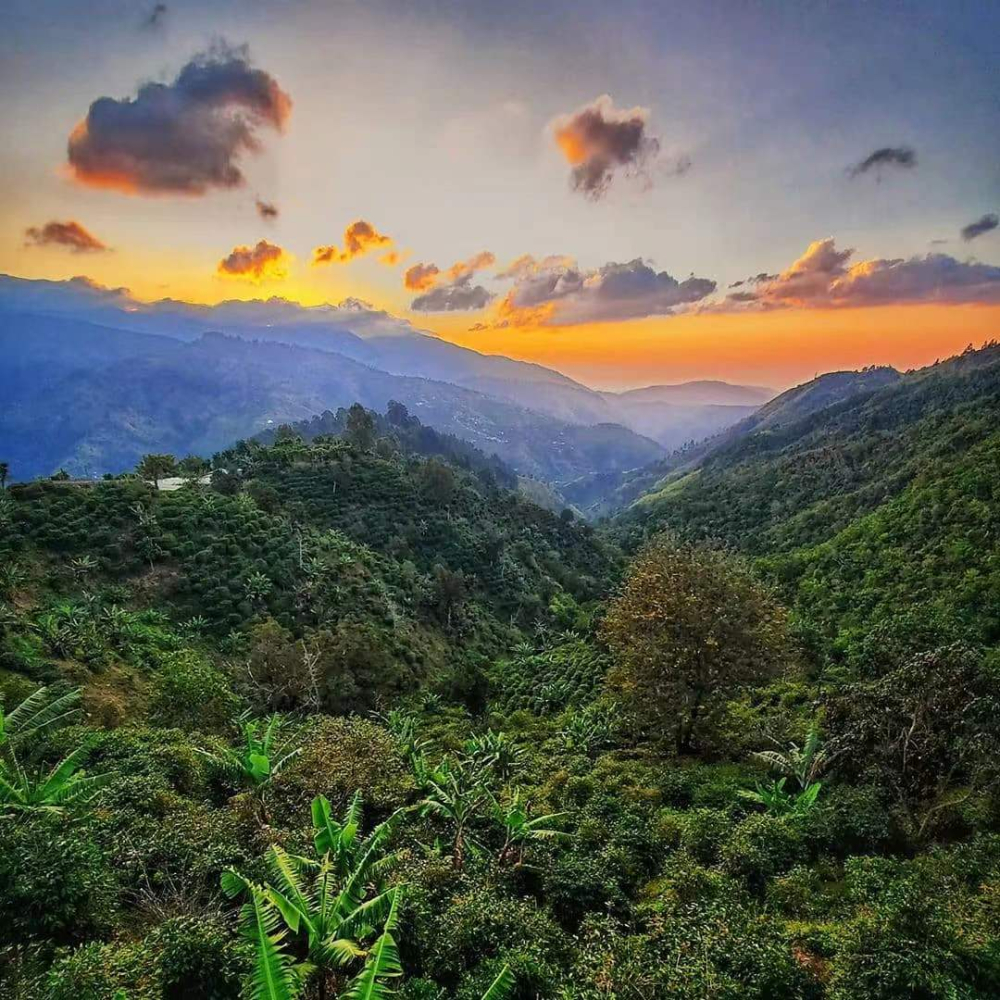
Located in the northeastern part of Jamaica, the Blue Mountains boast exceptional geographical and climatic conditions, which are key to the cultivation of Blue Mountain coffee. The area features towering mountains often shrouded in clouds, which not only reduce direct sunlight damage to the coffee trees but also maintain stable temperatures and humidity levels. The region experiences two main rainy seasons annually—May to June and September to November—coupled with excellent slope drainage, creating an ideal environment for growing Arabica coffee.
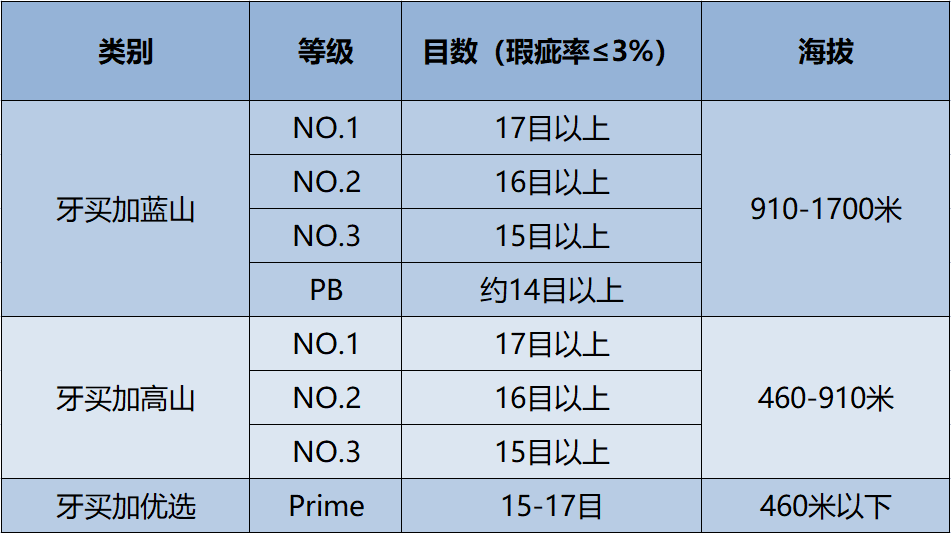
According to the standards set by the Jamaica Coffee Industry Board (CIB), only Arabica coffee grown at elevations above 910 meters qualifies as “Jamaican Blue Mountain coffee.” Coffee produced at lower altitudes is classified as Jamaican High Mountain or Jamaican Prime. The higher the altitude, the greater the challenges in cultivation and harvesting, which is why coffee beans from the high-altitude Blue Mountain regions are not only limited in yield but also relatively expensive.
Jamaican Blue Mountain coffee is further categorized into four grades based on bean size, defect rate, and cupping performance: NO.1, NO.2, NO.3, and PB (Peaberry, or round bean). Among these, NO.1 is the highest grade and is widely recognized as the benchmark for premium Blue Mountain coffee. To be classified as NO.1, green coffee beans must meet strict criteria, including uniform bean size, low defect rates, and complex, balanced cupping flavors.
Export-quality Blue Mountain green beans must pass rigorous quality inspections by the Jamaican Ministry of Agriculture. During inspection, a 300g sample is taken, with the requirement that 96% of the beans fall within the 17 to 18 mesh size range, the defect rate must not exceed 2%, and the moisture content should be around 13%. Additionally, the cupping profile must exhibit a well-rounded balance of acidity, sweetness, bitterness, aroma, and body to be certified as top-tier Blue Mountain NO.1 beans. The Blue Mountain No.1 we sourced is precisely this premium-grade coffee.
Due to the exceptional quality and rarity of Blue Mountain coffee, past market discussions often included phrases like “hard to buy,” “overpriced,” or even “prevalence of fake Blue Mountain.” However, nowadays, a significant amount of authentic Blue Mountain green beans are imported through legitimate channels, making it easier for consumers to access genuine products. Currently, the market price for Blue Mountain No.1 coffee is approximately 158 RMB per 100 grams. For a typical 1 to 2-person serving, each pack can yield about 5 to 6 cups of pure black coffee; alternatively, visiting a café to try it may cost around 60 RMB to experience the classic Blue Mountain flavor.
Blue Mountain NO.1 green beans are transported in handmade wooden barrels, unlike the common jute sacks used for other coffees. These barrels come in three sizes: 70 kg, 30 kg, and 15 kg. Not only do they help protect the beans, but they also serve as one of the hallmarks of authentic Blue Mountain coffee. Upon inspecting the barrels, you’ll typically find the official Jamaican Blue Mountain coffee logo, the name of the producing estate, and information such as the net weight of the barrel and coffee. Notably, the Blue Mountain No.1 we offer comes from the Clifton Estate, a member of the Rainforest Alliance, and thus the barrels also bear the Rainforest Frog certification mark.
The Clifton Estate has long employed the washed processing method for its Blue Mountain coffee beans. This meticulous process significantly reduces defect rates while enhancing the purity and clarity of the final flavor. The washed process involves the following steps: after harvesting, the coffee cherries are first depulped by a pulper to remove the outer fruit skin, then placed in fermentation tanks for about 24 hours to allow natural enzymes to break down residual mucilage. The beans are subsequently rinsed repeatedly in clean water tanks, where the friction between water flow and beans removes any remaining sticky residue. Finally, the parchment-covered beans are evenly spread out to undergo sun-drying or raised-bed drying for 2 to 3 weeks until the moisture content drops to 12% to 14%.
The washed process not only effectively controls the fermentation but also avoids excessive interference from impurities and off-flavors, resulting in a cleaner, brighter acidity and more nuanced aromatic layers in the final Blue Mountain coffee. This processing method is one of the key factors enabling Blue Mountain coffee to express flavors of dark chocolate, nuts, and caramel.
For medium to dark roasted Blue Mountain No.1 coffee, using a KONO filter cone for pour over is recommended to enhance overall body and mouthfeel richness. The suggested water temperature is 88°C, with a grind size close to coarse sugar—using a 20-mesh standard sieve, aim for a 75% extraction rate. Maintain a coffee-to-water ratio of 1:15. Typically, using 15 grams of coffee beans, the total brew water is 225 grams, with a total extraction time of around 2 minutes and 10 seconds.
Since freshly roasted coffee beans are still in their degassing phase, especially within the first 1 to 2 days after arrival, it is recommended to let the beans rest for 7 to 10 days until their flavors have fully developed before brewing, in order to achieve optimal aroma and taste performance.
A commonly recommended three-stage pouring method is as follows: start by pouring 30 grams of hot water for a 30-second bloom; then proceed to the second pour, adding water up to about 125 grams, and when the water level drops halfway, perform the final pour up to 225 grams. Finally, wait until all the coffee liquid has dripped through to complete the brew.
The final flavor profile of Jamaican Blue Mountain No.1 coffee is clear and well-defined: a rich base of dark chocolate aroma is complemented by delicate nutty notes and a smooth caramel sweetness. The mouthfeel is buttery-smooth, with a balanced interplay of acidity, sweetness, bitterness, and saltiness. The aftertaste is clean and slightly sweet, offering a rich yet harmonious flavor complexity—making it one of the quintessential representations of classic Blue Mountain coffee flavor.
The above content is compiled by CoffeeHunters, a coffee news website.


