







Introduction:Colombian coffee is renowned worldwide for its rich and layered flavor profiles, ranging from intense dark chocolate to captivating floral and fruity aromas. This South American coffee kingdom showcases diverse and fascinating characteristics. This article will take you on an in-depth exploration of the terroirs and flavor features of Colombia’s three major producing regions—northern, central, and southern—and will analyze the classic everyday beans from Huila Province and the unique charm of the high-altitude sakura processing method at Paradise Estate. Practical roasting and pour over parameters are also provided to help you explore the multifaceted nature of Colombian coffee.
Colombian coffee has long been hailed as the “green gold,” with its classic flavor profile known for its rich dark chocolate notes and full body. However, with the rise of the specialty coffee trend, this major coffee-producing country in South America has also demonstrated an increasingly diverse range of fruity acidity and delicate floral notes, catering to coffee lovers of all levels.
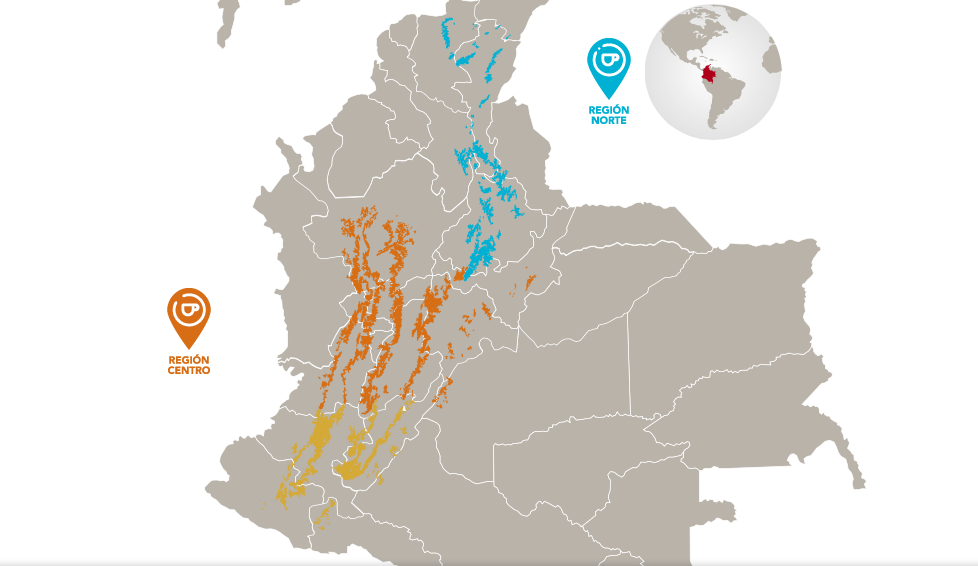
Colombia’s terrain is highly varied, stretching across both sides of the Andes Mountains in the west. Based on geographical and climatic conditions, it can be broadly divided into three major producing regions: northern, central, and southern. Each area, due to differences in altitude, temperature, rainfall, and soil, produces coffee with distinctly unique personalities—from bold to bright—with an extremely rich variety of flavor layers.
The northern provinces such as La Guajira, Magdalena, and Cesar, located at low latitudes with relatively high temperatures, often see coffee trees exposed to intense sunlight. As a result, shaded planting is commonly used to slow down overripening of the beans. The acidity of coffee from this region is relatively mild, but it performs excellently in terms of aroma and body, making it suitable for drinkers who prefer a balanced flavor.
The central producing region covers provinces such as Antioquia, Valle del Cauca, Tolima, and Quindío. It is the core production zone of Colombian coffee and the hub of traditional cultivation methods. Not only does this area have high output, but its moderate geographical environment also results in coffee beans that balance stable quality with diverse flavors, making it one of the go-to sources for many roasters.
The southern producing regions, including Caldas, Huila, and Nariño, benefit from high altitudes and proximity to the equator, becoming important representatives of Colombia’s specialty coffee. The large diurnal temperature variation here causes coffee cherries to ripen more slowly, allowing them to accumulate richer flavor compounds. With bright acidity and distinctive floral and fruity aromas, they are highly favored in the specialty coffee market.
The selected Huila everyday beans come from Huila Province in southern Colombia and are presented using the washed processing method to showcase the most representative terroir traits of the region. The washing process removes the pulp and some impurities, preserving a clear and bright coffee essence. For roasting, a medium-dark roast is chosen to enhance the classic dark chocolate character and bring out a rounded lemon acidity along with caramel sweetness. This makes it suitable for daily drinking and for pour over beginners looking to experience the classic profile of Colombian coffee.
Another notable coffee comes from Paradise Estate, grown in the mountainous region of Caldas Province, Colombia, at an altitude of up to 2050 meters. This estate is known for its innovative processing methods. These sakura-flavored coffee beans are processed using a double anaerobic washed method, which not only preserves the bright acidity brought by the high altitude but also highlights unique layers of floral and fruity notes. The variety used is Castillo, a locally popular and widely adaptable cultivar that thrives at high elevations.
The success of Paradise Estate is inseparable from its owner, Diego Samuel. Since taking over this family-run small estate in 2008, he has continuously learned and innovated, successfully establishing the estate as a model for specialty coffee. In 2015, it won the local cupping competition championship. Currently, the estate grows a diverse range of varieties, including Bourbon, Laurina, Geisha, and Castillo, continuing to explore the potential of coffee.
When roasting these Paradise Estate sakura coffee beans, a medium roast strategy is employed to preserve their bright acidity and complex floral and fruity notes. For pour over enthusiasts, it is recommended to use a Hario V60 filter, with water temperature controlled at 90°C, around 15 grams of coffee grounds, and a 1:15 coffee-to-water ratio. The grind size is suggested to be medium-fine, based on an 80% passing rate through a Chinese standard No. 20 sieve, which helps highlight the delicate flavors.
For the extraction steps, it is first recommended to perform a 30-second bloom to help release gases and initiate flavor development. Since it is freshly roasted coffee, the optimal flavor window is typically between 4 to 7 days post-roast, making it ideal for pour over. The bloom time can be flexibly adjusted based on bean expansion—if the degassing is still strong, it can be extended to about 40 seconds.
Then, pour 30 grams of hot water in a center pour for the bloom, followed by a slow circular pour up to 125 grams. When the water level is about to expose the coffee bed, continue pouring until the total water volume reaches 225 grams. The overall extraction time is controlled at around 2 minutes. With these parameter settings, the Paradise Estate sakura beans’ unique golden herbaceous and mugwort aromas can be fully expressed, with a sweet-sour aftertaste carrying a soft strawberry note, achieving a balanced and layered flavor profile.
In summary, the charm of Colombian coffee lies not only in its traditional bold and rich profile but also in the rich and varied flavor expressions nurtured by its diverse producing regions. Whether you are a beginner just starting with pour over or a seasoned coffee enthusiast seeking new flavors, you can find your ideal cup among Colombia’s various regions.
The above content is compiled by CoffeeHunters, a coffee news website.


