







Introduction:Kenyan coffee is renowned for its distinctive berry flavors, but grades like AA, PB, and E often confuse coffee newcomers. This article delves into Kenya’s bean-size-based grading system, explaining the differences between E (elephant bean), PB (peaberry), and AA grades. Through a pearl peaberry from the Ichamama washing station in the Nyeri region, we share a complete journey—from the green bean background and four different roast curve experiments to cupping flavors. Finally, we also provide practical pour-over parameters and flavor profiles for Kenyan AA to help you select and brew Kenyan beans more precisely.
Kenyan coffee has always held an important position in the global specialty coffee market, especially with its bright acidity and rich berry characteristics, which are deeply loved by coffee enthusiasts. However, many consumers are often puzzled by the common letter markings on Kenyan coffee beans, such as AA, PB, and E. What do these grades actually mean? What are the differences between them? This article will start with Kenya’s official coffee grading system to help you systematically understand these grades. Through a pearl peaberry (PB) from the Ichamama washing station in the Nyeri region, we will take an in-depth look at its green bean information, processing methods, and the impact of different roasting strategies on flavor. We’ll also offer practical pour-over recommendations and flavor profiles for Kenyan AA, helping you feel more confident in selecting and brewing these beans.
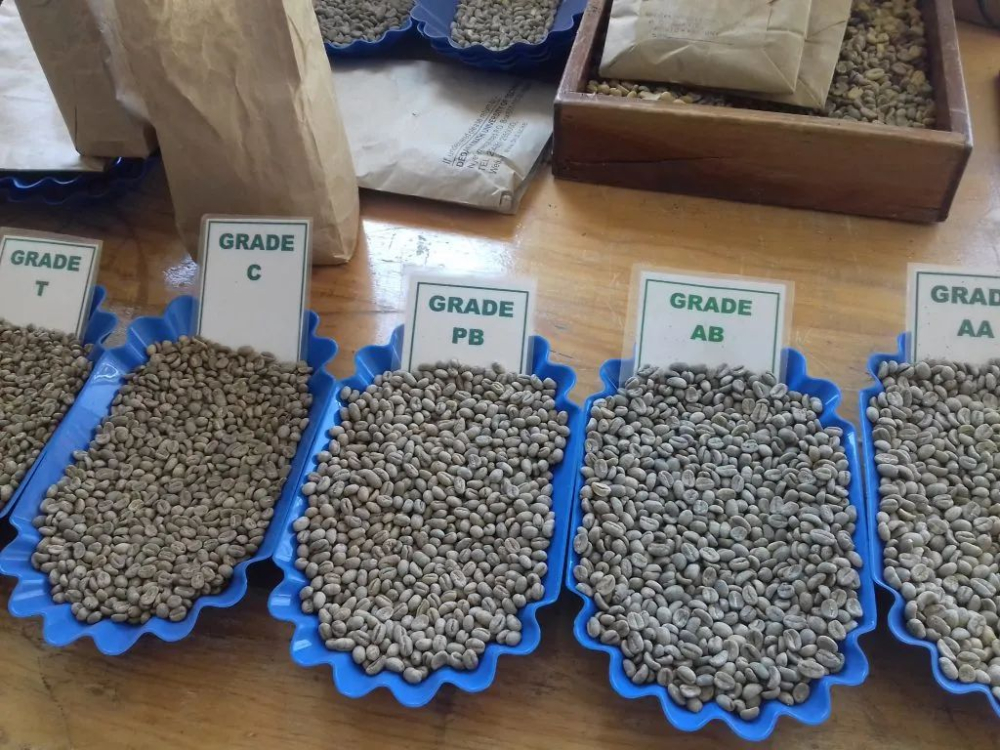
The grading of Kenyan coffee is primarily based on the size of the green beans. This grading method helps ensure even heat distribution during roasting, avoiding uneven roasting caused by significant differences in bean size. Common Kenyan coffee grades include: E (elephant bean), PB (peaberry), AA, AB, C, TT, T, and MH/ML. Among them, Grade E refers to the largest-sized coffee beans, commonly known as elephant beans; PB are peaberries, also called pearl peaberries. Normally, a coffee cherry contains two seeds, but a PB has only one, giving it a more spherical shape, and it accounts for only about 5% of Kenya’s total coffee production. AA beans are those that pass through an 18-mesh sieve or above, typically grown at altitudes exceeding 6,600 feet, and are considered representative of high-quality Kenyan coffee. AB beans are 16-mesh, a mix of Grade A (6.8 mm sieve) and Grade B (6.2 mm sieve). Grade C is around 15 mesh. TT consists of lightweight beans sorted out from AA, AB, and E using air classification. T beans are small broken beans with defects, while MH/ML are unripe beans.
To help readers better understand the actual performance of Kenyan PB peaberries, we take as an example the green beans from the Ichamama washing station in Karimba village, Nyeri region, and explain in detail their background and processing features. These Kenyan Nyeri Ichamama pearl peaberries come from the Othaya Farmers' Cooperative Society, located in the central highlands of Kenya’s Nyeri region, about 120 kilometers from the capital Nairobi. It is one of Kenya’s largest farmer cooperatives, holding Fair Trade certification and dedicated to improving smallholder farmers’ incomes and coffee quality. The cooperative has 19 washing stations, including Ichamama, as well as its own nursery and laboratory, continuously conducting trials of new varieties and agronomic research.
Here is the green bean information for this peaberry: grown at an altitude of 1,700–1,750 meters in volcanic soil, the variety is SL28 and SL34, the harvest season is from November to January each year, and the processing method involves water sorting, washed processing, followed by African-style raised bed sun drying. Due to the high-altitude growing environment, Kenya coffee experiences large day-night temperature variations, causing slow ripening of coffee cherries. This results in complex flavor layers and bright acidity, which is one of the reasons Kenyan coffee is so highly regarded.
For the roasting experiment, we conducted four different roast curve tests on this PB peaberry: FSSF style (fast in, slow out), adding heat at the yellowing point to promote Maillard reactions, adding heat at the browning point to enhance caramelization, and SSFF (slow in, fast out) with gradual heat increase. The roaster found that due to this bean’s high moisture content and high density, using a conventional drop temperature could lead to an overly high turnaround point, and the Rate of Rise (ROR) after first crack tends to drop sharply. Therefore, the adjustment strategy focused on extending the drying phase to ensure heat penetrates the bean core, and moderately increasing heat before first crack to bring out richer berry flavors and a fuller body.
Observing the beans from the four roasts, a gradual reduction in heat resulted in more chaff attachment, grassy aromas, and underdevelopment. In contrast, the three roasts with increased heat exhibited flavors of black plum, blackcurrant, and sugarcane sweetness. Ultimately, roast curves 2, 3, and 4 were selected for cupping. The cupping results showed that this PB peaberry has a steady flavor profile, with wine-like acidity. During sipping, notes of dark berries, apple-like acidity, along with sugarcane sweetness and cocoa aromas can be perceived. The overall mouthfeel is full and rounded. Notably, extending the drying time and controlling the ROR effectively reduced astringency and improved drinkability.
To more intuitively compare PB and AA, we also brewed a Kenyan Small Tomato AA coffee bean as a control. This bean comes from the Nyeri Assaliya washing station, grown at an altitude of 1,700–1,900 meters, with the same SL28 and SL34 varieties, using the K72 washed process. Although labeled as 72-hour fermentation, the actual fermentation time reached 80 hours, resulting in a brighter acidity. We used a V60 dripper, with water at 90°C, 15 grams of coffee, a 1:15 coffee-to-water ratio, and a grind size with 77% passing through a 20-mesh sieve. Using a pulsed extraction method: 30 grams of water for a 30-second bloom, then slow pouring to 125 grams, followed by pouring to 225 grams, with a total extraction time of about 2 minutes. It presented pronounced dark berry flavors, bright acidity and sweetness, shifting to grape-like acidity when cooled, and a tart plum-like sensation at lower temperatures, with a long-lasting aftertaste.
In summary, Kenya’s coffee grading system is mainly built on bean size, with AA and PB being the two most notable grades. AA is known for its high altitude, large bean size, and clear berry flavors, while PB, due to its peaberry nature, is often considered to have more concentrated and fuller flavors. Practical roasting and cupping comparisons not only deepen your understanding of the differences between these two grades but also provide clear guidance for everyday bean selection and pour-over brewing. If you enjoy bright acidity and berry flavors, Kenyan AA is an excellent choice. If you prefer a fuller, rounder coffee with dark berry notes, try the PB peaberry, and fine-tune your extraction parameters according to actual roasting conditions to find your optimal flavor profile.
The above content is compiled by CoffeeHunters, a coffee news website.


