







Introduction:Kenya AA coffee beans, with their bright, vibrant acidity and rich, full-bodied flavor, have become a key choice for pour over enthusiasts exploring African beans. This article delves into Kenya’s core coffee-growing regions, the characteristics of the SL28 and SL34 varieties, the unique craftsmanship of the K72 washed processing method, and compares the acidity differences with Ethiopian beans—helping readers fully grasp the classic flavor profile and brewing essentials of this exceptional coffee.
Kenyan coffee has long been celebrated for its bright acidity and solid body, making it a top pick for many pour over lovers when trying African beans, aside from Ethiopian options. This article will begin with Kenya’s geographical environment, analyze the terroir of its core regions, explore how areas like Thika and Kirinyaga shape the unique character of the coffee, while introducing the origins and performance of the classic SL28 and SL34 varieties, and focusing on the pride of Kenya—the K72 washed processing method—to take you deep into the craftsmanship behind this multi-dimensional flavored coffee.
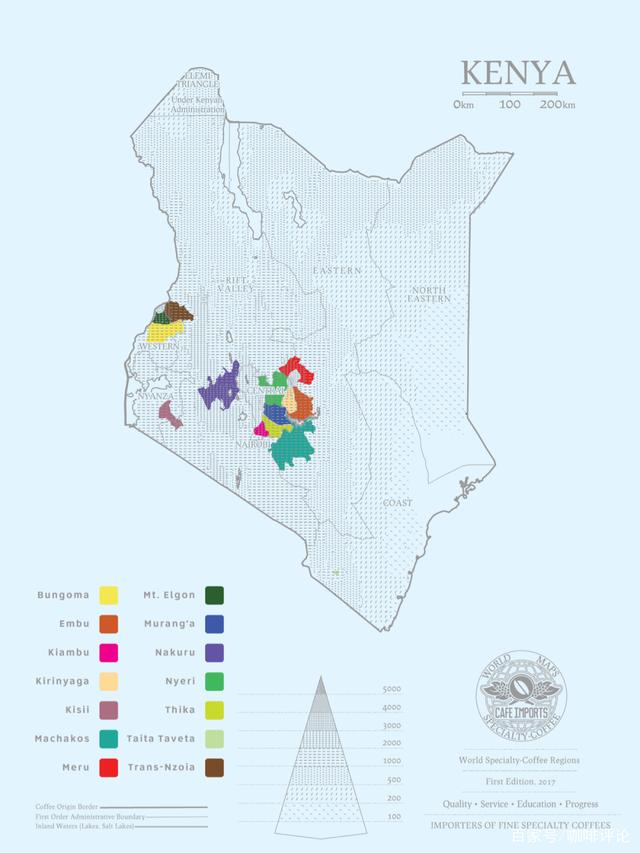
Located in East Africa, Kenya is traversed by the equator and the East African Rift Valley runs from north to south. The terrain is predominantly highland, with an average national elevation of about 1,500 meters and numerous high-altitude areas suitable for coffee cultivation. The country’s highest peak, Mount Kenya, stands at 5,199 meters, featuring a cool climate and significant day-night temperature variations—all of which contribute to the slow ripening of coffee cherries and the accumulation of richer flavor compounds. Kenyan coffee is renowned for its distinct acidity, layered complexity, and robust body, making it especially appealing to those who enjoy vibrant acidity without sacrificing body.
Coffee cultivation in Kenya is primarily concentrated in the central and western highlands, encompassing six major regions: Thika, Kirinyaga, Nyeri, Kiambu, Muranga, and Kirinyaga. The harvesting seasons across these regions are largely similar, mainly falling within the main season from October to December and the secondary season from June to August. Due to differences in altitude and microclimate, even with similar varieties and processing methods, these regions can still exhibit subtle yet captivating flavor variations.
Among them, Thika and Kirinyaga are considered quintessential representatives of Kenyan coffee flavors. Thika, located near the capital Nairobi, is an industrial town surrounded by farmland and natural landscapes, with around 2,000 local coffee growers. The history of coffee cultivation in Thika dates back to the late 19th century, with initial varieties introduced from neighboring Ethiopia and later improved through multiple iterations. Currently, the main planted varieties include SL28, SL34, Bourbon, Typica, and Ruiru 11, among which SL28 and SL34 dominate. Thika coffee is known for its bright acidity, rich berry notes, and honey-like sweetness, grown at altitudes between 1,550 and 1,750 meters.
The Kirinyaga region is situated at the foot of Mount Kenya, adjacent to Nyeri, and is one of the most highly regarded regions in the global specialty coffee market. The area consists of numerous smallholder coffee farmers organized into cooperatives that manage harvesting and post-harvest processing uniformly to ensure consistent quality. With an extensive altitude range from 1,300 to 1,900 meters, the climate conditions here create the rare layered complexity and delicate sweetness found in Kenyan coffee. The flavor profile is characterized by vivid acidity, a mid-palate oily texture, and a soft finish, also primarily cultivated with the SL28 and SL34 varieties.
The main coffee varieties grown in Kenya include SL28, SL34, and Ruiru 11. Among them, SL28 and SL34 are genetic variants and form the backbone of the region’s high-quality coffee. Though susceptible to leaf rust, the coffee they produce boasts extremely high flavor complexity—with bright acidity, prominent sweetness, and unique notes often including citrus and dark plum. Ruiru 11, on the other hand, is a hybrid variety developed in 1985 to resist widespread rust disease. While it offers higher disease resistance and yield, its flavor profile does not match that of traditional varieties and is generally used only in commercial blends, rarely reaching specialty-grade status.
When it comes to Kenya AA coffee beans, “AA” is actually a key indicator in its grading system. Kenya grades its green coffee beans by bean size, divided into eight grades, with AA being one of the highest, representing bean sizes between 17 and 18 screens, typically possessing the richest flavor potential. Additionally, AA+ refers to batches within the AA grade that exhibit exceptionally outstanding flavor and mouthfeel; AB grade beans measure 15 to 16 screens and are the market mainstream; C, TT, and T are beans of smaller size or lighter weight; E denotes the rare “elephant ear” beans which are double beans; PB refers to peaberry beans, which often due to higher density, exhibit different extraction responses but have no absolute correlation with flavor.
Kenya’s coffee processing is primarily washed, and it has developed unique “double washed” and K72 washed processing techniques. Traditional washed processing includes steps such as flotation, pulping, fermentation, washing, and drying, demanding relatively high water resources and equipment. Due to limited drying space in the early days, Kenya developed a “secondary soaking” technique—re-soaking fermented beans in clean water to lower temperature and delay drying time. This practice later became known as “Double Washed” or “Fully Washed,” forming the prototype of Kenya’s processing method.
Kenya’s most representative K72 washed process is an extension based on traditional washed methods. Its key lies in the precise control of the fermentation stage: the coffee beans undergo the first 24-hour fermentation, are washed, then go through a second 24-hour fermentation, repeating this cycle until the cumulative time reaches 72 hours. This technique not only effectively enhances the purity and layering of acidity but also significantly reduces interference from impurities and undesirable flavors, resulting in cleaner, brighter, and more distinctive fruit acidity—commonly exhibiting notes like small tomato, dark plum, and wine-like sweet-tart profiles. Many professional roasters and pour over enthusiasts praise the K72 process for its ability to fully showcase the delicacy and vibrancy of Kenyan coffee.
In summary, Kenya AA coffee beans, with their distinct acidity structure, full body, and unique processing methods, hold a notable place in the global specialty coffee market. Whether you’re new to African beans or seeking new inspiration for your pour over selection, gaining an in-depth understanding of Kenya’s regional characteristics, variety genetics, and the K72 washed process will help you more accurately master the brewing and tasting essentials of this classic coffee.
The above content is compiled by CoffeeHunters, a coffee news website.


