







Introduction:Have you ever wondered why some coffee products specifically label themselves as “100% Arabica”? In reality, this reflects the long-standing perception of Robusta coffee beans as inferior. This article delves into the origins, variety characteristics, price differences, and practical applications of Robusta, and explains the general market price range per jin. Whether you're a beginner coffee enthusiast or a professional wanting to understand the composition of blended beans, you’ll gain a more comprehensive insight.
Among the many coffee varieties, Arabica and Robusta are the two pillars of the commercial market, but in the specialty coffee realm, Arabica almost monopolizes the narrative, while Robusta is often labeled as “cheap” or “bitter.” Where does this stereotype come from? Where does Robusta actually originate? Why is its market price only half that of Arabica? How much is it per jin? This article will take you through taxonomy, historical development, flavor profiles, and practical uses to give you a complete understanding of this often overlooked coffee bean.
Currently, the mainstream coffee varieties in the global market can be divided into three main categories: Arabica, Robusta, and Liberica, with commercial value concentrated in the first two. In the culture of specialty coffee, Robusta is often marginalized. Consumers frequently hear merchants emphasize the slogan “100% Arabica,” as if Arabica were synonymous with nobility and elegance, while Robusta is like the ugly duckling that was cast aside.
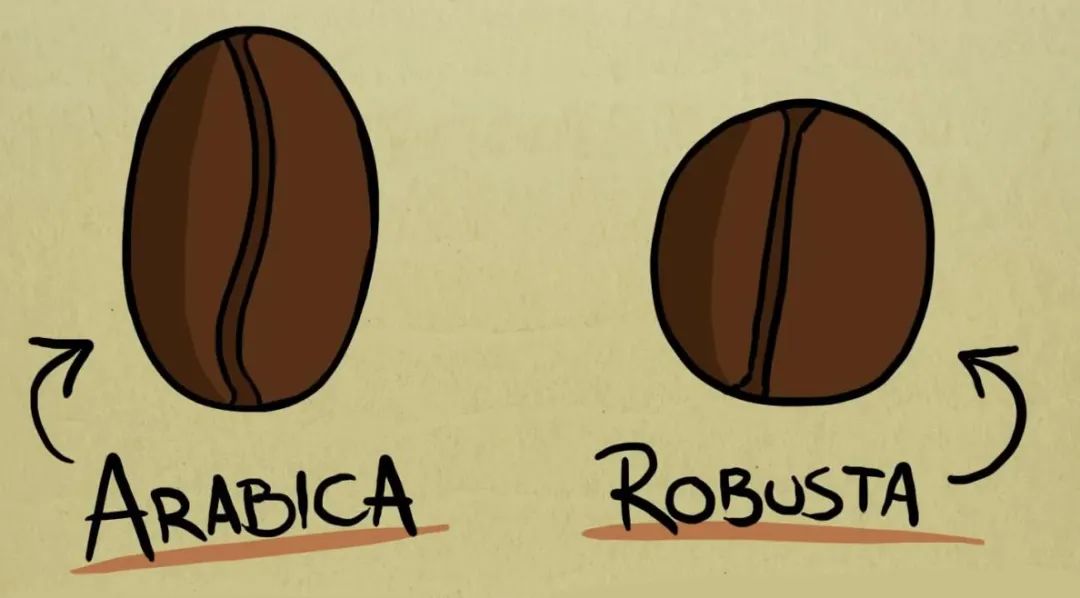
In fact, both Arabica and Robusta originated in Africa. Arabica is a small-seeded variety, originally grown in the high-altitude mountainous regions of Ethiopia, and later spread outward via the port of Mocha. Through prolonged cultivation and selective breeding, it evolved into several well-known cultivars such as Typica, Bourbon, Geisha, and Caturra—all classified under the Arabica variety.
As for Robusta, it is a medium-seeded variety, native to the Congo Basin on the west coast of Africa. From a botanical perspective, the formal scientific name for Robusta is “Coffea canephora,” which shares the highest-level classification with Arabica, except that Robusta is one specific variety within the Coffea canephora species—similar to how Typica is positioned within Arabica. However, since most other varieties within the Coffea canephora species remain wild or undeveloped, and only Robusta has been widely cultivated and commercialized, the term “Robusta” is now commonly used to represent the entire medium-seeded coffee category.
In terms of human domestication history, Arabica has been cultivated and utilized for centuries, whereas Robusta was not discovered until 1898 by Belgian botanists in the Congo region. It’s worth mentioning that at the time, the world was ravaged by coffee leaf rust, severely affecting many traditional Arabica varieties, while Robusta’s excellent disease resistance made it an important alternative in the affected regions, thus gradually gaining prominence.

Robusta once had its own golden era. Due to its higher caffeine content and rich oils, during the height of espresso’s popularity, Robusta was often used as part of the blend, especially when consumers prioritized caffeine intake. Additionally, its bold taste and unique aroma gave it a foothold in certain markets.
However, with the rise of the specialty coffee concept, consumer focus has gradually shifted from “stimulant effect” to “origin flavor.” Robusta’s inherent bitterness, along with common flavor notes like walnut, peanut, hazelnut, and smokiness, are often seen as negative traits in evaluation systems that emphasize refinement. Moreover, Arabica, which has been cultivated for years in various regions, offers far greater flavor diversity and complexity than Robusta. This “innate gap” makes the public favor Arabica more.
When it comes to roast suitability, Robusta is almost noncompetitive in light roasts. Light-roasted Arabica can showcase bright floral-fruity aromas and vibrant acidity, leaving a memorable impression. But when Robusta is processed the same way, it often releases monotonous flavors reminiscent of grains or almonds, accompanied by chaotic and unpleasant acidity. Overall, Robusta has almost no room to shine in the light roast domain.
Now look at dark roast performance: Robusta’s intense bitterness is further amplified during dark roasting. Although it also brings rich aromas, for many consumers, this bitterness is simply too harsh. For instance, Vietnamese consumers, though accustomed to drinking Robusta, often counterbalance the heavy bitterness by adding sweetened condensed milk or eggs, creating a unique local drinking culture.
Some have also asked: If Robusta is grown at high altitudes, can its flavor profile be improved? Indeed, some producers have tried this approach to enhance quality. For example, India’s “Coffee Royale” Robusta is cultivated using the standards of specialty Arabica, resulting in a cleaner taste, fewer of the usual rough off-flavors, and the emergence of rich peanut, hazelnut, and wheat-like aromas, with a fuller and more stable mouthfeel. However, such cases remain rare and require substantial resources and technology, making them difficult to replicate on a large scale.
Although improving growing environments and techniques can slightly enhance Robusta’s flavor, its genetic nature determines that it can never achieve the delicate complexity of Arabica. When the mainstream market preference still leans toward Arabica, Robusta struggles to turn the tide—because people often judge it based on its differences from Arabica, and even if that comparison isn’t entirely fair, it is the reality.

If Robusta doesn’t excel in flavor, then what is its market position? In fact, Robusta’s greatest advantage lies in “price.” For example, in the Brazilian producing region, regular Robusta typically costs only about half that of ordinary Arabica, with a per-jin price usually falling within a relatively affordable range. Additionally, Robusta significantly outperforms in body and caffeine content. These three characteristics make it the preferred raw material for instant coffee production.
Of course, some higher-quality Robusta beans, which boast prominent caramel aromas and rich oils, are also used in premium espresso blends or sold as single-origin Robusta coffee. If you enjoy traditional-style espresso, you might want to try classic blends containing Robusta. These recipes often release complex aromas of butter, nuts, spices, and dark chocolate after extraction, with rich crema and a bold mouthfeel. Paired with professional latte art, they can deliver a profound coffee experience.
However, it’s also worth noting that some Robusta beans still have quite intense flavors. For example, certain Vietnamese Robustas, though carrying rich cream and milk aromas, also deliver a rather shocking bitterness. It’s recommended to drink them with milk to balance their strong flavor impact.
The above content is compiled by CoffeeHunters, a coffee news website.


