







Introduction:Colombia is a globally renowned Arabica coffee origin, and its green bean export grading system is centered on defect rate and bean size. Common grades such as Supremo and Excelso are actually based on rigorous screen size and defect tolerance standards. This article delves into the export specifications set by FNC, explaining the 12×60 defect scoring logic, the specific differences between UGQ/EP/Supremo grades, and how to understand green bean quality from packaging names.
Colombia has long ranked among the top three coffee-producing countries in the world, primarily exporting Arabica varieties. The coffee here often features chocolatey notes with balanced acidity and bitterness, and due to its large supply, it frequently serves as the base for blends. However, Colombia has strict grading standards for export green beans, with evaluation focusing on defect ratio and bean size. What exactly do the commonly seen "Supremo" and "Excelso" on packaging represent?
In Colombia, green bean sacks that meet export standards are usually labeled "Excelso." This is the highest export specification established by the Colombian Coffee Growers Federation (FNC). To achieve the Excelso grade, green beans must pass several strict criteria: in a 500g sample, bean size must be above 14 mesh, with no less than 50% of beans larger than 15 mesh, and no more than 5% of beans between 12 and 14 mesh. Additionally, green beans must have no insect damage, consistent color, no off-flavors, clean flavor profiles, moisture content controlled within 12.5%, and a total defect score not exceeding 24 points.
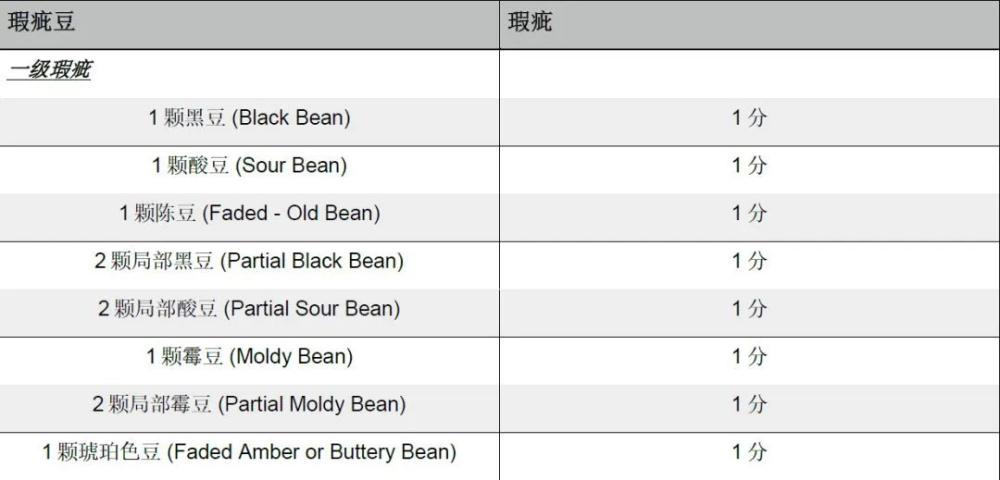
Defect scoring is divided into primary and secondary defects, using a deduction system based on a 500g sample, with a maximum total score of 24. Some producing countries believe bean size is not key to flavor, while others hold that fuller, more uniformly shaped, and larger green beans indicate better fruit development, sufficient ripeness, more even heat absorption during roasting, and ultimately more consistent flavor performance.
Colombia’s green bean screen size grading is done using fixed-aperture sieves. Different sieve specifications correspond to different hole sizes—for example, a 17-mesh sieve will not allow beans larger than 17 mesh to pass through. FNC classifies coffee beans into multiple grades based on screen size, with the three most commonly used being: Excelso UGQ 12×60 (1.5% tolerance), Excelso EP 12×60 (10% tolerance), and Excelso Supremo 12×60 (5% tolerance).
Specifically, Excelso UGQ 12×60 (1.5% tolerance) requires green beans to be larger than 14 mesh, allowing up to 1.5% of beans between 12 and 14 mesh, but they must still be larger than 12 mesh, and over 50% must be larger than 15 mesh. Excelso EP 12×60 (10% tolerance) requires beans larger than 15 mesh, allowing up to 10% of beans smaller than 15 mesh, but they must still be larger than 12 mesh. As for Excelso Supremo 12×60 (5% tolerance), it requires beans larger than 17 mesh, allowing up to 5% of beans smaller than 17 mesh, but they must still be larger than 14 mesh.

From this, we can see that "Supremo" is essentially a screen size grade, and the percentage in parentheses represents the "tolerance rate." As for "12×60," it has a specific meaning: in a 500g sample, a maximum of 12 primary defects and 60 secondary defects are allowed. This scoring rule is a key basis for judging green bean quality.
Over 90% of Colombia’s green beans are exported, but some beans fail to meet Excelso standards and are classified as "Product of Colombia." As long as they pass phytosanitary requirements, these beans can still be exported, though they are typically used for instant coffee and similar purposes.
Colombian coffee growers register each batch of green beans with a number and relevant information for traceability. Green bean naming usually follows the order of "country, region, grade, screen size," for example, "Colombia Huila Supremo SC17/18 FNC" is the full name of a Colombian Huila everyday coffee bean from a certain brand. Through these details, consumers can better understand the grade and origin of the coffee beans in their hands.
The above content is compiled by CoffeeHunters, a coffee news website.


