







Introduction:Recently, multiple Lavazza outlets in Changsha, including those at Wan Kuntu and CapitaLand ONE, have reportedly announced impending closures, with scheduled shutdown dates of January 8 and January 9, 2026, respectively. There are also reports suggesting that the brand may completely withdraw from the Changsha market. This article delves into Lavazza’s development in Changsha, the reasons behind these closures, and the brand’s strategic adjustments in the Chinese market, aiming to help readers understand the current status and challenges facing this century-old Italian coffee brand.
Recently, many local Changsha consumers have shared on social media platforms that the well-known Italian coffee brand Lavazza, located at Wan Kuntu in the city, will officially cease operations on January 8, 2026, followed by the CapitaLand ONE outlet, which is expected to close the next day on January 9. Some local users have further revealed that the brand might be planning a complete exit from the Changsha market, sparking widespread discussion.
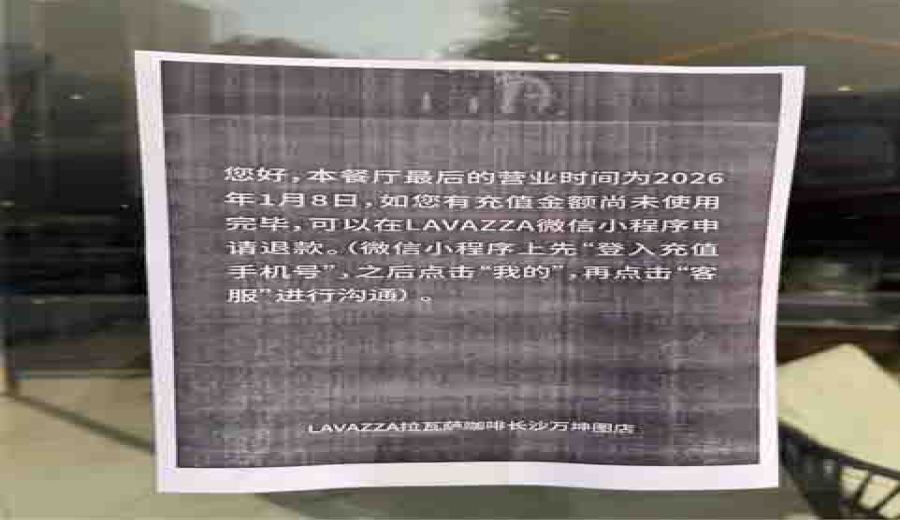
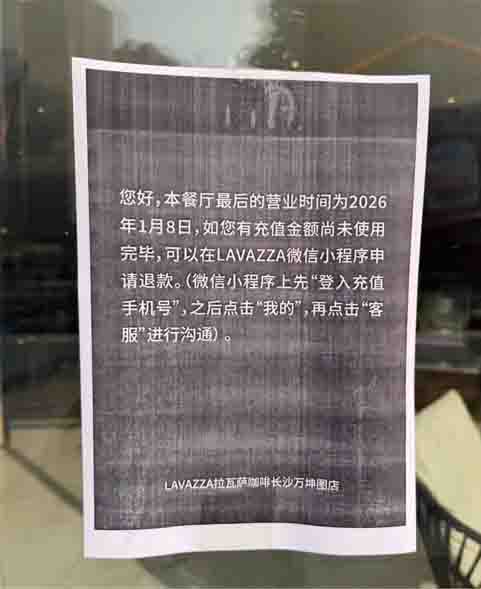
According to photos shared by netizens, the Wan Kuntu outlet has already posted an official closure notice, reminding customers with stored-value cards or remaining balances that they can process refunds via the official mini-program to ensure consumer rights.
Meanwhile, another report indicates that Lavazza’s other Changsha outlet — the CapitaLand ONE store — will also stop operations on January 9, 2026. A well-informed netizen further stated that the brand may no longer maintain any presence in Changsha in the future, leaving many long-time customers of the brand shocked and saddened.
In fact, Lavazza, as an Italian coffee brand with a history of over a hundred years, has long been hailed as the “godfather of Italian coffee.” The brand officially entered the Changsha market in late 2021, with its first outlet located at the iconic Orange Isle Park, marking its first store in central China. At the time, it attracted a large number of coffee enthusiasts who came to pay homage.
After the successful opening of its first store, Lavazza quickly expanded, subsequently establishing five outlets across Changsha’s urban area, demonstrating the brand’s confidence and commitment to the local market. However, the good times didn’t last — its first store quietly ceased operations just about a year after opening in December 2022, which came as a surprise. Later, the outlet at Xingcheng Tiandi also announced its closure at the end of March 2025.
Currently, definitive closure news has emerged for both the Wan Kuntu and CapitaLand ONE stores, and some local consumers have pointed out that the remaining two outlets may only remain operational until the end of this month. It is expected that after January 2026, the blue-and-white signage of Lavazza will no longer be seen in Changsha’s urban area.
In the eyes of many long-time loyal customers, Lavazza’s product positioning falls within the mid-to-high-end range, and its coffee quality and store service are considered no less competitive than those of international chains such as Starbucks and Peet’s Coffee. However, the brand’s local operational performance has failed to keep pace with its competitors, particularly in terms of brand visibility and market communication, where it has appeared relatively low-profile. As a result, many consumers were unaware that Lavazza had multiple branches in Changsha until hearing the closure news.
Some veteran customers recall that Lavazza stores did manage to attract a certain level of foot traffic upon opening, but often became deserted once the novelty wore off, rarely seeing bustling, high-traffic scenes. In response, some consumers believe that it is a reasonable and pragmatic business decision for the brand to close stores that fail to meet expected performance levels based on market feedback.
However, some netizens have expressed concerns about Lavazza’s overall development in the Chinese market, pointing out that the brand is noticeably less well-known compared to international heavyweights such as Starbucks, Peet’s, and Blue Bottle Coffee. Moreover, in terms of pricing and product cost-performance, it also struggles to compete with rapidly rising domestic brands like Luckin, Cotti, and Manner. Following the successive news of multiple store closures, some fans are skeptical about Lavazza’s future direction, believing the brand seems to be in a kind of “half-dead” operational state.
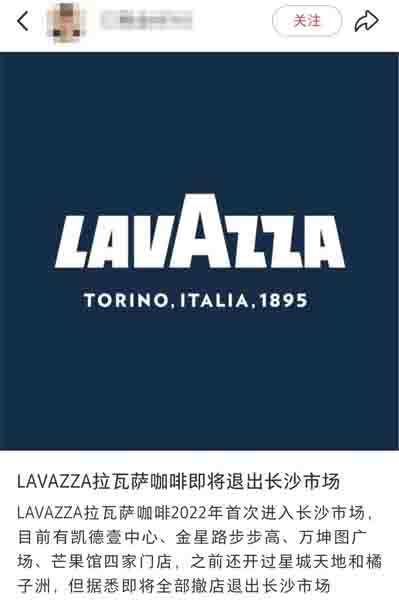
Nevertheless, more optimistic observers note that although Lavazza’s recent performance in Changsha has been lackluster, its frequent new product releases on official social media platforms and occasional news of new store openings in other cities suggest that the brand’s overall operational condition may not be as dire as it seems from the outside. They argue that market adjustments are a normal part of brand development, and consumers should not overinterpret or worry excessively about the brand’s overall strategy based on changes in localized markets.
The above content is compiled by CoffeeHunters, a coffee news website.


