







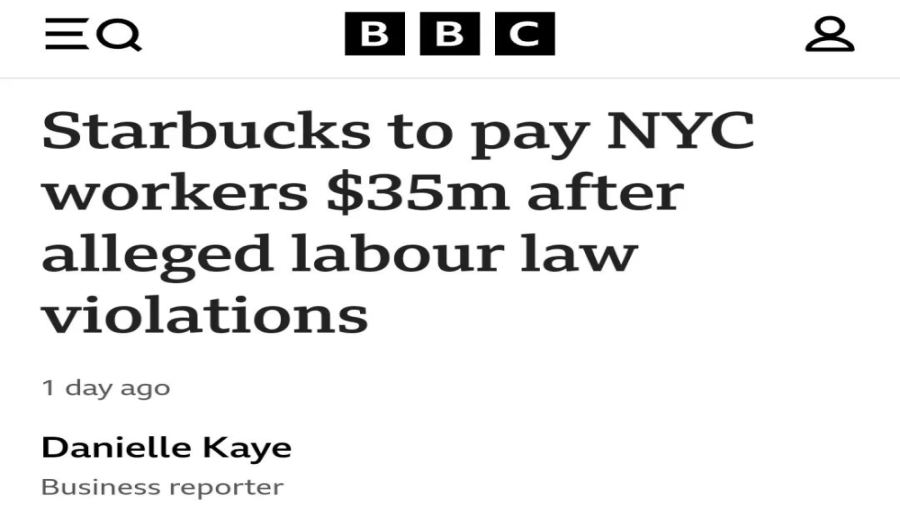
Introduction:An investigation by the New York City Department of Labor in the United States found that Starbucks had accumulated over 500,000 violations of the Fair Workweek Law across its New York locations over the years, affecting the rights of more than 15,000 employees. In the end, Starbucks reached a settlement with employees for $38.9 million, making it one of the highest labor litigation settlements in the area’s history. This article details the full sequence of events, the specifics of the violations, and the employee compensation plan.
The New York City Department of Consumer and Worker Protection (DCWP) has been investigating Starbucks since 2022 and discovered widespread violations of the Fair Workweek Law at the chain’s local outlets. The findings revealed that between 2021 and 2024, Starbucks committed over 500,000 violations, primarily involving failure to provide stable scheduling, unauthorized reduction of employee hours, and refusal to accommodate reasonable overtime requests.
According to the Fair Workweek Law, fast-food businesses including Starbucks are prohibited from altering an employee’s fixed schedule without notice, and employees have the right to refuse additional hours assigned by their employer. Additionally, the law explicitly requires companies to offer new shifts to existing employees before hiring new staff. However, Starbucks has been accused of long-term non-compliance with these regulations, resulting in many employees facing income instability and difficulty in planning their lives.
The DCWP noted that the investigation was initiated after receiving numerous complaints from Starbucks employees, followed by in-depth audits of over 300 stores in New York City. Investigators found that many employees had their hours unexpectedly cut by up to 15% or more, severely impacting their daily living expenses. At the same time, the company often refused overtime requests under various pretexts, forcing employees to work only part-time, further exacerbating income instability.
The case was ultimately settled when Starbucks agreed to pay $38.9 million, setting a new record for labor rights settlements in New York City.Out of this amount, $35.5 million will be distributed to over 15,000 employees who worked at Starbucks locations in New York City between July 2021 and July 2024 as compensation.Under the terms of the settlement, employees can receive $50 per week based on their length of service. For example, an employee who worked for a year and a half would be eligible for approximately $3,900 (equivalent to RMB 27,500).
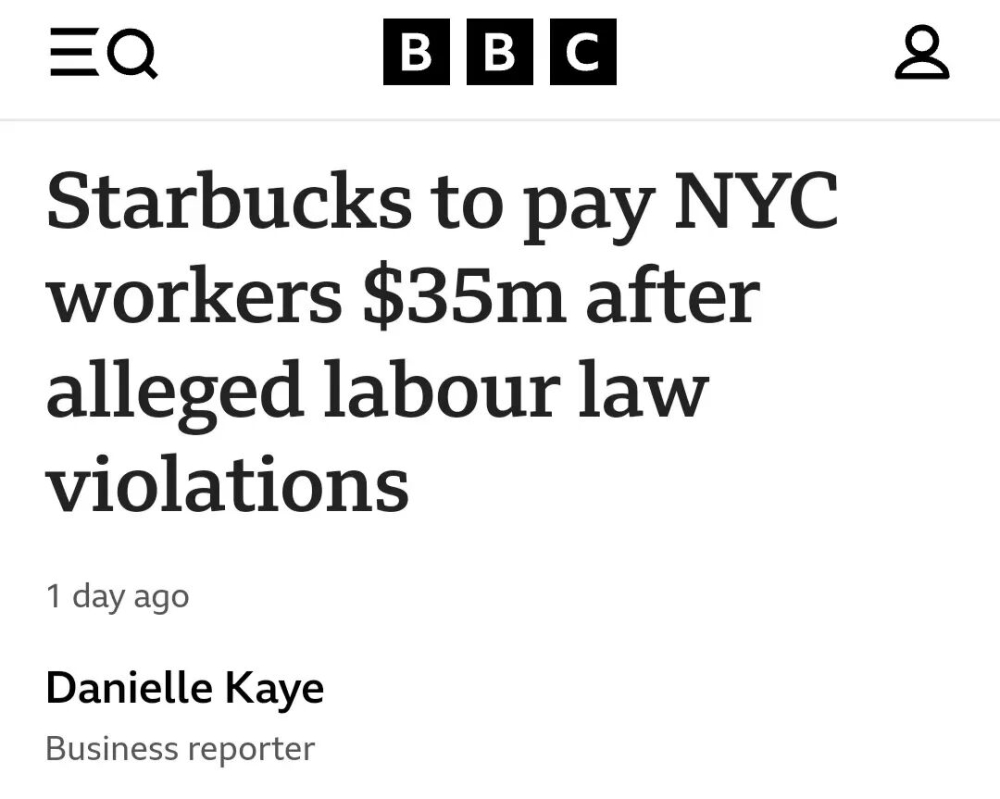
In addition to the compensation, Starbucks is also required to pay $3.4 million in civil penalties and litigation-related costs. This payment will be borne by Starbucks as punishment for the violations. Overall, Starbucks must pay a total of$38.9 million (approximately RMB 275 million)in this settlement, making the case a landmark example in New York City’s labor law history.
Local officials in New York stated that this is one of the largest and highest-value labor rights settlements in the city’s history, emphasizing that “no matter how large a business is or how much profit it makes, if it violates employee rights, it will have to pay the price.” This stance underscores the local government’s emphasis on labor rights and serves as a warning to other businesses.
Regarding the settlement, Starbucks issued a statement stressing that the payment “is to ensure compliance, not to recover unpaid wages.” The company said it is committed to abiding by the Fair Workweek Law but also admitted that meeting the requirements of these regulations is challenging. Starbucks pointed out that nearly any adjustment to the schedule, including changes caused by employees taking temporary leave, could be considered a potential violation, adding complexity to business operations.
This incident not only resulted in significant financial losses for Starbucks but also had a certain impact on its corporate image. However, for the affected employees, the settlement agreement provides a degree of financial compensation to help alleviate the life pressures caused by scheduling violations. Employees who believe they continue to experience scheduling violations after July 7, 2024, may still file complaints with the DCWP to seek additional compensation.
The above content is compiled by CoffeeHunters, a coffee news website.


