







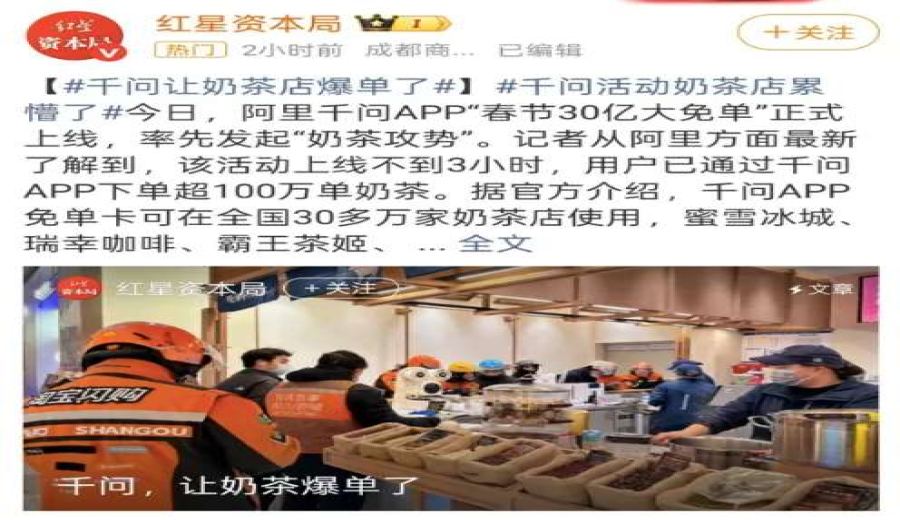
Introduction:Alibaba’s Qianwen App “Spring Festival 3 Billion Free Orders” campaign went live and attracted 10 million orders within just 9 hours. Users could get coffee or bubble tea for just 1 cent by simply inputting their requests to AI. Chain brands such as Luckin and Heytea were instantly overwhelmed with a massive influx of orders, with printers continuously spitting out orders, staff being urgently called back, and online ordering temporarily suspended. This article details the scene of the order explosion, the experiences of consumers and delivery riders, as well as the emergency measures taken by the brands, providing practical references for the beverage industry in handling sudden traffic spikes.
During the Spring Festival, Alibaba’s Qianwen App launched a “3 Billion Free Orders” promotional campaign, in which the “order bubble tea with just one AI sentence” feature quickly attracted a large number of users. By simply inputting their needs via simple voice or text, users could purchase coffee or bubble tea for 1 cent. Within just 9 hours of the campaign going live, the order volume exceeded 10 million.
As soon as the campaign launched, numerous well-known chain beverage brands including Luckin, Heytea, and Jasmine Tea White were immediately flooded with a large number of free or extremely low-priced orders. Hundreds of thousands of coffee and bubble tea shops across the country were thrown into an over-ordering state almost instantly, with many store systems nearly paralyzed and staff overwhelmed with work.
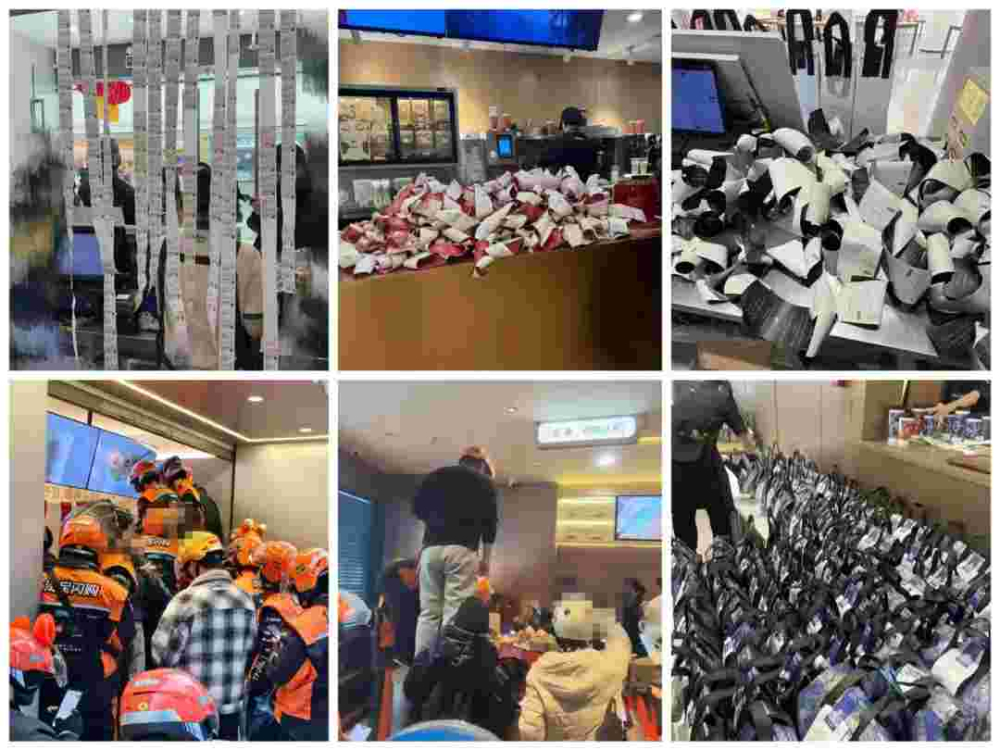
According to on-site situations shared by netizens in various locations, shortly after the campaign went live, the order printers at chain beverage shops kept running non-stop. Baristas behind the counter were busy shaking bubble tea, with shakers hardly having a moment to rest, yet still struggling to keep up with the hundreds of orders continuously pushed by the system.
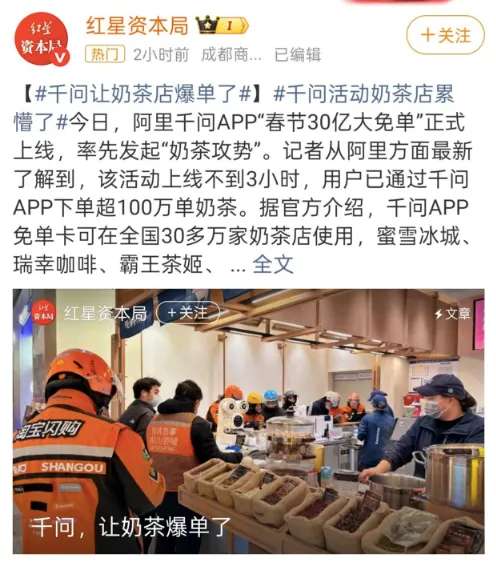
Some stores quickly took emergency measures, contacting employees who were originally off duty to come back and support the store immediately. Some shops, due to the severely overloaded order volume, proactively adjusted delivery time slots or even temporarily closed ordering channels on mini-programs and third-party delivery platforms to alleviate the pressure of in-store preparation and serving, effectively implementing a “temporary closure.”
At the same time, consumers participating in the campaign also complained continuously on social media platforms. Many said that although they successfully placed free bubble tea orders via AI in the morning, they often had to wait four or five hours before their orders began to be processed for delivery. Even more frustratingly, some consumers ultimately received drinks that were not what they had ordered, but other products randomly assigned by the system, and the taste was noticeably different from the usual offerings.
Delivery riders also faced unprecedented chaos. One rider said that when arriving at the store, the scene was like a battlefield—drinks just made by the staff were often mistakenly taken, and the counter piled high with beverages made it difficult for both riders and customers picking up their own orders to identify which drink belonged to which order. “It was like a war,” with the entire delivery process extremely disorganized.
This wave of “freebie hunting” driven by AI left many beverage industry workers exclaiming that it felt like “reliving last year’s delivery wars”—receipts printing non-stop, the preparation counter stacked with cups waiting to be packaged, delivery riders queuing up in layers at the store entrance urging for orders, and staff running around without a moment’s rest. They couldn’t help but lament: “AI is fighting, but why are we the ones getting hurt?”
According to official disclosures from Qianwen, the order volume had exceeded 5 million within 5 hours of the campaign going live. By the afternoon of that day, statistics showed that the total order volume had surpassed 10 million within 9 hours. But along with this came a large amount of user feedback about the app system being unstable, with issues such as inability to place orders normally and lagging. Multiple related topics also quickly climbed the Weibo hot search rankings.
Faced with system crashes and user complaints, the Qianwen official blog posted around 5 PM stating, “We’re completely worn out today, please come back tomorrow,” and confirmed that the technical team was urgently expanding capacity to keep the campaign running smoothly. Early the next morning, the officials further announced that the original expiration date of the free order vouchers, originally set for February 23, would be extended to February 28, and that the vouchers could be used not only for coffee and bubble tea but also for breakfast, lunch, dinner, and New Year goods. They urged users to use the vouchers at off-peak times to reduce system burden.
This incident not only exposed the extreme operational challenges faced by beverage stores under sudden traffic surges, but also provided the industry with valuable experience in emergency response and system adjustments, which is worthy of reference and learning for all coffee and bubble tea professionals.
The above content is compiled by CoffeeHunters, a coffee news website.


