







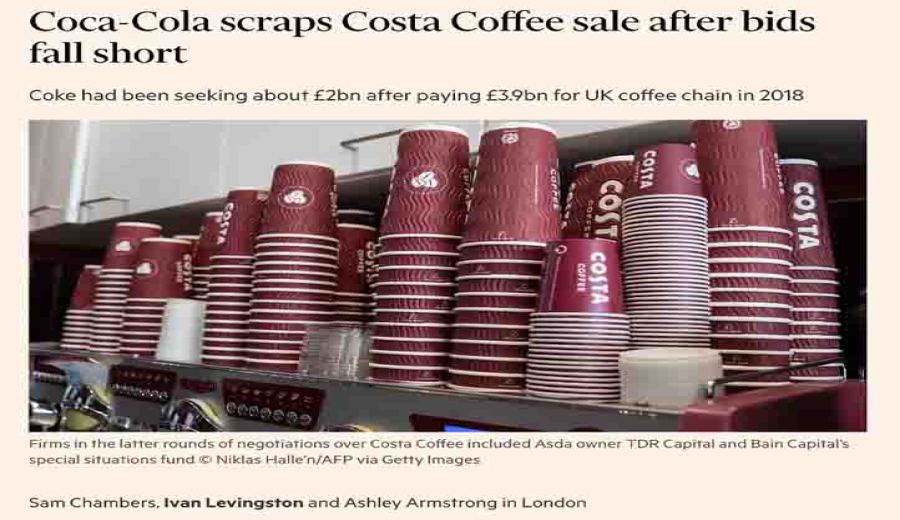
Introduction:The world’s leading beverage company, Coca-Cola, has announced the suspension of the sale process for its UK coffee brand, Costa, primarily because none of the bidders met its psychological price threshold of £2 billion. What was once a highly anticipated divestiture planned for 2025 is now facing a significant valuation drop—from an acquisition price of £3.9 billion just three years ago, the brand is now valued at less than a quarter of that. This article will provide an in-depth analysis of the entire Costa sale process, changes in bidding rounds, the current loss situation in the Chinese market, and whether the deal might be reignited in the future.
The global beverage giant Coca-Cola recently officially announced the halt of negotiations to sell its UK-based coffee chain, Costa. The sale process, which began in mid-2025 and lasted for several months, was initially expected to close at around £2 billion, but ultimately fell through as no potential buyers met the required price.
Looking back to 2018, Coca-Cola acquired Costa for a staggering £3.9 billion, seen at the time as a major strategic move to enter the ready-to-drink coffee market. However, with intensifying competition in the coffee chain market—especially challenges in the Chinese and European markets—Costa’s brand value gradually declined. Its overall valuation has now plummeted to less than £1 billion, less than a quarter of the original acquisition price from the beginning of that year.
It is understood that as early as August 2025, the market reported that Coca-Cola was working with investment bank Lazard to evaluate the possibility of selling Costa, with several private equity firms expressing preliminary interest. The initial reported sale price was about £2 billion, which was already a significant drop from the acquisition amount, yet still failed to attract a willing buyer.
By November of the same year, several well-known investment institutions—including Bain Capital, KKR, and Luckin Coffee’s major shareholder, Centurium Capital—were reportedly interested in Costa. However, the preliminary bids that emerged were further reduced to around £1 billion, only a quarter of the original acquisition price. Despite the more attractive pricing, the actual negotiation process did not go smoothly.
According to insiders, during multiple rounds of bidding, buyers who had been actively involved—including Centurium Capital, US investment fund Apollo, and KKR—successively dropped out. By the final stage, only Bain Capital and Taiwan’s TDR remained at the negotiation table, with their respective bids of £1.2 billion and £1.4 billion, still falling short of Coca-Cola’s psychological expectation of £2 billion.
Notably, TDR later proposed acquiring only Costa’s UK and international businesses, with the intention of excluding its China operations. This was mainly due to Costa’s persistently poor performance in China, where its number of stores continued to shrink, its market share lagged far behind competitors like Starbucks, and it even suffered significant financial losses, becoming a “drag” on overall performance.
According to publicly available financial data, Costa’s global revenue in 2024 was £1.2 billion, but in the UK—one of its key markets—it recorded losses that widened to £13.5 million. The situation in the Chinese market was even more severe, with the brand taking a one-time impairment loss of £48.6 million in last year’s financial report, reflecting its serious operational difficulties there.
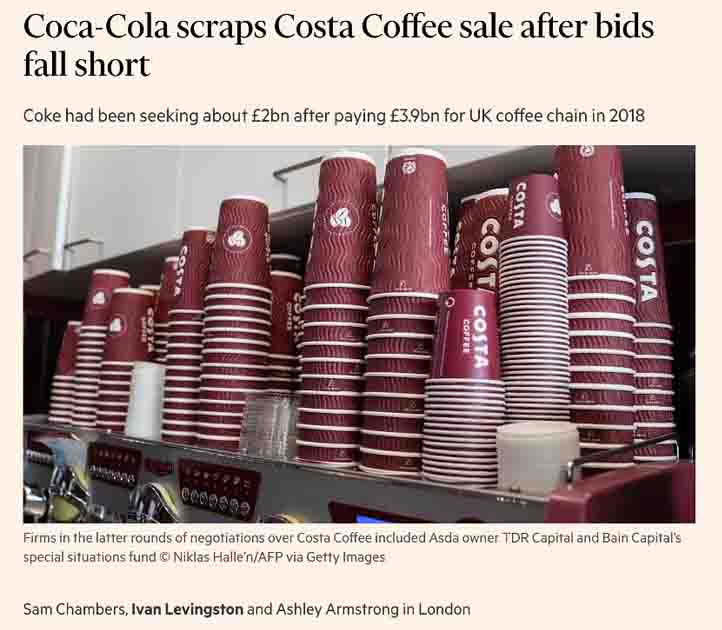
Even in the final stages, Coca-Cola attempted in-depth discussions with TDR, the highest bidder, in hopes of salvaging the deal, but it ultimately collapsed due to failure to agree on price. According to sources quoted by the UK’s Financial Times, in December 2025, Coca-Cola formally terminated negotiations with all remaining bidders, bringing an end to this prolonged sale process.
Although the sale plan has been temporarily put on hold, the door has not been completely closed. Sources suggest that Coca-Cola internally still believes that if market conditions improve or a suitable buyer is found in the near to medium term, it may still restart the sale of Costa. After all, optimizing assets amid market volatility remains an important part of its global strategy.
The above content is compiled by CoffeeHunters, a coffee news website.


