







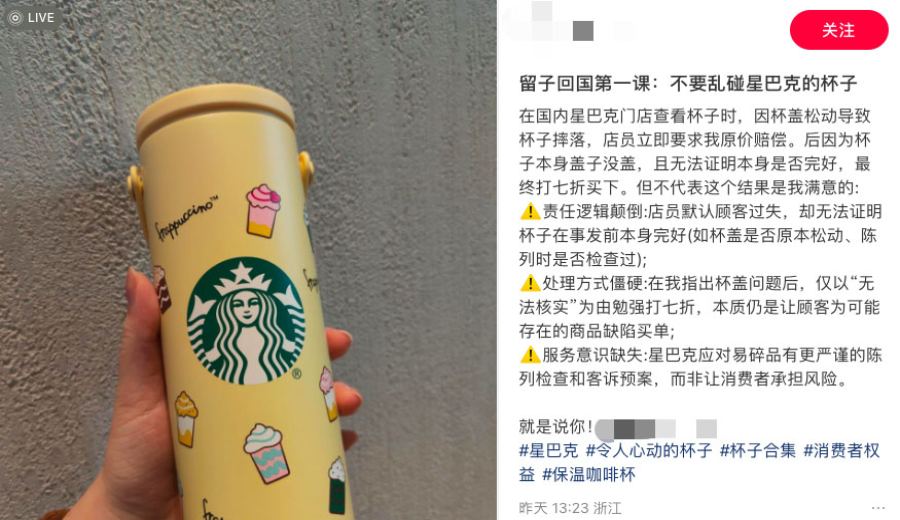
Introduction:When a customer accidentally breaks a display cup at Starbucks, what would be a reasonable way to compensate? Recently, an incident where a customer was asked to pay the full price for a damaged cup after its lid came loose and caused it to fall sparked widespread discussion. The ways in which domestic and international Starbucks handle such accidents differ greatly—so what lies behind these differences? This article delves into the details of the incident, explores the balance of rights and responsibilities between the brand and customers, and offers practical advice to help consumers respond more wisely in similar situations.
Recently, a customer was browsing cups on display at a Starbucks outlet when, due to the lid not being securely closed, the cup slipped from their hand and sustained a dent on the base. The staff immediately asked the customer to compensate at the original price, but after negotiation, the customer ultimately purchased the cup at a 30% discount. Once the incident became public, it quickly triggered online discussion, especially regarding the differing approaches of domestic and overseas Starbucks in handling similar accidents, prompting reflection on brand management and customer rights.
According to the customer’s account, the staff immediately assumed the damage was the customer’s fault without providing evidence of the cup’s original condition or considering whether the display setup was reasonable. She felt it was unreasonable to make customers bear the risk of damaging fragile display items, especially when it was unclear whether the item was originally intact. This experience resonated with many consumers, who shared their own stories and opinions.
Many netizens with experience shopping at overseas Starbucks pointed out that in the regions they visited, if a customer accidentally damages a display item, staff typically first ask if the customer is injured, then allow them to leave while the staff clean up and report the damage internally—rarely asking the customer to pay directly. This approach emphasizes customer experience and reduces unnecessary conflict.
In contrast, at some domestic outlets, the placement of display items is often reported to be too close to walkways or in easily bumpable locations, where customers’ clothing, backpack straps, or other items can inadvertently knock items off the shelves. When damage occurs, staff often demand full compensation at the original price or offer a so-called “staff price” discount—such as buying the damaged cup at 70% off. Multiple cases show that such situations are not uncommon, leaving many consumers feeling helpless and even avoiding certain display areas altogether.
Netizens have shared their own experiences: “I had the same thing happen at Xi’an Airport—they also made me buy it at 30% off,” “Just broke one, also had to buy it at 30% off, I’m never going near that counter again,” “My son touched it and they immediately came over asking us to buy it.” These accounts highlight that domestic outlets often place responsibility on the customer rather than improving management or display methods.
Regarding the difference in handling between domestic and international locations, some overseas netizens analyzed that Starbucks outlets in certain regions are usually insured, so any unintentional customer-caused losses during business hours can be directly claimed through insurance, eliminating the need for staff to insist on full customer compensation. However, due to different management mechanisms domestically, if a customer accidentally damages a display item, the loss is often borne by the on-duty staff or the customer themselves. It’s been said that domestic outlets cannot directly report losses, leading staff to seek cost-sharing from customers.
While such handling logic may aim to teach customers a lesson to “learn from mistakes” and reduce the risk of accidental touches to display items, many consumers believe that brands should conduct stricter checks and planning regarding the placement and presentation of display goods, and establish better contingency plans for accidents—rather than shifting all risks onto customers or frontline staff. One comment bluntly stated that Starbucks should re-examine its management policies and strike a balance between store operations and customer experience for long-term success.
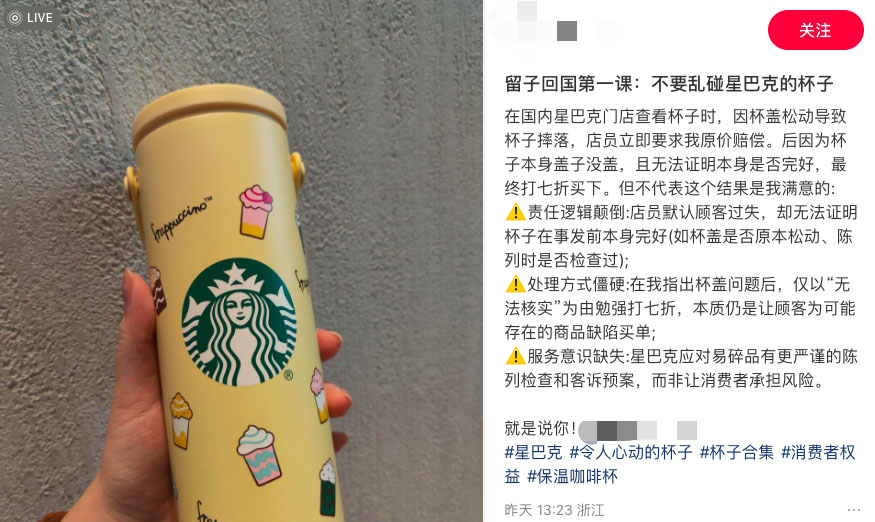
Taking all perspectives into account, this incident not only highlights the disparity in service standards across Starbucks locations globally, but also draws attention to consumer rights. When facing similar accidents, it is advised that customers stay calm, communicate rationally, and document the scene as much as possible to protect their own rights. At the same time, brands should also reflect on how they manage display items and create a more customer-friendly environment in order to truly earn trust and support.
The above content is compiled by CoffeeHunters, a coffee news website.


