








Introduction:The emerging tea beverage brand "Grandpa Doesn’t Brew Tea" has recently seen frequent reports of store closures in regions such as Shandong and Jiangsu, presenting a stark contrast to its ambitious goal of reaching 5,000 stores by 2025. This article delves into the actual operational status of the brand, explores the hidden risks behind the rapid expansion of the tea beverage industry, and dissects franchisee optimization strategies and market elimination mechanisms through real-life cases, providing key decision-making insights for readers following the beverage sector.
Recently, the emerging tea beverage brand "Grandpa Doesn’t Brew Tea," originating from Wuhan, has seen a series of store closures reported in places such as Zibo in Shandong, Suzhou in Jiangsu, and Poyang in Jiangxi. Netizens who visited these locations in person found that the brand’s store in Wangfujing Plaza, Zibo, had quietly ceased operations last week, while the outlet in Jingkai Wuyue Plaza, Zibo, had stopped business even earlier. Information circulating on social media platforms shows that several popular storefronts, including the Suzhou Center branch, the Shouguang Wanda store in Shandong, and the only two outlets in Poyang, have all been withdrawn.
Media investigations revealed that the contact number for the Wangfujing store in Zibo is either turned off or goes unanswered, with mall management stating only that the store had officially exited recently, without disclosing specific reasons. As for Jingkai Wuyue Plaza, management disclosed that the brand opted not to renew its lease due to underwhelming performance and the expiration of the rental agreement. Notably, according to information from online second-hand platforms, a store that opened as recently as November 2024 sought to quickly sell off all its equipment just three months after opening, indicating that some franchisees are facing serious challenges.
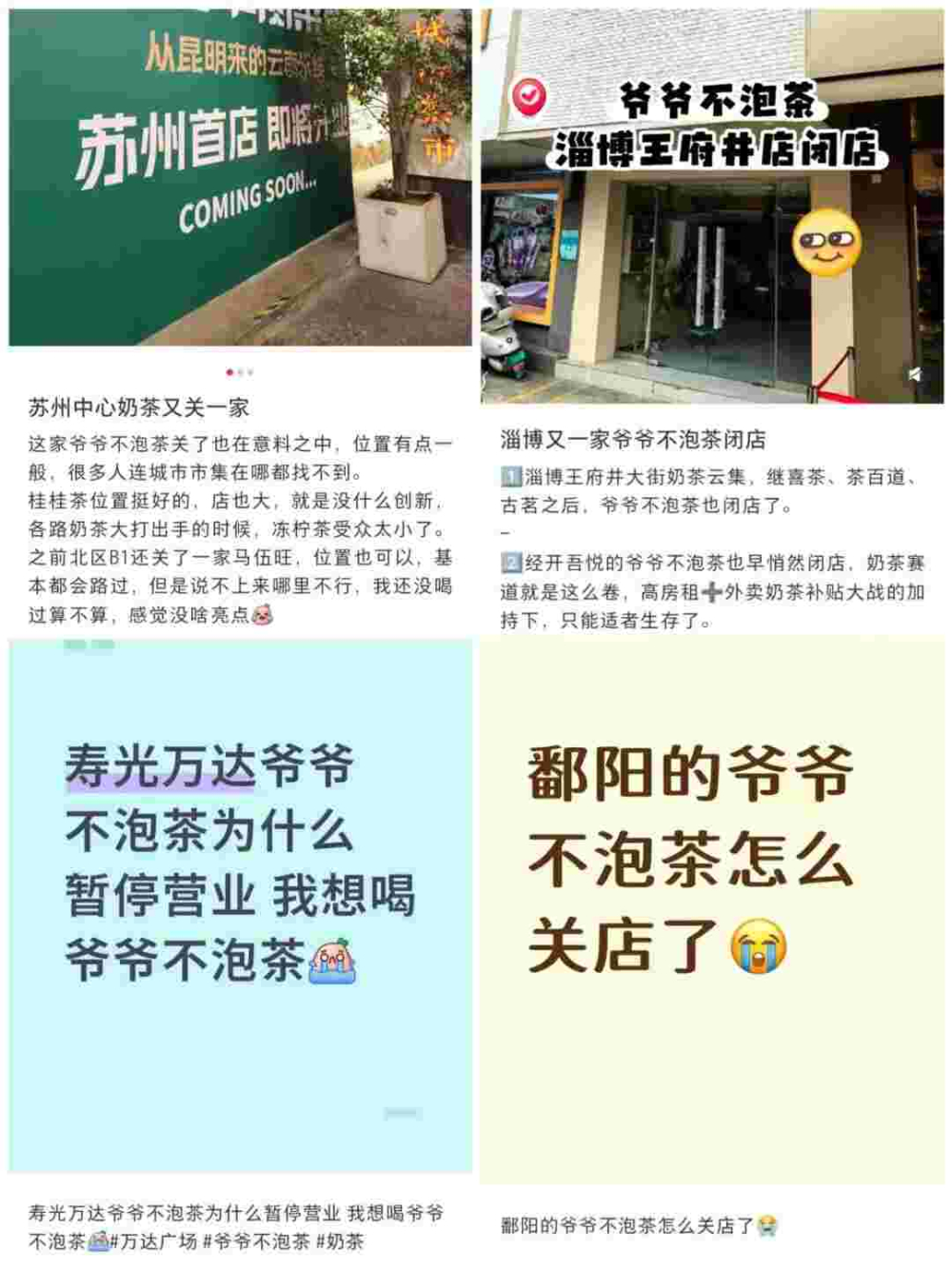
Official data shows that Grandpa Doesn’t Brew Tea opened its first outlet in 2018 at Nanhu Baihang City in Wuhan. The brand’s co-founder had ambitiously proposed an expansion plan at the beginning of the year: “a minimum of 4,500 stores by 2025, aiming for 5,000.” However, according to the latest statistics from Zhaomen Canyan, as of October 18, the brand had only 2,274 stores in actual operation, falling more than halfway short of its target. Further analysis indicates that the brand closed 22 stores and withdrew from one city within this month alone. To meet the original store count target by the end of the year, it would need to open over 2,000 new stores in the next two months—an extremely tall order.
In fact, this wave of store closures is not unique to a single brand. Over the past year, several well-known brands, including the popular Xiamen-based tea drink chain Sevenbus, have faced significant reductions in their number of outlets. Sevenbus once had over 400 branches but had dwindled to fewer than 20 by May this year. Shenzhen’s renowned high-end milk tea shop 813 Bayi Shan has encountered a similar situation, with the permanent closure of its “Shimudi Store” leaving many local consumers lamenting “the disappearance of a bygone era.”
In response to external doubts about the brand’s future prospects, Grandpa Doesn’t Brew Tea stated that it has currently signed contracts for approximately 110 stores in Shandong, and that overall operations remain under control. The brand emphasized that the closure or relocation of individual stores is mainly influenced by factors such as changes in the market environment, adjustments in commercial districts, and mismatches between rent and foot traffic—common optimization strategies among franchisees during regular business operations, rather than signs of systemic failure or poor overall management. The brand urged consumers not to worry excessively, as existing stores continue to provide stable services.
Industry experts analyze that after years of rapid expansion, the emerging tea beverage market is gradually entering a period of adjustment. Many brands initially expanded their market share rapidly through franchising, but as market saturation increases and consumer tastes shift, some outlets struggle to adapt and face elimination.Data shows that brands expanding too quickly can easily lose competitiveness in fierce competition if they fail to properly adjust their single-store profit models, supply chain management, and market positioning.
Observing the case of Grandpa Doesn’t Brew Tea, it is not difficult to see that although the brand maintains a certain scale of overall store numbers, adjustments in individual regions already reflect the market’s real test of the brand’s operational capabilities. Whether the brand can stabilize its existing stores and effectively implement its expansion plans in the coming months will be a key indicator of its long-term development.

The above content is compiled by CoffeeHunters, a coffee news website.


