







Introduction:Have you ever experienced the situation where your pour over coffee loses much of its aroma and flavor after it cools down? In fact, freshly brewed coffee also has an “optimal drinking window.” Once this golden period is exceeded, the overall experience noticeably declines. This article delves into the two main reasons why coffee’s flavor deteriorates as it cools, including the concentration gradient effect of aroma evaporation and oxidation reactions. It also offers practical preservation tips—such as using a cup lid or a thermos—to slow down the loss of flavor, ensuring every cup can be enjoyed at its best.
A freshly brewed pour over coffee often boasts a rich aroma and bright flavors. However, if you delay drinking it due to being busy and only come back to it once it’s cooled, you’ll often find that the aroma has significantly faded and the overall flavor is not as impressive as when it was just brewed. This gap in experience actually reflects the fact that coffee also has its own “optimal drinking period.” Mastering the tricks to extending this golden time can help maintain the coffee’s captivating flavor for longer.
Many coffee enthusiasts have faced similar situations: just as you’re about to savor a carefully brewed pour over coffee, something urgent comes up, and by the time you return, the coffee has already gone cold. By then, not only has the aroma dissipated, but the originally rich layers and full-bodied mouthfeel have also taken a big hit, almost as if it were an entirely different drink. This clearly illustrates that there is a specific drinking time window to be mindful of after brewing.
So, is there a way to slow down the decline of coffee’s flavor, keeping it in good condition even when we’re busy? The answer is yes. One simple and effective method is to create a relatively enclosed environment for the coffee—for instance, by placing a lid on the cup or pouring the coffee into a thermos with good sealing properties. This not only helps reduce the loss of aroma but also slows down the negative impact of oxidation.
First, let’s understand the main principle behind the loss of coffee aroma. Aroma molecules naturally diffuse due to differences in concentration, moving from the high-concentration coffee liquid to the surrounding low-concentration air until equilibrium is reached. However, in an open environment, the constant flow and renewal of air cause the aroma molecules in the coffee to continually escape outward, making it difficult to reach a stable state. This is one of the reasons why cooled coffee tastes increasingly “flavorless.”

If we take measures—such as covering the cup with a lid or pouring the coffee into a well-sealed thermos—we can effectively reduce the pathways for aroma molecules to disperse. In this case, the air inside the container gradually becomes saturated with aroma, the concentration gradient lessens, and the rate at which aroma escapes outward also slows down. This helps maintain the coffee’s aromatic qualities for a longer period.
In addition to aroma loss, coffee’s flavor and mouthfeel may also change over time due to oxidation reactions. Various compounds in the coffee liquid—such as phenolic substances, fats, and proteins—are prone to chemical changes when exposed to oxygen in the air, which in turn affects the overall taste. These oxidation reactions can make the coffee taste dull, lose its original complexity, or even develop unpleasant off-flavors.
By using sealed storage methods, the contact between the coffee liquid and oxygen can be greatly reduced, thereby slowing down the occurrence of these oxidation reactions. This helps preserve the coffee’s original flavor characteristics, allowing it to maintain a better drinking experience for a longer time.
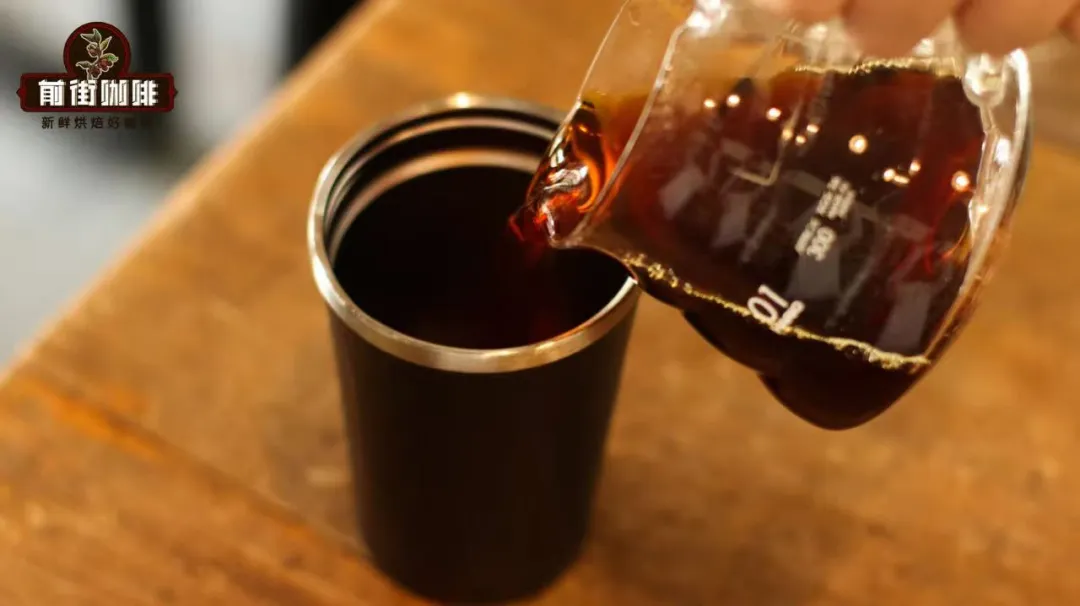
In fact, many coffee shops and professionals have long applied this principle by directly pouring freshly brewed pour over coffee into sealed thermoses for serving to customers. This approach not only saves time on on-site brewing but also ensures that the coffee’s aroma and flavor do not rapidly dissipate due to exposure to air. For busy daily routines or small gatherings, this is indeed a practical solution that balances efficiency and quality.
If you also often find yourself unable to drink your freshly brewed coffee right away, try simply covering it with a lid or sealing it in a thermos. However, it’s worth noting that when choosing a container, it’s advisable to avoid overly large capacities. Since the surface area of coffee exposed to air is proportional to the remaining space, the smaller the space, the quicker the aroma molecules reach equilibrium, and the slower the rate of loss. This helps extend the coffee’s optimal drinking state.
The above content is compiled by CoffeeHunters, a coffee news website.


