








Introduction:Dirty coffee is always served in small portions, meant to be sipped quickly one after another. This unique drinking method actually stems from a meticulous design of flavor layers. This article will delve into why Dirty isn’t suited for large cups, how smaller sizes affect overall taste and visual experience, and includes a real-world test of a 300ml large Dirty to help you understand its true charm.
Walk into a café and order a Dirty, and it often arrives as just a tiny cup—so small you might finish it before truly savoring it, leaving you wondering if the portion is too small. Compared to an iced latte, which also combines espresso and milk, why can’t Dirty be served in a larger, more drinkable size? In truth, this all ties closely to the unique logic behind how Dirty showcases its flavors. From actual serving experiences at a certain café, the small-cup design of Dirty isn’t just for visuals—it’s essential for maintaining overall flavor balance and highlighting its layered profile.
Regular coffee drinkers may have had similar experiences: you get a Dirty, it doesn’t look like much, but it’s full of surprises. Yet both Dirty and the latte combine espresso with milk—so why can’t Dirty be offered in a large size like a latte, allowing customers to enjoy it in one go? On the surface, Dirty and iced latte may seem just like a mix of black and white, but in reality, their drinking methods and design philosophies are fundamentally different.
The name “Dirty” in English means “dirty,” so many assume its defining trait is merely the striking black-and-white visual contrast. But in fact, with proper technique, an iced latte can also achieve beautiful layering. What truly sets Dirty apart is the intense yet icy contrast between flavors when espresso meets milk—not just its looks.
One customer, who had long been used to starting the day with an iced latte, tried Dirty by chance and was immediately drawn in by its bold, ice-free intensity. They never went back. This highlights the clear taste difference between Dirty and regular iced milk coffees.
For most milk-based coffees, consumers are accustomed to stirring before drinking to mix the espresso and milk evenly, ensuring a consistent flavor—like with an iced latte. But the essence of Dirty is the exact opposite—it emphasizes the distinct presence of coffee and milk. Stirring isn’t recommended, and even ice cubes should be avoided as they dilute the coffee’s strength and ruin the original layer contrast.
A well-made Dirty delivers dynamic changes both visually and in taste. As you take small sips, the angle of the cup shifts slightly, altering the ratio of espresso to milk with each mouthful. This results in constantly shifting flavors—from strong coffee aroma to soft milky notes, each sip distinct.
So why is Dirty typically served in small cups? This ties directly to the key elements of how its flavors are presented. An article from a certain café previously mentioned that a freshly made Dirty thrives on the contrast between coffee and milk—the top layer is oily espresso, the bottom relatively cool fresh milk. Your first big sip brings the bitterness of espresso and the sweetness of milk, a double stimulation of cold and hot, followed by their balanced fusion, and finally the sweet aftertaste of milk—all usually within just three or five sips.
To fully showcase this layering and set Dirty apart clearly from iced lattes, baristas typically control the ratio of espresso to milk, often using more concentrated Ristretto, with milk quantity adjusted based on cup size. Generally, Dirty is kept between 150 to 200 milliliters, finishing in about three to five sips.
In practice, a certain café makes Dirty using a 200ml clear glass cup, with 20g of Warm Sun blend coffee beans to extract 30ml of double Ristretto, then adds 150ml of room-temperature fresh milk—at a ratio of roughly 1:5. This way, even without stirring, the dark espresso remains visibly floating atop the white milk right until the last sip, with flavor layers still distinctly clear.
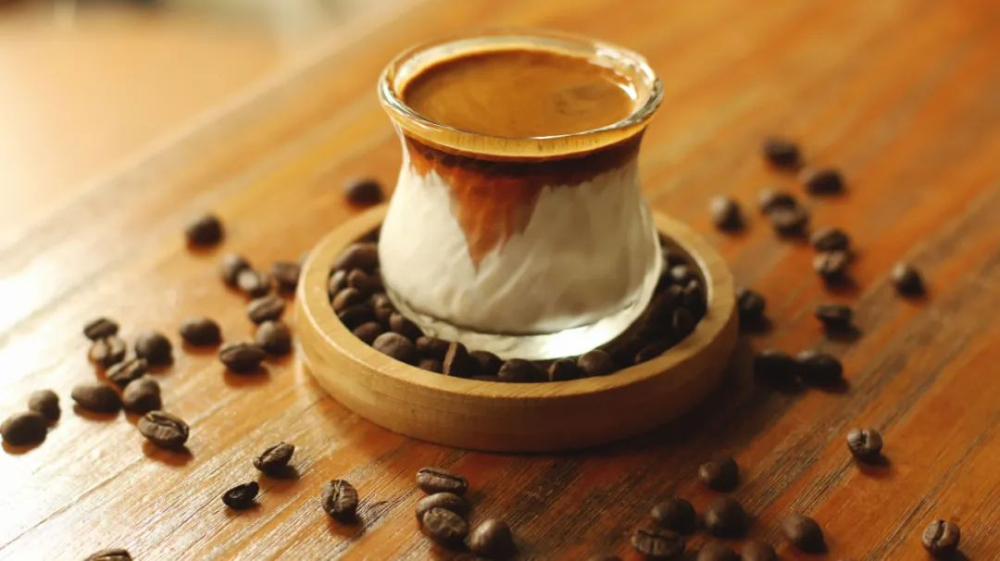
But what if Dirty were served in a large cup? Would the flavors still shine? To answer this, a certain café specifically tested a 300ml “big bowl Dirty.” In the experiment, they used a 300ml transparent cup, poured in 200ml of room-temperature fresh milk, then extracted about 30ml of espresso from the front and middle sections using 20g of Warm Sun blend beans through a split-flow portafilter. This approach helped keep the espresso mostly suspended at the milk’s surface, maintaining the visual layering effect.
Tasting results showed that the first sip clearly revealed the strong contrast between hot espresso on top and cold milk below—the charred aroma of coffee oils intermingling with the sweetness of milk, followed by hints of vanilla and cookie-like notes. The second sip still featured the hot-cold clash, but with slightly reduced intensity, and the overall flavor became more balanced. By the third sip, however, the milk’s temperature had risen, taking over the dominant role—the original ice-fire contrast disappeared, and the taste became closer to a mildly bitter coffee-milk drink, noticeably different from the traditional Dirty experience.
This shows that Dirty is served in small cups not just for aesthetics, but to preserve its unique flavor layers and contrasting experience. When the cup size increases, the interaction time between espresso and milk lengthens, causing the flavor layers to quickly dissipate and the original charm to be lost.

The above content is compiled by CoffeeHunters, a coffee news website.


