







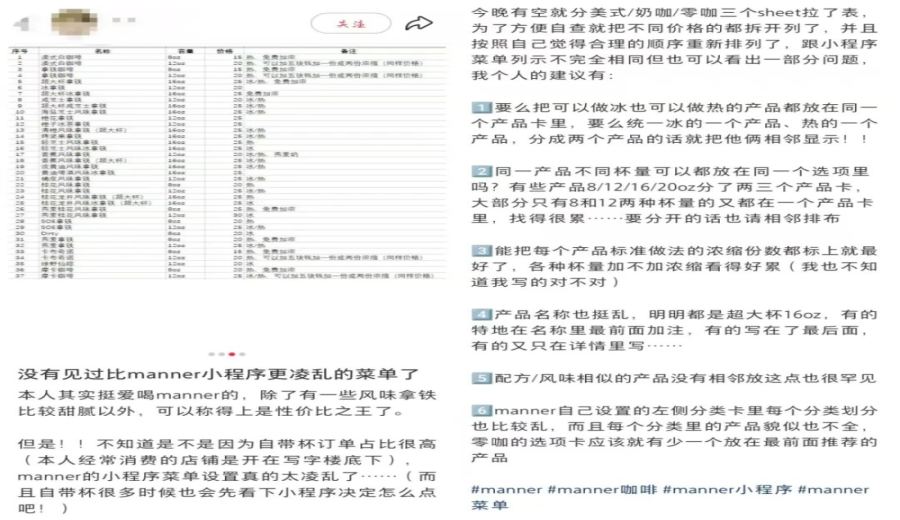
Introduction:Chain coffee brands have successively launched mini-program ordering services, but whether the menu layout and categorization are clear directly affects the consumer experience. Recently, Manner’s mini-program has sparked widespread discussion among users due to issues such as confusing product categorization, repeated items, and unintuitive store sorting. One long-time user even personally created an Excel table to organize the information, pointing out that the unclear menu structure makes selection difficult. This article delves into user feedback and explores the critical impact of well-designed menus on the coffee purchasing process.
Amid the trend of chain coffee shops widely adopting mini-program ordering, a clear menu interface has become key to improving customers’ purchasing efficiency. However, Manner’s mini-program has recently been criticized by many users for its messy menu layout. A loyal customer who has long used their own cup posted on social media that the Manner mini-program’s menu design makes it hard to quickly find the drink they want to order, and even went so far as to personally create an Excel spreadsheet to organize all product information for easier ordering.
The user observed that the same drink is often split into multiple separate product cards due to conditions such as cup size (e.g., large, extra-large), temperature (hot, iced), etc., and scattered across different categories, causing selection difficulties. For example, the familiar Americano in Manner’s mini-program actually comes in as many as six different specifications, categorized under “Treasure Series,” “Seasonal Limited,” and “Espresso” among other sections, with only slight differences in product names—making it easy to confuse them if not carefully compared.
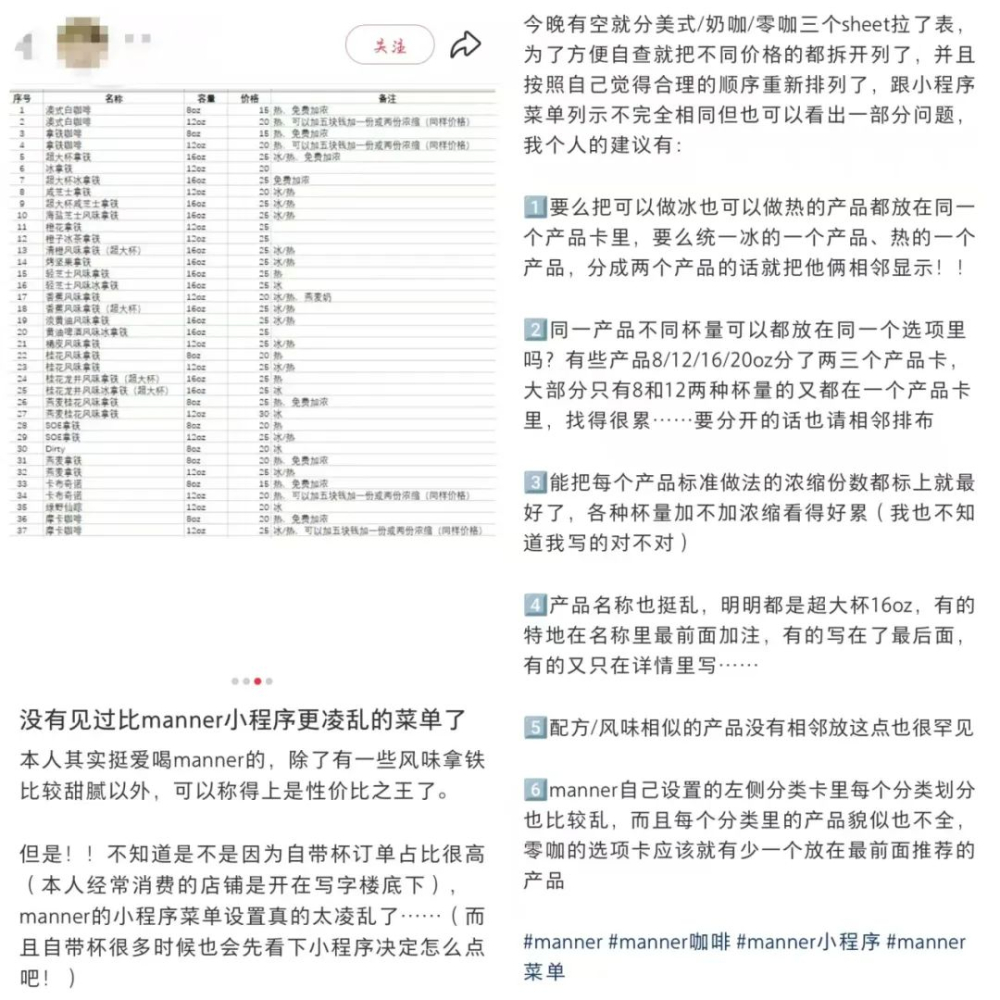
This categorization and naming approach has left many customers frustrated, especially new users. Some netizens responded: “Turns out I’m not the only one who has this problem,” “Hot and iced versions are split into two separate items, and the categories are messy—it’s really annoying,” “Every time I order, it feels like solving a puzzle.” Some users also said that just finding a drink on the mini-program takes more time than expected, to the point where they’d rather go to a physical store to order directly.
Not only do customers feel this way, but Manner’s store employees also admit the system is not easy to operate. Some part-time staff said that some drink names and images on the menu are similar, making it easy to accidentally select the wrong item, especially for new employees who need some time to get familiar with the tablet ordering system at the start. One employee joked: “I don’t know who designed this, it’s literally counterintuitive logic.”
In addition to menu categorization issues, users have also reported other design aspects affecting the experience, such as store search not being sorted by distance but by administrative district, which is particularly inconvenient for users living near district borders. One fan mentioned: “I live on the border of two districts, and every time I want to find a less crowded store, I have to search more than once.” In addition, the mini-program’s agreement checkbox process has also been repeatedly criticized—users must re-check multiple consent terms every time they log in, and the interface buttons are too small to operate conveniently, with no one-click agree option, making it time-consuming and annoying.
Based on user feedback, it’s clear that most people hope to have an intuitive, efficient, and clear ordering experience through the mini-program, but Manner’s current design clearly fails to meet this need. Experts point out that good menu design should follow principles such as clear categorization, non-repetitive information, and intuitive search, which help shorten customer decision-making time and improve overall satisfaction with the purchasing experience.
Faced with widespread user feedback, the industry generally believes that if Manner can optimize the menu categorization logic, product card integration, and store search mechanism, it will help improve the customer experience and further boost brand loyalty and service efficiency. For consumers, understanding these pain points can also help them be more strategic when ordering—for example, by checking the category location of frequently ordered drinks in advance or using the search function to quickly locate items.
The above content is compiled by CoffeeHunters, a coffee news website.


