







Introduction:Recently, JD Delivery adjusted the subsidy sharing model of its "Hundred Billion Subsidy" campaign, sparking dissatisfaction among many merchants. The change shifted the full subsidy burden from the platform to a 50-50 split with merchants. In some campaigns, merchants are now required to cover up to 50% of the subsidy costs, and they also face issues such as mandatory participation and reduced traffic ranking. Chen Ziyu, the person in charge of Grid Coffee, publicly criticized the move, highlighting a growing trust crisis between merchants and the platform.
Recently, JD Delivery announced an adjustment to the cost-sharing model of its "Hundred Billion Subsidy" campaign, changing from the platform bearing the full cost to requiring merchants to share up to 50% of the expenses. This adjustment quickly drew dissatisfaction from many merchants on the platform, especially given that their profit margins were already slim, placing even greater operational pressure on them.
According to feedback from multiple merchants, in subsidy campaigns such as "Spend ¥11, Get ¥10 Off," "Spend ¥15, Get ¥14 Off," and "Spend ¥40, Get ¥20 Off," the platform initially covered the full subsidy amount. However, just one week later, the rules changed, requiring merchants to bear 30% to 50% of the subsidy costs. The latest policy has now uniformly increased the requirement to50%the subsidy amount to be paid by merchants.
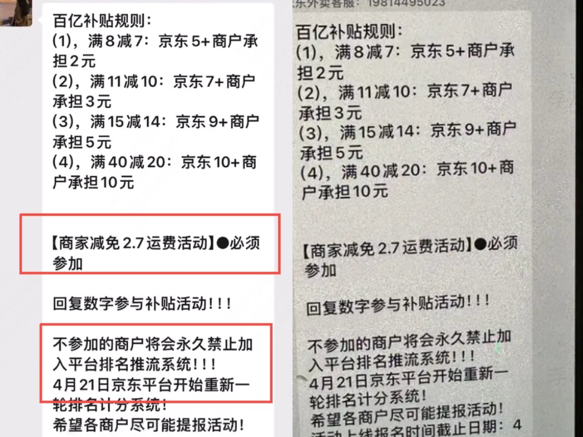
Moreover, merchants are also required to mandatorily participate in a "¥2.7 Shipping Fee Waiver" campaign. Screenshots show that the platform notified merchants that failure to participate in the subsidies could result in being "permanently banned from the platform’s ranking and traffic recommendation system." This has left many merchants caught in a dilemma of "participating leads to losses, not participating leads to no traffic."
As the issue gradually came to light, on April 25, the hashtag #JDDeliveryHundredBillionSubsidyRequiresMerchantsToBear50Percent# quickly trended on Weibo, drawing widespread public attention. Merchants pointed out that not only is the platform mandating subsidy sharing, but it is also applying pressure through ranking mechanisms, resulting in reduced store visibility and directly impacting revenue.
Under public pressure, JD Delivery issued a statement on the afternoon of the same day denying the allegations. It emphasized that the subsidy campaign was "open and transparent," that merchants could "choose to participate voluntarily," and that the platform "does not set mandatory subsidy sharing ratios." However, this explanation was immediately refuted by many merchants, with some publicly sharing screenshots proving that the subsidy sharing ratio is indeed50%, and that not participating in the campaign directly affects store traffic and recommendation rankings.
Additionally, some merchants reported that during the campaign period, the backend system was locked, preventing them from restoring original prices even if they lowered their food and beverage item prices. Some merchants also stated that they were automatically enrolled in the subsidy campaign without their knowledge and were unable to find options to cancel or delist, leading to orders where customers paid¥15.56while the merchants actually received only-¥3.14— a negative income order that severely impacted business performance.
Chen Ziyu, the person in charge of Grid Coffee, recently spoke out about the incident on social media. He stated bluntly: "The platform pays to have all merchants' products sold at a loss, and then says it won’t subsidize as much anymore — now the merchants have to cover that money. If you don’t, your orders will be gone." Chen Ziyu’s Grid Coffee is a well-known chain coffee brand, established in 2022 and incubated by the education technology company Yuanfudao. In recent years, it has been actively expanding its online delivery market.
Chen Ziyu also previously stated on the Jike platform: "When platforms fight, users might benefit, but merchants are definitely squeezed dry. Enough is enough, A-Dong." This remark quickly resonated with many and drew renewed attention to whether the mutually beneficial relationship between delivery platforms and merchants has become imbalanced.
Some merchants admitted that when JD Delivery first launched its subsidy campaign, they saw it as a great opportunity to increase exposure and sales. However, they did not expect the platform’s policies to change so rapidly that merchants simply couldn’t adapt. Now, not only do they have to share high subsidy costs, but they also face mandatory participation and traffic penalties, significantly eroding their trust in the platform.
The above content is compiled by CoffeeHunters, a coffee news website.


