







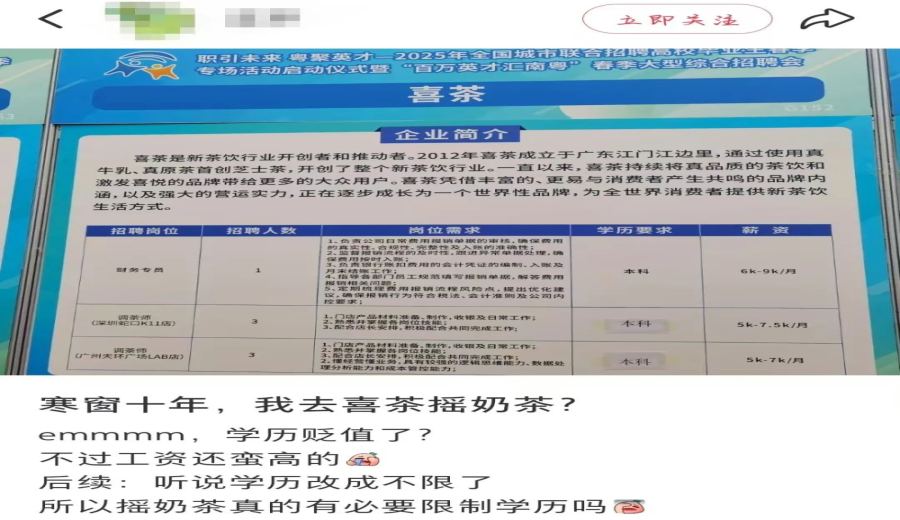
Introduction:Heytea listed a bachelor's degree as a requirement for baristas in a job fair in Guangzhou, sparking heated online debate: Do you really need a college degree to shake milk tea? The store later clarified that a degree is not a mandatory requirement, and promotions depend on ability. This article delves into the full story behind the incident, helping you understand the real recruitment criteria, career paths, and how to improve your competitiveness when entering the tea beverage industry.
Recently, Heytea posted job openings at a recruitment fair in Guangzhou, one of which explicitly required a "bachelor's degree" for the barista position, immediately triggering a wave of discussion on social media platforms. According to applicants who were present, the original notice stated a "college diploma" requirement, but someone later altered it to "bachelor's degree" with a sticky note, leaving many stunned. Some even bluntly remarked, "After studying hard for over ten years, I end up shaking milk tea?"
This job posting quickly spread online, with many netizens questioning why a barista—whose main duties include making drinks, handling cash, preparing ingredients, and assisting with store operations—is fundamentally a service and skills-oriented role—would need a university degree. Observers also pointed out that although the job description mentioned the need for logical thinking, data analysis, and cost control abilities, these skills are not necessarily directly correlated with the level of one's education.
In response to public scrutiny, a Heytea store stated that the recruitment of baristas places more emphasis on practical abilities and adaptability in the workplace, and that academic qualifications have never been the sole criterion for hiring. Future promotions within the company will be based entirely on individual performance, not educational background. Following the escalation of the issue, the educational requirement on the job posting was swiftly revised back to “no restrictions,” demonstrating the company’s quick response to external feedback.
It is understood that Heytea originally planned to recruit one finance specialist and six baristas at this job fair. The salary range for baristas was between 5,000 and 7,500 yuan per month. Job responsibilities covered daily store operations, from preparing ingredients and making beverages, handling cashier tasks, to assisting the store manager in various duties. Although the role may seem basic, it actually requires a certain level of teamwork and attention to detail.
Some netizens analyzed that phrases in the barista job description such as "understanding of operations and business" may have led people to assume it’s a position requiring a high level of education to qualify. However, most consumers generally believe that the core job of a barista remains making milk tea behind the counter—a service role with relatively low barriers to entry. The sentiment that “anyone with hands can shake milk tea” has been frequently echoed.
Regarding this controversy, a staff member at Heytea’s LAB store in Guangzhou’s Tianhuan Plaza said in an interview that the recruitment of baristas at their location is centrally planned by headquarters, and they were not directly involved in setting the educational requirements. However, he emphasized that even without a bachelor's degree, one can still join the team by going through the normal application process. He further explained that the responsibilities of baristas in the store can be divided into five or six specialized areas, such as beverage preparation, cashier duties, and customer service, assigned according to individual strengths. Promotion opportunities depend entirely on personal ability, not academic qualifications.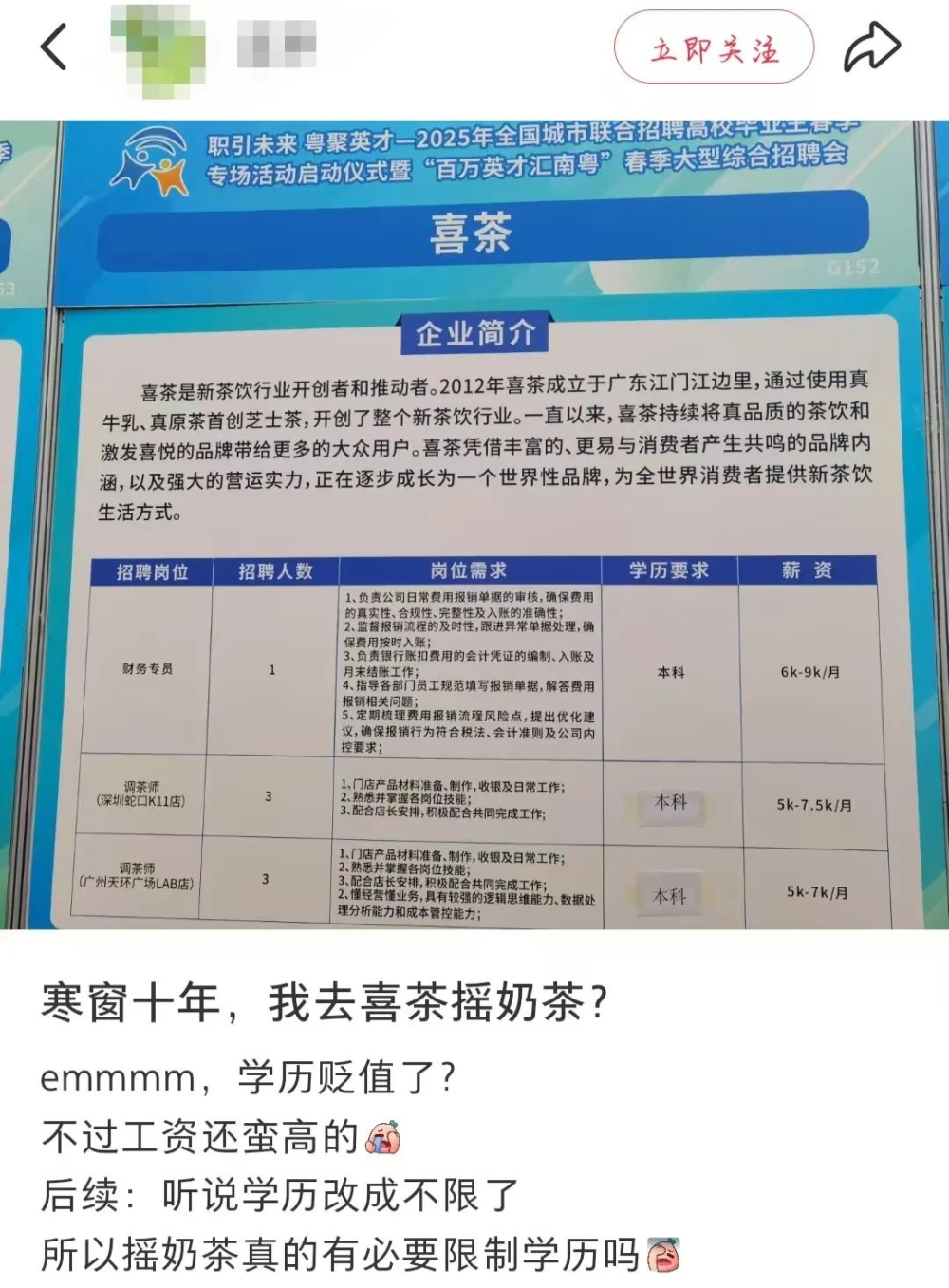
Heytea’s official customer service also responded to media inquiries, advising aspiring job seekers to contact the store directly or submit resumes through the official recruitment website. Currently, there is no specific contact number provided for recruiters. Additionally, on third-party recruitment platforms, many job seekers reported that they did not receive clear answers when inquiring about the educational requirements for baristas, indicating possible information gaps in the execution level of the company’s recruitment practices.
This recruitment controversy not only highlights the current sensitivity around the "match between educational background and job roles" in the job market but also prompts the public to reconsider: How should the entry barrier for service-oriented roles in the tea beverage industry be defined? For those aiming to join the tea beverage industry, in addition to academic qualifications, greater focus should be placed on practical skills, teamwork, and service enthusiasm—qualities that often prove key to long-term career development.
The above content is compiled by CoffeeHunters, a coffee news website.


