







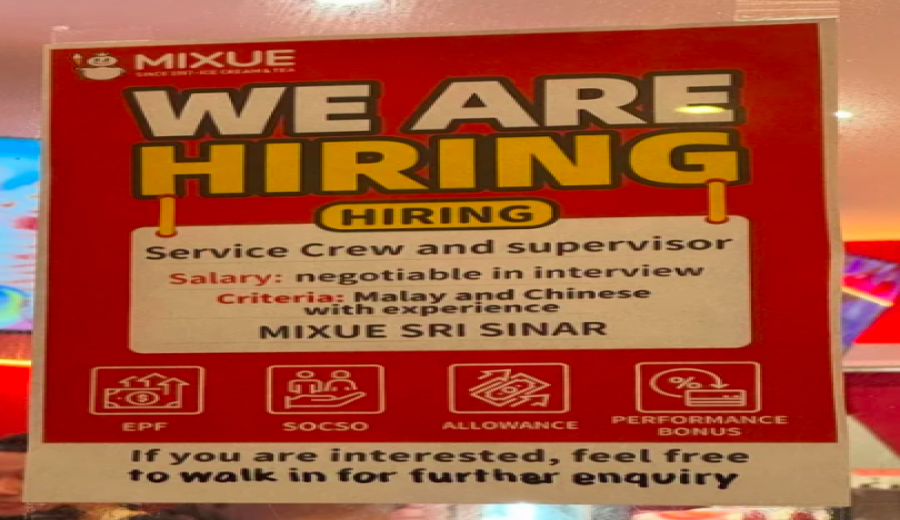
Introduction:A recruitment notice at a Malaysia-based Milk Tea Ice City (蜜雪冰城) outlet specifying that applicants must be “experienced Malays and Chinese” has sparked online accusations of racial discrimination—particularly against groups such as the Indian community. The incident quickly spread across social media, and rather than responding directly, the brand conveyed an inclusive message indirectly through stories of multi-ethnic employees and themed promotional visuals. This article delves into the background of the incident, public reactions, and considerations for cross-cultural employment practices.
Recently, a recruitment notice from a Milk Tea Ice City outlet in Seberang Jaya, Penang, explicitly stating the requirement for “Malay and Chinese with experience” caused an uproar online, with many netizens pointing out that the criteria may constitute racial discrimination. As a country with a diverse population comprising Malays, Chinese, Indians, and other ethnicities, the exclusion of other groups—especially Indian Malaysians—from job opportunities raised concerns over fairness.
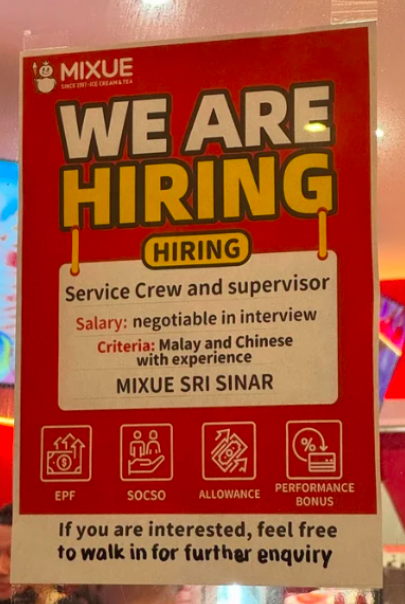
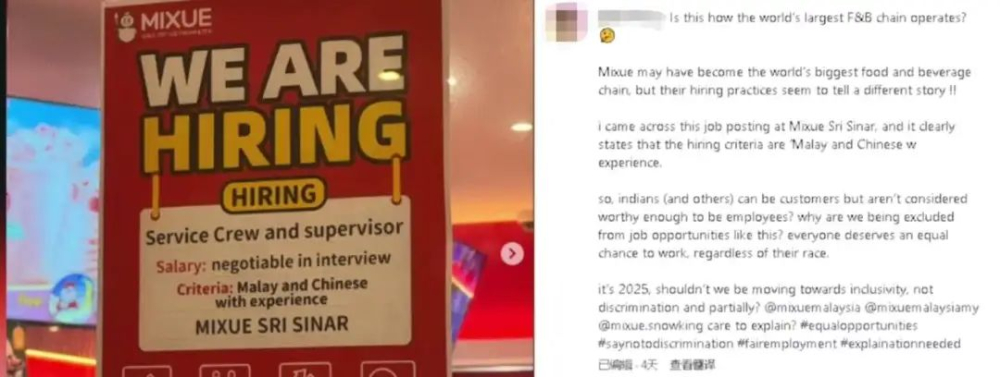
Photos shared by netizens showed that the outlet was hiring for both service and supervisory positions, with salaries to be discussed during interviews. However, the clear ethnic restrictions in the job criteria left many puzzled and upset. One poster noted that the Indian community is also an important customer base for the brand yet is excluded from employment opportunities, questioning: “Everyone deserves equal employment opportunities, regardless of race. It’s already 2025—we should be moving toward inclusivity, not discrimination.”
After the controversial recruitment criteria were exposed, it quickly became a hot topic on social media. Many netizens echoed the original poster’s sentiments, arguing that such overtly ethnically targeted hiring practices were inappropriate. Calls were made for companies to offer fair employment opportunities, with some even urging authorities to investigate or launching boycott movements. Comments such as “As an Indian, I will tell my children not to buy this product anymore,” “I used to go often, but I won’t anymore,” and “Customers come from all ethnicities, yet hiring is restricted to specific groups—that’s really unreasonable,” appeared frequently.
However, some netizens suggested that the controversy might stem from a misunderstanding of the wording used in the recruitment ad. They speculated that “Malay and Chinese with experience” might refer to candidates needing proficiency in the Malay and Chinese languages, rather than a restriction limiting the job to those two ethnicities. If interpreted this way, the criteria may not reflect racial discrimination but rather an emphasis on language communication skills. Although this explanation offers another perspective on the issue, it has not entirely quelled the public outcry.
Faced with extensive online discussion and negative sentiment, Milk Tea Ice City did not issue a direct public response or clarification regarding the incident. Instead, the brand has been posting content on its official social media channels under the theme “Make Us One” (“團結一心”), highlighting the diversity of its staff to project an image of multiculturalism and inclusiveness.
In a recently published post, Milk Tea Ice City introduced three female employees—Ashnawi, Chan Pui Lai, and Jamaliah—sharing their career journeys with the brand. At the same time, the company released a promotional image featuring its mascot “Xue Wang” (the Snow King) dressed in traditional attire representing Malays, Chinese, and Indians, all sharing beverages together. This symbolizes ethnic harmony and coexistence within the company. This series of content is widely regarded as the brand’s indirect response to the controversy, using visual and narrative methods to express its respect and support for multicultural values.
This incident highlights the need for multinational brands operating in culturally diverse societies to exercise particular sensitivity in how they phrase recruitment policies and communications. For coffee and food & beverage brands looking to expand into Southeast Asian markets, in addition to product and service quality, formulating inclusive and clearly communicated employment policies is key to safeguarding brand reputation and local acceptance. It is recommended that employers avoid using ethnic or language restrictions that may cause misunderstandings when drafting job postings. If there are genuine requirements for language skills, specific criteria such as “candidates must possess proficiency in Malay and Chinese communication” should be clearly stated to minimize unnecessary misinterpretations and disputes.
The above content is compiled by CoffeeHunters, a coffee news website.


