







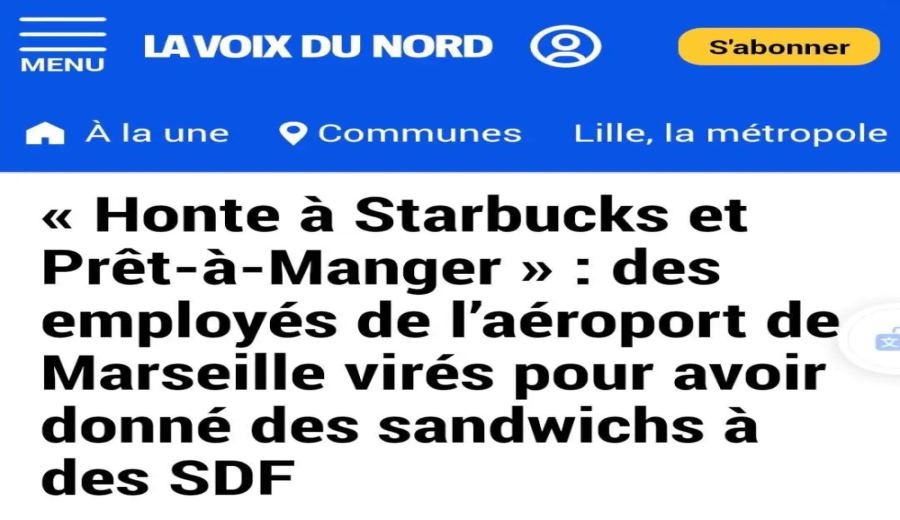
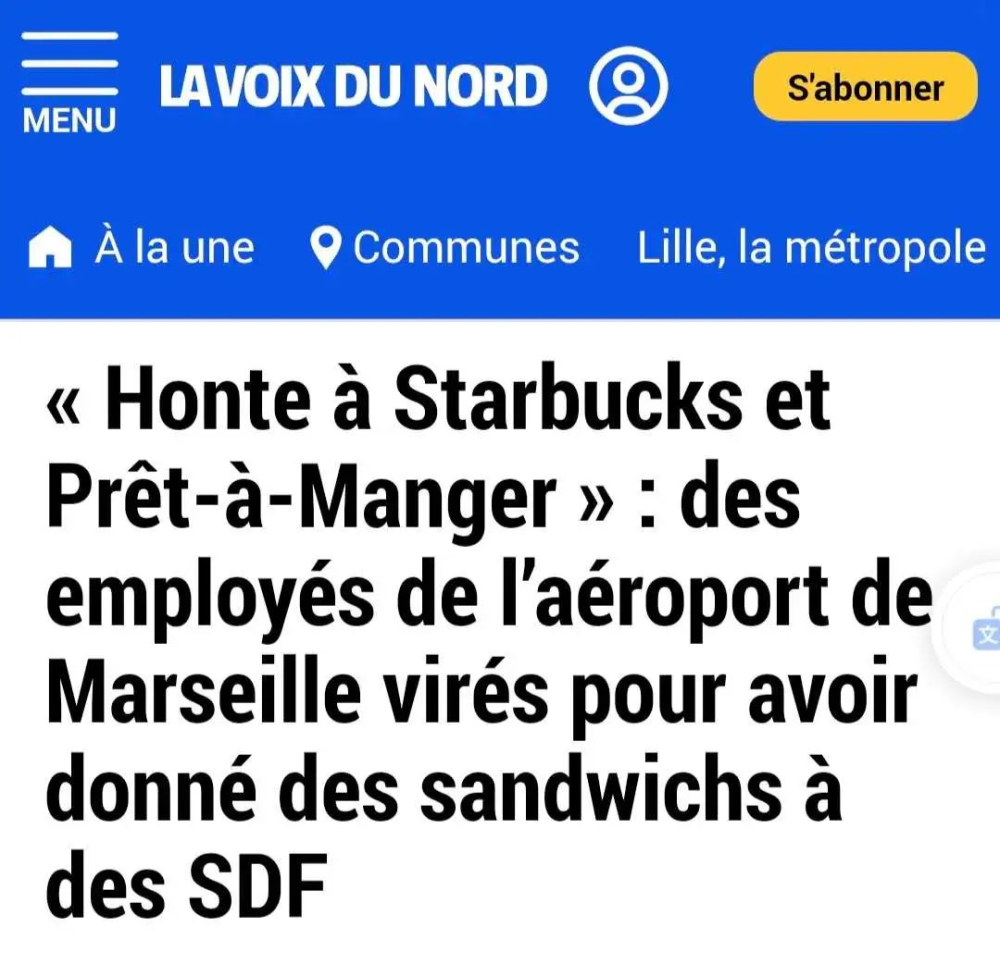
Introduction:Four Starbucks and Prêt-à-Manger employees at Marseille Provence Airport in France were fired by their management company, SSP Group, for “serious misconduct” after giving away unsold sandwiches to homeless people and fellow airport workers. The incident has sparked widespread debate about the conflict between corporate food management policies and acts of human kindness, and has prompted the public to reconsider the boundaries and practical challenges of anti-food waste initiatives.
At Marseille Provence Airport in France, four employees — working respectively at Starbucks and Prêt-à-Manger — were recently dismissed by their management company, SSP Group, for “serious misconduct” after they privately distributed unsold sandwiches to homeless individuals and airport staff. This decision quickly ignited heated discussion across society, with overwhelming public support for the employees’ good intentions. However, legal experts have reminded that even with benevolent motives, handling corporate food without authorization may still constitute a legal violation.
A veteran employee who had worked at the airport’s Starbucks for thirty years stated that he had been giving away sandwiches that would otherwise have been thrown away to the homeless and colleagues for many years, and had never hidden this practice. He admitted that he never imagined such a “small act of kindness” would one day become the reason he lost his job. Yet in March 2025, after discovering this “unauthorized” behavior, SSP Group swiftly made a ruling and dismissed all four employees involved.
SSP Group subsequently issued a statement emphasizing that it deeply regretted such violations and had followed its internal procedures to dismiss the employees in question. The group further explained that while it supports the goals of food donation and reducing food waste, all donation activities must comply with transparency, regulatory compliance, and strict hygiene standards — informal or private actions are absolutely not permitted. In other words, even if food is destined for disposal, its final destination cannot be decided by employees on their own.
After the incident came to light, it quickly ignited a wave of online discussion, with numerous netizens voicing support for the employees on social media platforms, arguing that they were simply doing the right thing. A French politician even publicly stated: “In France, fraternity is not a crime, but the very core of our republican values!” reflecting the emotional resonance felt across society regarding this incident.
However, labor lawyers have pointed out that from a legal standpoint, even if the sandwiches were about to be discarded, their legal ownership still belongs to the company, not the employees. Therefore, giving food away to others without explicit company authorization — even with good intentions — may be regarded as misappropriation or even theft. Lawyers further analyzed that such actions not only violate internal company regulations but also challenge product management processes, and could constitute what is termed “serious misconduct,” which served as one of the legal grounds for SSP Group’s dismissal decision.
Additionally, legal experts noted that if employees handle near-expiry or surplus food without authorization, and such food causes health issues for consumers due to improper storage — such as food poisoning or allergic reactions — the company will ultimately bear the responsibility. Therefore, from the perspectives of risk management and corporate legal liability, SSP Group’s choice to dismiss the employees holds a certain degree of legal and operational justification.
In response to the accusations, the involved employees claimed that the operations director at the time was not only aware of their actions but had even told one of them directly to “keep up the good work.” They also questioned that if the food were instead sent to designated waste stations outside the airport, it would incur additional manpower and transportation costs — compared to that, direct distribution seemed more efficient and humane. On this point, lawyers advise that if employees can provide concrete evidence proving that company management tacitly approved, encouraged, or was aware of such actions, they may potentially file a legal appeal claiming wrongful dismissal and seek fair compensation.
This incident is not just a personal ordeal for the four employees; it also highlights the practical and ethical dilemmas modern companies face when implementing anti-food waste policies. How to balance adherence to legal norms and food safety, while also taking into account humanitarian spirit and efficient resource utilization, remains a shared challenge for businesses and societies around the world.

The above content is compiled by CoffeeHunters, a coffee news website.


