








Introduction:Recently, footage of HeyTea’s kitchen staff freshly squeezing mulberry juice has sparked heated discussion on social media platforms. The deep red juice splattered all over the workstations, instantly evoking scenes from horror movies. These images come from the preparation process of drinks such as “Pitch Black Delight” and “Triple Berry · Goodnight Cup.” This article will delve into the practical challenges of squeezing mulberry juice, the difficulties in cleaning, and share practical precautions summarized from the experiences of frontline staff.
The daily work of bubble tea shop employees has long been a hot topic on social media. Whether it’s the process of making new products, fruit-cutting techniques, or routine ingredient preparation, it has attracted the attention of many consumers and industry peers. However, a recent video of HeyTea’s kitchen squeezing juice has gone viral online due to its overly “horrifying” visuals.
The leaked GIF shows the entire workstation almost completely covered in deep red mulberry juice — plastic buckets, filter bags, and blenders were all affected, resembling the aftermath of a “juice disaster.” Especially when the footage zooms in on black-gloved hands vigorously squeezing the mulberries, the thick juice splashes everywhere, with spoons and scrapers on the counter also covered in red, creating a chilling sight.
These photos were taken during the routine process of freshly squeezing mulberry juice for HeyTea’s new drinks “Pitch Black Delight” and “Triple Berry · Goodnight Cup.” Because mulberries are naturally rich in high concentrations of anthocyanins, their deep color easily stains, not only making cleanup difficult but also giving the whole preparation area a rather “striking” appearance.
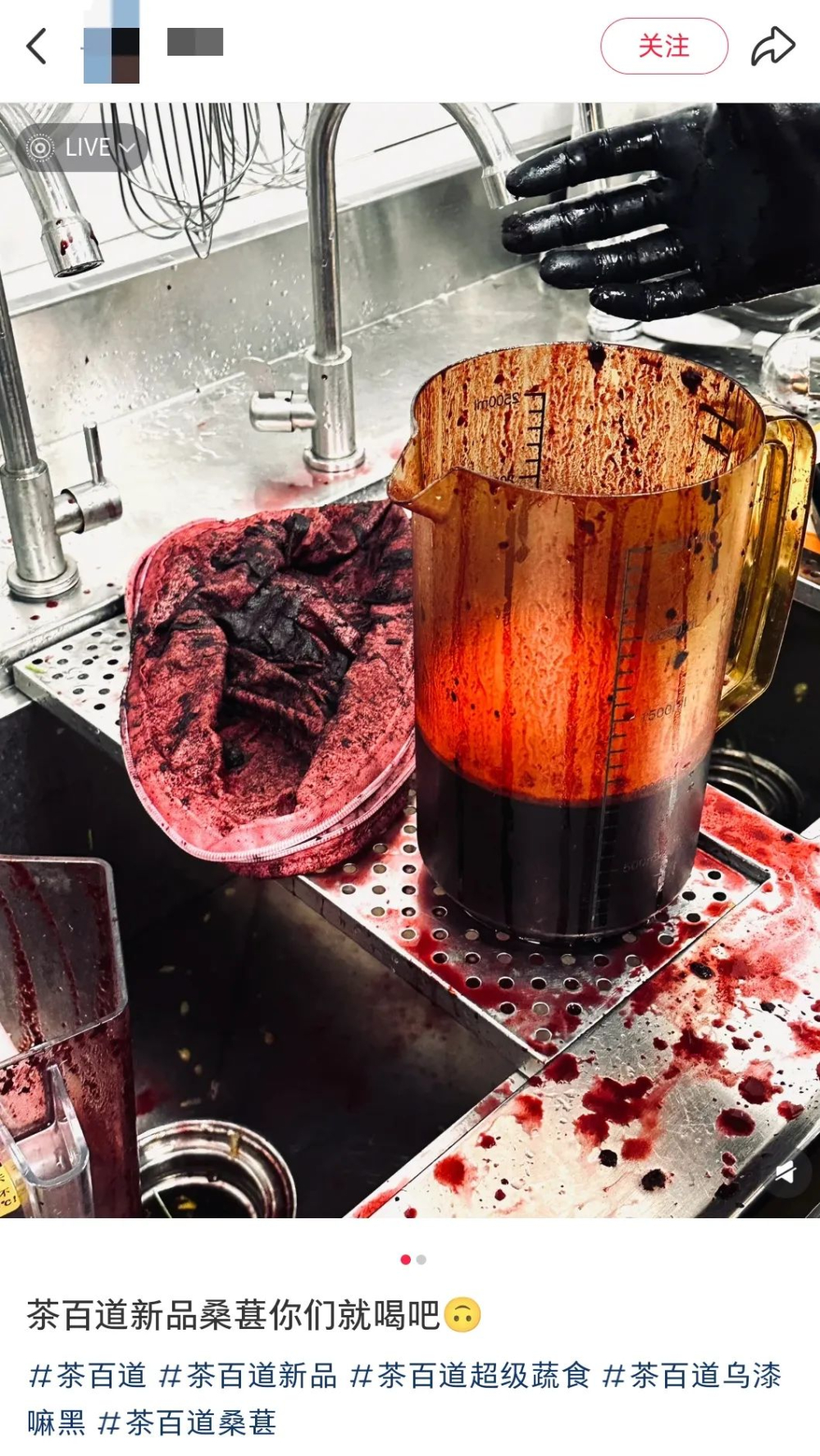
Many frontline staff have taken to social media to vent, describing the scene as akin to a “horror movie set,” with some even jokingly calling it the “HeyTea Mulberry Cannibal Incident.” They noted that while such situations are not unfamiliar to those who regularly work in the kitchen, every time juicing takes place, the pressure still intensifies — especially under high-saturation lighting, the visuals become even more startling.
In fact, making mulberry drinks is not only a technical challenge for staff, but also a test of physical stamina and patience. Mulberry flesh is soft and juicy, requiring significant effort and repeated actions to fully extract the flavor during juicing. But precisely because of this, it also makes juice splattering more likely — not only dirtying clothes and utensils, but also making cleanup extremely time-consuming.
Moreover, due to the nature of anthocyanins, once they stain white or light-colored work uniforms and equipment, they are extremely difficult to clean completely. Many employees reported having to discard uniforms due to accidental splashes. Some stores, during peak hours, even need to squeeze juice multiple times a day, which is a considerable burden for back-of-house staff.
It’s worth noting that currently, the series of drinks using freshly squeezed mulberries are only available in select cities due to fruit supply issues. As a result, some store employees have secretly expressed relief at not having to face such “backstage challenges” for now — but they also worry that if the drinks are rolled out nationwide in the future, they may face even more frequent “mulberry attacks.”
Despite the complaints, many employees have begun to face these challenges with humor, turning their daily juicing routines in the kitchen into various internet memes, such as “HeyTea’s Crime Scene No. 1” and “Backstage Taken Over by Mulberries.” These not only resonate among colleagues but also help consumers better understand the truth behind the making of these drinks.
In summary, a seemingly simple mulberry drink actually involves a complex preparation process and high-intensity cleaning requirements. For consumers who enjoy this flavor, understanding these processes can also foster a greater appreciation for the effort that goes into each cup they receive.
The above content is compiled by CoffeeHunters, a coffee news website.


