







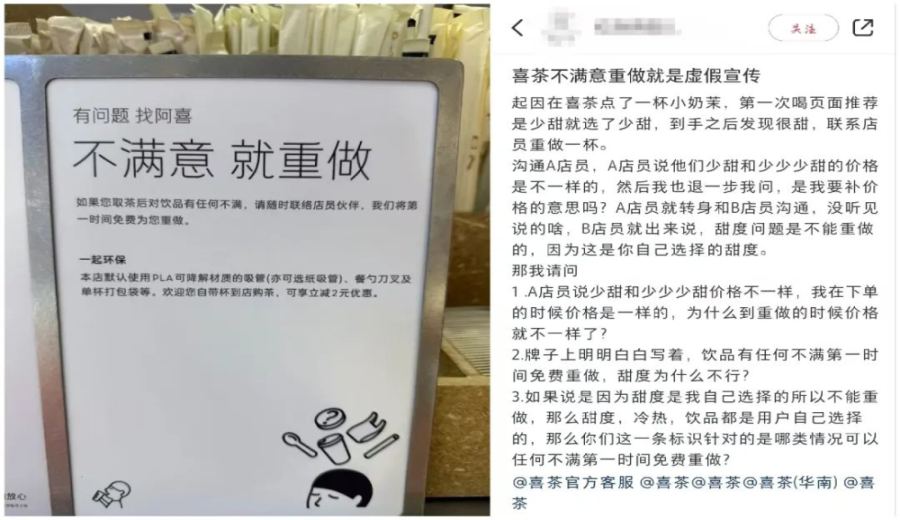
Introduction:Recently, Heytea’s service promise of “remake it if you’re not satisfied” has sparked widespread consumer controversy. Multiple customers were denied remakes after requesting adjustments due to unexpected sweetness levels, with customer service responding that drinks must be made according to standard specifications. Similar cases have also emerged in regions such as Shandong, where stark differences in policy enforcement between company-owned and franchised stores have become evident. This article provides an in-depth analysis of the incident, compares practices at industry peers such as Starbucks andCHA BING CHI, reveals the actual boundaries of the “remake if not satisfied” service, and offers practical advice for consumer rights protection.
Heytea’s publicly displayed “remake it if you’re not satisfied” service commitment has recently been repeatedly questioned as being “all talk and no action.” Numerous customers reported that when they asked for a remake because the sweetness of their drink far exceeded expectations, staff refused, citing reasons such as “sweetness is a personal choice” or “we must follow the standard recipe,” with official customer service offering the same response. Such disputes are not limited to regular outlets; on social media, a Shandong consumer even shared a case where the store manager outright refused to remake a Mango Pomelo Tea for his girlfriend after she complained about its unusual taste.
Notably, consumers have observed significant differences in how company-owned and franchised stores implement the policy. Long-time Heytea customers pointed out that company-operated stores are usually willing to accommodate adjustments, while franchised stores often cite material waste as a reason to avoid remaking drinks.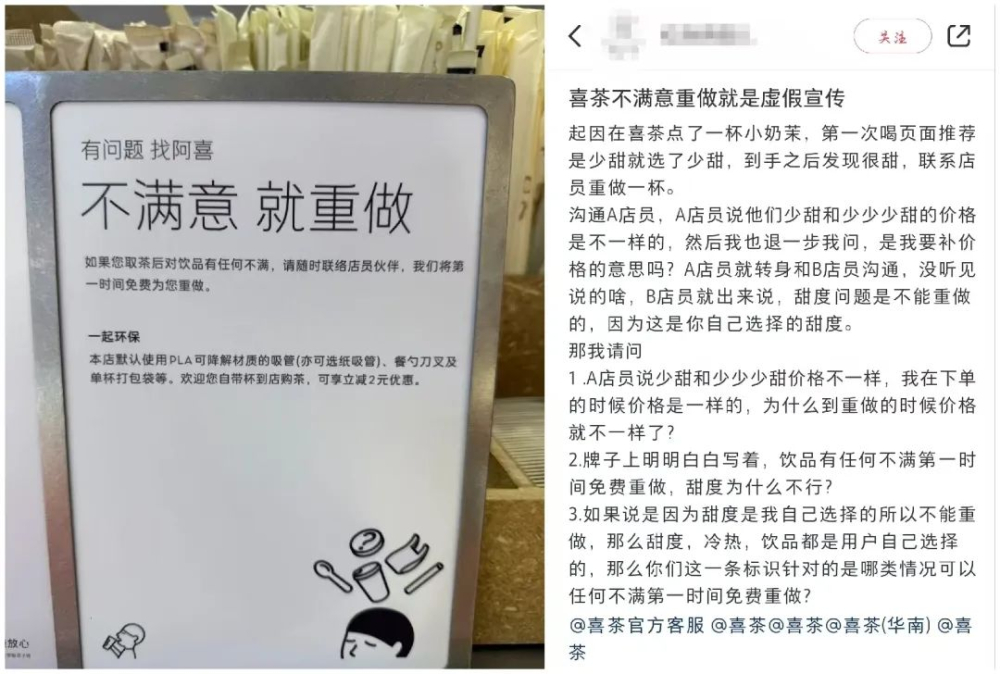 This situation makes the “remake it if you’re not satisfied” signs hanging at store entrances particularly jarring — according to the sign’s wording, customers can “communicate with staff immediately after picking up their drink and receive a free remake without delay for any dissatisfaction.” However, actual feedback shows that the promise often only applies to issues related to product quality, while subjective preferences such as sweetness or temperature are generally not entertained.
Further observation reveals that even when individual stores agree to a remake, they rarely actually adjust sweetness levels or temperature settings. The drink customers ultimately receive may still be essentially the same. Compared to other brands that also promote a “remake if not satisfied” policy — such as Starbucks and CHA BING CHI — Heytea’s implementation is noticeably weaker: most stores that uphold the policy are company-owned, and there is a lack of follow-up mechanisms to ensure “customer satisfaction.” Industry insiders revealed that adjusting sweetness levels in tea beverages actually involves complex parameters such as tea extraction ratios and syrup measurements, and non-standardized operations may lead to increased costs, which could be a potential reason why franchisees resist making remakes.
From a consumer rights perspective, legal experts point out that since brands publicly promise “remake it if you’re not satisfied,” they should not, in principle, set hidden thresholds. However, the current point of contention is: do subjective taste preferences (such as “too sweet” or “too astringent”) fall within the scope of the promise?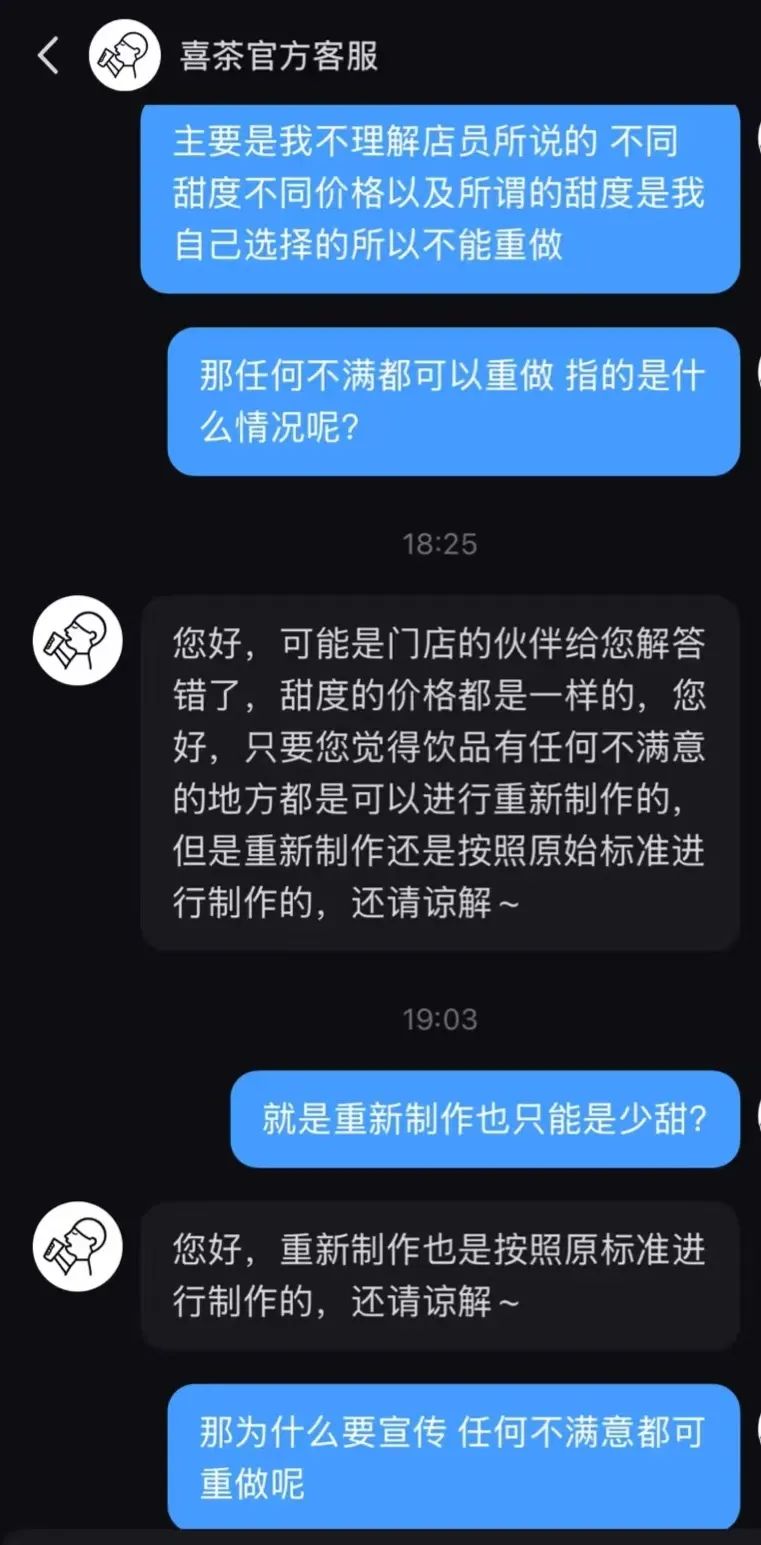 Netizens are clearly divided on this issue — some believe brands should accommodate all remake requests, while others suggest clearly stating that remakes are “only for quality issues” to avoid disputes. Notably, Heytea’s current signage does not clearly define what “not satisfied” specifically entails. This vague wording may not only mislead consumers but also gives stores leeway in how they handle requests.
For consumers, if they encounter issues with sweetness, it is recommended to first specify detailed preferences in the order notes via the official app (such as “slightly sweet test” or “confirming 30% sugar level”). When communicating in person, clearly refer to screenshots of the sugar level information from the ordering page. If communication fails, retain evidence such as photos of the drink and the receipt, and file a complaint with the platform’s customer service — according to industry practice, brands usually initiate internal reviews for highly disputed orders. Of course, the safest approach is to research the actual implementation reputation of different stores in advance, and prioritize shopping at company-owned stores or branches with faster response times for remake services based on user reviews.
The above content is compiled by CoffeeHunters, a coffee news website.


