







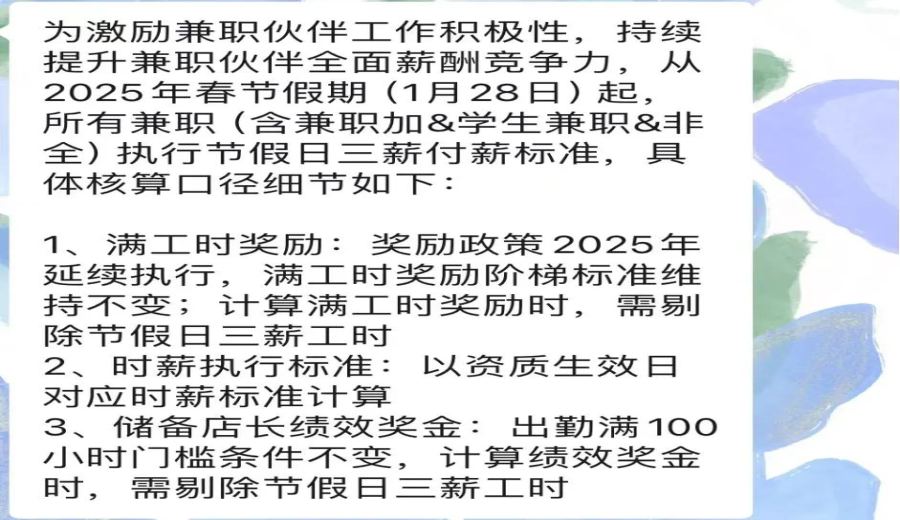
Introduction:Luckin Coffee has, for the first time in the 2025 Spring Festival, implemented a triple-pay policy for all employees (including part-timers) during public holidays. This new measure breaks with the previous practice of only offering such benefits to full-time staff. What prompted Luckin to adjust its compensation strategy? This article will delve into the labor challenges behind the policy, real employee feedback, and show you how the coffee industry maintains service quality during peak holiday periods through fair incentive systems.
Luckin Coffee has recently announced that it will provide a triple-pay incentive policy for all employees during the 2025 Spring Festival, marking the first time this benefit is extended to all staff, including part-time workers. In the past, only full-time employees were eligible for triple pay during holidays, but according to internal notices, starting from the 2025 Spring Festival holiday (January 28),all types of part-time employees (including part-time additions, student part-timers, and non-full-time workers)will also be subject to the same compensation standards.
This policy has been gradually implemented across multiple stores via official internal workgroup announcements. Although some regions such as Shanghai and Guangdong have not yet officially received the notice, it has already sparked discussions among employees and netizens. This move is seen as a proactive response by Luckin to tackle the high turnover rate and pre-holiday labor shortages faced over the past year.
Over the past year, frontline Luckin store employees have faced numerous pressures. From the various cost-cutting measures introduced after the “March 1 Incident” to the continuously increasing performance metrics such as order preparation timeliness, hourly cup volume, and scan rate—coupled with reduced working hours—grassroots employees’ workload has significantly intensified. Many employees report thatthe high-intensity work is not commensurate with their income, making resignation a common occurrence in the industry.
Especially during golden holiday periods like the Spring Festival, many part-time workers originally planned to return home. When they found that overtime wages were not specially increased, many chose to give up their part-time jobs. Employees posted on social media platforms comments such as: “Because of the high turnover rate, we can’t recruit anyone,” “Nearby stores are all short-staffed, everyone’s understaffed, and no one is keeping people for the holidays,” and “Five people are quitting at our store during the holidays,” revealing the staffing challenges the brand currently faces.
To stabilize service quality and operational manpower during the holiday season, Luckin has opted to roll outa “triple pay for all”policy, hoping to attract and retain experienced employees and ensure that stores can operate normally during peak demand periods.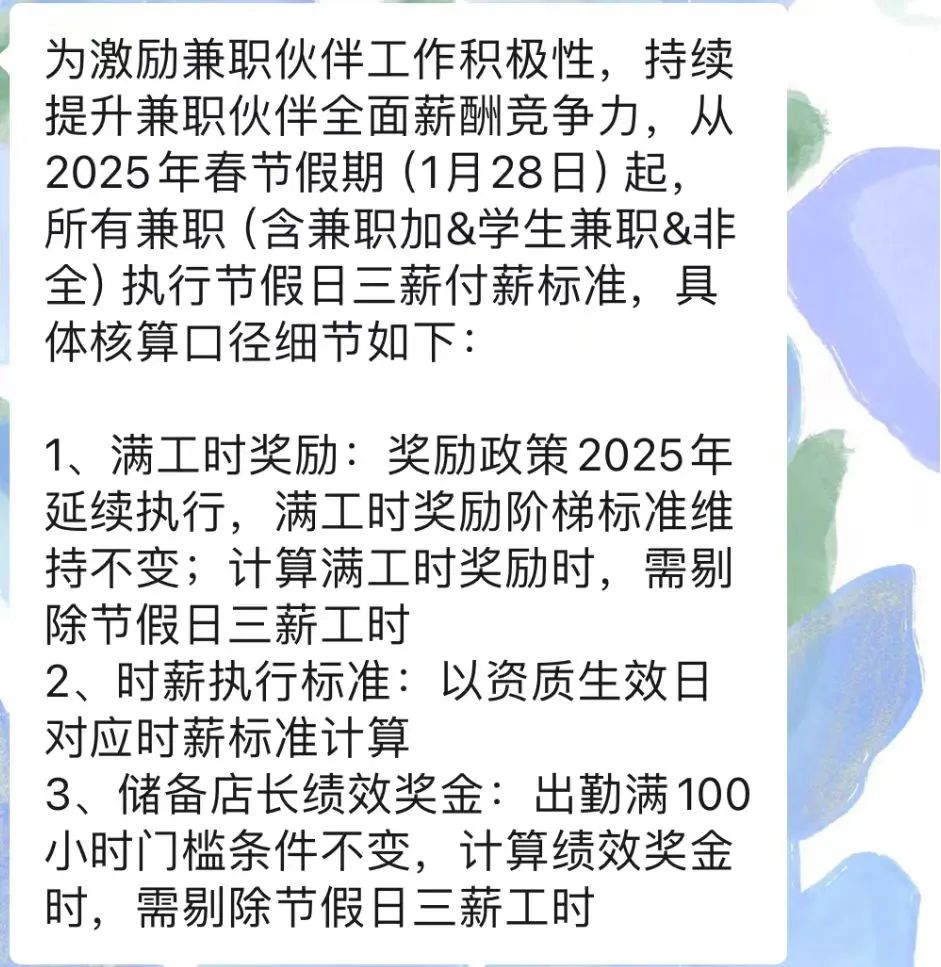
The scope of this triple-pay policy covers both full-time and various part-time forms, including student workers and short-term staff—benefits that were relatively rare in the past. Previously, due to the internal practice of “not scheduling full-timers on holidays,” often only store managers or assistant managers could truly receive triple pay, while part-time staff, even when working, found it hard to enjoy additional compensation. Now, with the policy adjustment, not only has staff morale improved, but it also aligns with the actual needs of the holiday labor market.
It is worth noting that the calculation method for triple pay usually involves tripling the regular hourly wage. That is, during the statutory Spring Festival holiday period (such as the first to third days of the Lunar New Year), for each hour worked, an employee can receive three times their normal hourly wage. For many young people who join Luckin as part-time or casual workers, this undoubtedly enhances the appeal of working during holidays.
Industry observers note that similar holiday incentive measures are gradually becoming a trend among other food and service industry brands, especially during peak periods like the Spring Festival and National Day. A reasonable salary structure and welfare system have become one of the key factors in stabilizing teams and ensuring service quality.
In summary, Luckin’s adjustment this time is not only an enhancement of employee benefits but also a strategic response to market challenges and internal pressures. For consumers, the ability of stores to maintain stable operations and service standards is precisely the positive impact brought about by these policy adjustments.
The above content is compiled by CoffeeHunters, a coffee news website.


