







Introduction:Recently, a Starbucks employee was subjected to intense verbal abuse and even nearly assaulted by a customer for refusing to sell cold brew concentrate alone, sparking widespread online discussion about employee rights protection. This article delves into the underlying reasons behind the incident, explores how the brand's handling approach impacts employees, and provides practical advice to help readers understand the real challenges faced on the front lines of the coffee industry.
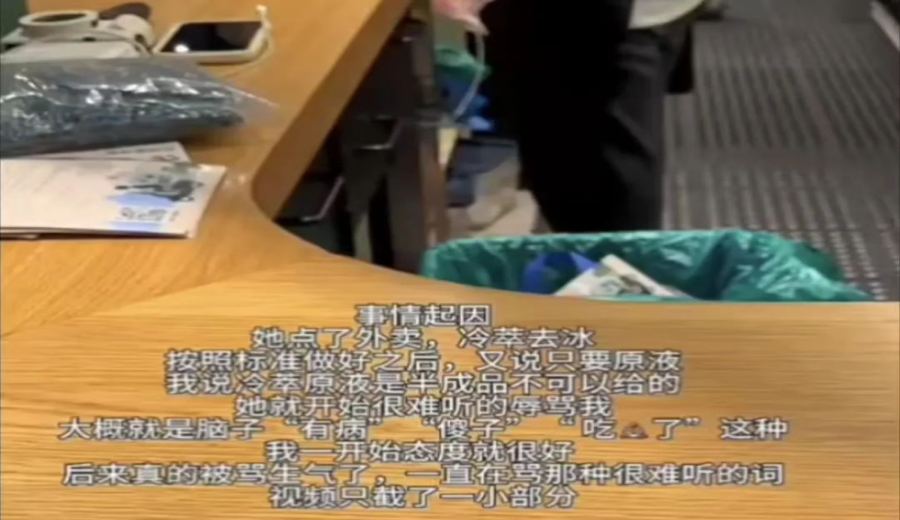
A widely circulated short video on social platforms shows a Starbucks employee being verbally insulted and nearly involved in physical conflict by a customer who was denied a special request to purchase cold brew concentrate separately, simply because the employee followed company policy. The incident quickly caused an uproar online, with many netizens expressing sympathy for the employee and reflecting on the brand’s approach to handling customer complaints, as well as the issue of protecting the rights of frontline staff.
According to the video, the employee was processing a delivery order when the customer made an unusual request to buy cold brew concentrate. However, cold brew concentrate is actually a semi-finished raw material used in making Starbucks’ cold brew coffee. As per clear store regulations, such raw materials are only meant for preparing complete beverages and cannot be sold separately. Therefore, the employee repeatedly explained to the customer that their request could not be fulfilled.
Surprisingly, the employee’s reasonable refusal provoked strong dissatisfaction from the customer, who not only used offensive language but also made threatening gestures, creating a tense atmosphere on the spot. The employee recalled that the customer was extremely agitated at the time, “gritting their teeth and glaring at me as if they were about to hit me any second.”
Although the video does not capture the entire incident, the intense language from the customer alone, as shown in the clip, was enough to outrage most netizens. Many left comments in support of the employee, arguing that following the rules was entirely appropriate, while the customer’s behavior was clearly excessive. Some even suggested that the employee should keep evidence and report the incident to the police if necessary, rather than silently enduring the mistreatment.
The incident also resonated with many in the coffee industry. Numerous current employees noted that although brands encourage customized beverages, there are still many non-negotiable boundaries in practice — for example, core ingredients like cold brew concentrate are strictly prohibited from being sold individually. Any violation not only risks affecting beverage quality but is also considered non-compliant behavior, which can bring unnecessary trouble to the staff.
What makes frontline employees even more helpless is that even when they remain professional and are not at fault, once similar conflicts arise, brands often prioritize customer satisfaction — sometimes even unilaterally issuing coupons to placate the situation. While this approach may seem to quickly resolve issues, it can also allow some customers to exploit loopholes in the rules to gain extra benefits through complaints.
One employee revealed having encountered customers who deliberately nitpicked or made unreasonable demands just to get free drinks or discounts, and then filed complaints when their requests were not met. In response, the common approach taken by the brand was to simply issue coupons, a “damage control” strategy that, instead, left truly rule-abiding employees feeling disheartened.
Industry insiders pointed out that brands should focus more on fact-based investigations when handling customer complaints, rather than relying solely on the subjective statements of customers. Surveillance footage, employee accounts, and on-site evidence should all serve as important bases for determining right from wrong. At the same time, more comprehensive employee protection mechanisms should be established to ensure that frontline workers receive reasonable support and safeguards when facing irrational customers.
This Starbucks cold brew concentrate dispute not only highlights the real challenges of frontline work in the coffee industry, but also reminds us that a good customer experience should not come at the expense of sacrificing employee rights. Only by establishing fairer and more transparent handling mechanisms can we truly achieve a win-win-win situation for the brand, the customer, and the employee.
The above content is compiled by CoffeeHunters, a coffee news website.


